
University of Hamburg (Image credit: UHH/Ohme)
The Literacy in Diversity Settings Research Center (LiDS) at the University of Hamburg will host a summer school and conference devoted to “Literacies for Social Participation” in July this year.
The summer school dates are July 20-31, and the conference dates are July 27-28. The summer school includes the conference but the conference can be attended separately.
Readers are cordially invited to attend and/or alert their students and colleagues to these exciting events (for details how to apply, scroll down to the end of this post)
About the Summer School “Literacies for Social Participation” (July 20-31, 2026)
Literacy is an individual competence that is critical for social participation. It is key to education, employment, health, rights and well-being. Yet, this key is not a singular entity, not least in contemporary differentiated societies marked by migration; it is complex as it involves multiple languages, registers, modalities, as well as different technologies and formats. In a highly mobile and interconnected world, migration and digitalization have collided to fundamentally transform what it means to be literate.
These emerging complex multilingual, multilectal, and multimodal literacies may be poorly matched to the literacy requirements of institutions with a monolingual habitus (Gogolin, 1994), where literacy practices in one dominant, standard language prevail. The resulting communication gaps can threaten access, equity, inclusion, and cost-effectiveness, and hence constitute a real barrier to social justice (Piller, 2016).
As all contemporary societies are affected by migration and digitalization, with individuals facing the barriers and opportunities associated with multilingualism, this summer school offers an internationally oriented curriculum to outstanding masters and doctoral students.
The core learning aims are:
1) to enhance knowledge on literacy and learner diversity;
2) to trace tendencies that go beyond one national, regional or local context;
3) to examine literacy development across the life-course;
4) to critically discuss the implications of research findings for policy and practice.
The learning goals will be achieved across five core modules with required readings:
1) Literacy across the lifespan;
2) Institutional settings;
3) Research methods in social literacies;
4) Academic skills;
5) Independent course work.
About the conference “Literacies for Social Participation” (July 27-28, 2026)
Are you a PhD student researching in the field of multilingual literacy development and social participation? If so, you are cordially invited to submit an abstract to participate in the doctoral symposium Literacies for Social Participation at the University of Hamburg on 27-28 July 2026. Successful applicants will present their research to an international audience of their peers and receive in-depth feedback from renowned experts in the field, including:
- Prof Dr Dr h.c. mult. Ingrid Gogolin, University of Hamburg
- Prof Yanli Meng, University of the Chinese Academy of Sciences
- Humboldt-Professor Ingrid Piller, University of Hamburg and Macquarie University
- Prof Yixi (Isabella) Qiu, Tongji University
- Prof Vera Williams Tetteh, University of Ghana and Macquarie University
- Prof Yufang Ruan, Zhejiang University
The doctoral symposium is a constituent event within the Hamburg International Summer School, Literacies for Social Participation, which runs from 20-31 July 2026. We invite you to also apply to participate in the summer school, however this is not a requirement to present at the doctoral symposium. The summer school and the doctoral symposium provide an exceptional combination of high-level academic engagement and networking opportunities related to linguistic diversity and social participation. Participants will have the opportunity to both showcase their expertise and deepen their knowledge of cutting-edge research in the field.
How to apply
- Find out how to apply to attend the summer school here. (Application deadline: April 06, 2026)
- Find out how to apply to present at the doctoral conference here. (Application deadline: April 06, 2026)
Attendance at the summer school and conference is free thanks to sponsorship from the Alexander-von-Humboldt-Foundation and the University of Hamburg.
]]>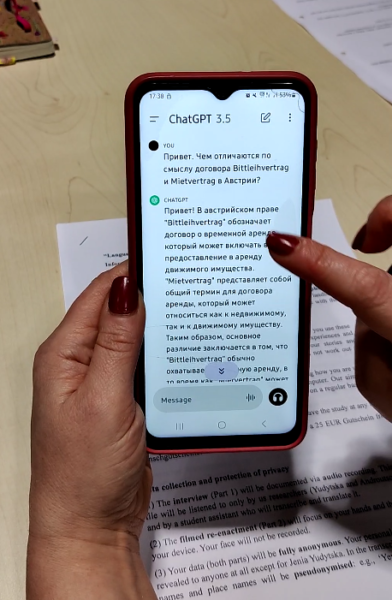
Ukrainian migrant asking ChatGPT to explain different types of rental contracts in Austria (still from Yudytska & Androutsopoulos 2025)
For nearly four years now, I’ve been heavily involved in online (Telegram-based) communities for Ukrainian forced migrants in Austria. Such communities sprang up all across Europe after Russia’s full-scale invasion of Ukraine in early 2022, serving as grassroots digital info-points. In those early, chaotic days, the groups focused on a Ukrainian’s first steps upon getting off the train in their new country. They have since expanded to cover everything from where to buy buckwheat (a very pressing question!) to the fine details of the local education system, health insurance, job market, etc.
The communities are run for Ukrainian refugees, by Ukrainian- and Russian-speakers, that is, overwhelmingly by migrants – forced, labour, student; first-gen, second-gen; etc. It truly is mutual aid: those who migrated earlier answer questions on integration, those who left recently give tips on how best to reach relatives in occupied territory. My family left in 1999, when I was five; I co-admin one group for Ukrainians in my home state of Upper Austria (ca. 3,700 members) and one group focused on how to change from the Temporary Protection status to a longer-term work/residence permit (ca. 8,300 members), plus I occasionally help out in other groups.
In 2025, our communities gained one more, less welcome, “member”: ChatGPT.
Migrants’ search for information
Understanding the role of ChatGPT in these communities requires understanding the complex informational space newly arrived migrants are in. There is an avalanche of info to take in. Some involves the everyday differences: when your child has a fever, at what temperature can you call the ambulance without getting in trouble for wasting their time? Other aspects are specific to the (forced) migrant status, and would stump a local too. Language barriers make accessing information difficult. Even with machine translation, it’s hard to know what term to google or how to interpret a bureaucrat’s answer.
This is where the Telegram communities come in, providing an easy place to ask for help and discuss problems.
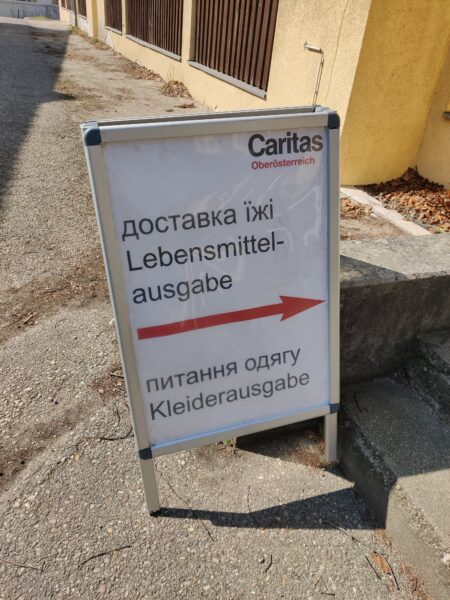
An NGO’s German-Ukrainian sign about food and clothing distribution; the understandable but incorrect Ukrainian suggests machine translation (photo taken by author)
Still, they’re not a panacea. Us volunteers learned only on the fly the ins-and-outs of the Austrian asylum system in all its kafkaesque glory: we sometimes misremember, misunderstand, and mistranslate. Grasping a question can take real detective work, especially when there’s a dozen ways to translate a single German term. Official Austrian sources give a lot of information orally; this leads to bewildering discussions where one person informs the chat their social worker said X, another says it was Y, and the third Z. Maybe it’s miscommunication, maybe the official sources have no clue either.
Above everything loom the rumours, best illustrated by the (admittedly pretty sexist) Russian acronym, ОБС – одна бабка сказала, lit. “some old lady said”. It’s used in the sense of, “Uh-huh, riiight, you got that info from your cousin’s friend’s mom’s neighbour”. In 2027 all Ukrainians in the EU will be put on the next train home, even if the war is still ongoing. Truth or ОБС? Great (unanswerable) question!
Enter ChatGPT
Into all this chaos slams the iron certainty of ChatGPT. If it worked as advertised, it would be an invaluable resource for migrants. You ask a question, it searches for and provides a summary of official information. No linguistic barriers, no mistranslations, no complex legalese; no petty online fights to wade through. The appeal is clear.
The only tiny problem is that it doesn’t work as advertised.
The biggest issue is in how ChatGPT functions: it doesn’t search for and copy-paste information from a database, but rather generates a statistically likely sequence of tokens (words) based on the data it was trained on. This is why it can “hallucinate”, that is, make up answers which are linguistically coherent but factually untrue. It has also obviously been fed more data (law databases, official websites, forum discussions, etc.) from Germany than Austria. For example, it has confidently explained to a Ukrainian that she’s legally obligated to have health insurance – true in Germany, not so in Austria.

Linz Castle on the Danube, Upper Austria, lit up in the colours of the Ukrainian flag (photo taken by author)
The AI technique ‘Retrieval Augmented Generation’ (RAG) is meant to resolve this: ChatGPT first searches for and pulls relevant information from a website, then incorporates it into the answer. (ChatGPT uses RAG sometimes, but not constantly. It costs more energy, thus more money.) But the answer is still generated, so hallucination is still possible. This leads to ChatGPT claiming, for example, “According to the City of Vienna website, Ukrainians have to hand in their old refugee ID card. [Link to website]” Except its generated summary missed a negation: the website explicitly states Ukrainians do not have to hand in their old refugee ID card. RAG can thus lead to even greater misinformation, as it implies a direct source.
The other huge problem is the limited information actually available on migrant issues; even if hallucination was somehow solved, the adage of ‘garbage in, garbage out’ for machine learning remains. For example, to switch to a longer-term residence permit requires the migrant to have an ortsübliche Unterkunft (“housing according to local standards”). ChatGPT physically cannot answer what these local standards are. I know this because, according to my old-fashioned research techniques of searching law databases, skimming court cases, and asking lawyer friends, neither can anybody else! Unfortunately, it is too often the case that there is too little concrete info for ChatGPT to be trained on.
In short, using ChatGPT for information is a gamble. Sometimes it works great, sometimes it generates nonsense. To know which is which, the migrant is left with the same problem of surmounting the language barrier they started with.
Mutual aid with and against machines
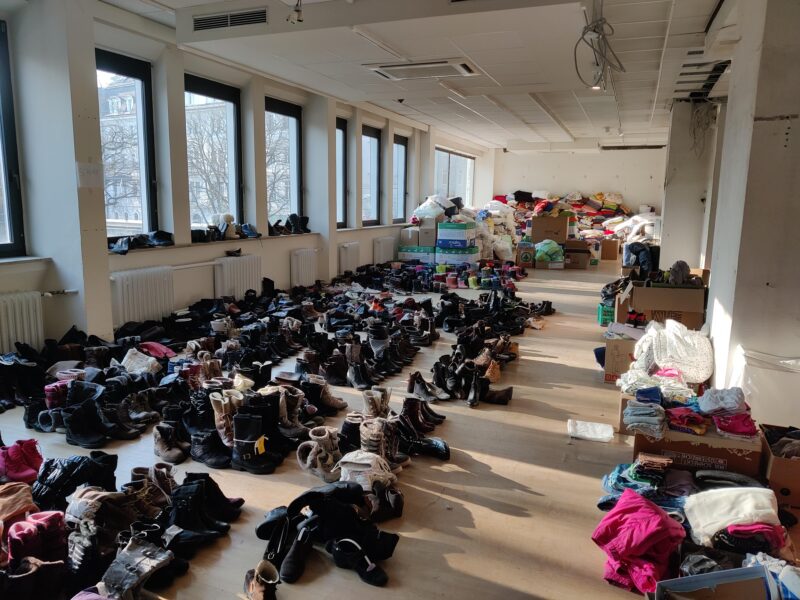
Rows of donated women’s shoes at SUNUA, a grassroots organisation supporting Ukrainians in Upper Austria, 3 weeks post-invasion (photo taken by author)
I don’t consider myself a techno-pessimist – actually, I rely on language technologies heavily in my online volunteer work. My phone’s autocorrect is a life-saver. While I can read and write in Russian, I left Ukraine before starting formal education, and find it slow and frustrating to spell without autocorrect. Similarly, machine translation is a great help. I occasionally need it to double-check my understanding of more complex Ukrainian-language questions; I also machine translate German-language official updates for the sake of speed, then post-edit the Russian text to correct mistakes and stilted phrasing before posting.
That is, due to my background as a child migrant from a primarily Russian-speaking area of Ukraine, I have varying levels of competencies in the three languages I need: Russian, Ukrainian, German. For all their faults, language technologies are an invaluable resource for stuffing the gaps so I can help people successfully. And efficiently, as this has always been 100% unpaid labour in my free time, next to my full-time uni work.
But all this is why I find the intrusion of ChatGPT into our spaces so infuriating on a personal level. In the midst of a horrible situation, between fear, grieving, trauma, burnout, we’re all trying to use the linguistic and technological resources available to us to help each other. I accept arguing against a community member’s cousin’s friend’s mom’s neighbour’s experience as part of that – that connection is also a resource, and it’s human to trust an acquaintance over a fuzzily written law in a language you don’t speak yet. I’m willing to spend my free time picking apart where the confusion lies.
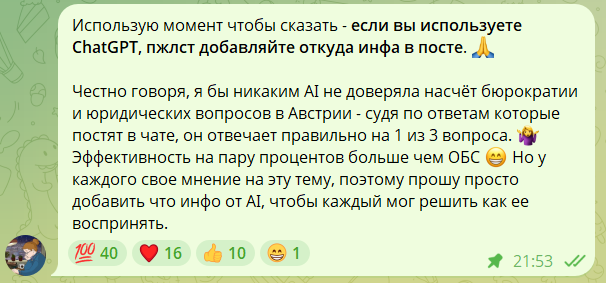
The author’s post in a Telegram group explaining that AI as a source must be clearly stated, with over 60 users leaving reaction emoji of agreement (screenshot taken by author)
I don’t accept arguing with ChatGPT screenshots.
ChatGPT adds beautiful formatting, with eye-catching emoji as bulletpoints. ChatGPT switches between Cyrillic and Latin easily, writing out German acronyms and translating them to Russian in brackets: ÖGK (Österreichische Gesundheitskasse – Австрийская касса медицинского страхования), wow. ChatGPT cites laws using a fancy § paragraph sign I have to copy-paste each time.
Sure, the actual information may or may not be correct, but that’s less important than the style, which so neatly mimics that of official sources. It simply looks trustworthy – the complete opposite of my own messages, written one-handed on a moving bus, with at least one butchered case suffix apiece. It’s unsurprising that people cling to ChatGPT’s information more stubbornly than to the usual ОБС.
Arguing against it is thus extra tedious and, frustratingly, requires me to do additional work. “Wait, no, where did you get that information from, is that an official source?” “Uh, nope, that website ChatGPT cited says the opposite.” “Dude, did you actually read the law ChatGPT ‘references’ – it’s about industrial chemicals, not document translation.” Most unsatisfactorily for all involved, having to prove a negative: “I’m sorry, but there’s no information on that. I don’t know why ChatGPT says there is, maybe it exists for Germany, but not for Austria.”
As a migrant who’s also stared at bureaucratic German in confusion and anxious despair, I don’t blame people for turning to AI. As a volunteer, it’s genuinely made me want to quit: in anger, in exhaustion, with a childishly vindictive, “Well, if they prefer machine over human, so long and thanks for all the fish.”
Where to next?
In principle, the issues explored here are no different from those we’re facing in other areas: education, academia, news, etc. Misinformation is rife everywhere; so is a lack of digital literacy on what current AI can and can’t do. For me, the crucial point is how vulnerable forced migrants are. Misuse of ChatGPT can lead not to a failed homework assignment but to problems on an existential level: with the legal status, with housing, with having enough money for food. Similarly, to put it bluntly, I’m paid to deal with students’ AI use; in volunteer work, it’s just one more weight tipping the scales in favour of finally quitting. It’s also important to add that not all my fellow admins share my worries. Some eagerly embrace ChatGPT answers themselves, which of course save time and energy for volunteers who have little of either to spare.
Our current ‘solution’ is that people must state openly that the information they’re posting is AI-generated. Then other members can decide themselves to what extent they trust it. In this, I would say, we’re ahead of the curve compared to many organisations, and for now, this will have to be enough.
Reference
Yudytska, J. & Androutsopoulos, J. (2025). The use of language technologies in forced migration: An explorative study of Ukrainian women in Austria. In M. Mendes de Oliveira & L. Conti (eds.), Explorations in Digital Interculturality: Language, Culture, and Postdigital Practices (pp. 135-166). Transcript. https://doi.org/10.1515/9783839476291-007
]]>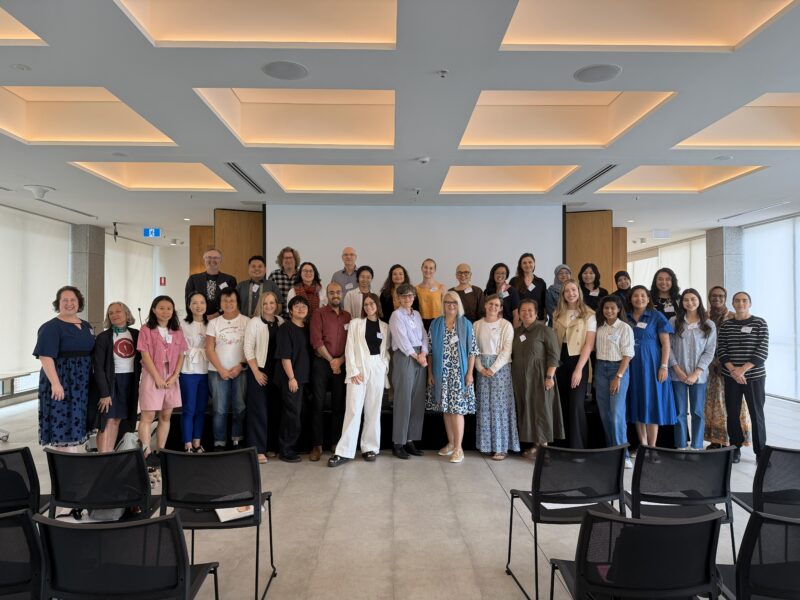
Group photo, New Technologies in Intercultural Communication Symposium (Image credit: Language on the Move)
On a crack-of-dawn flight early Monday morning last week, I flew to Sydney for the day to attend “New Technologies in Intercultural Communication“, a symposium hosted by the Language on the Move Team at Macquarie University.
The presentations explored intercultural communication ranging from the use of digital technologies by elderly migrants and their families (Dr Earvin Charles B. Cabalquinto), GenAI as digital shadow care support by international students (Dr Julia Kantek and Dr Thilakshi Mallawa Arachchi), language learning tools by transnational parents for heritage language maintenance (Dr Ana Sofia Bruzon), learning technologies in primary science classrooms in Australia and Korea (Dr Hye-Eun Chu), and social media in language learning (Dr Yeong-Ju Lee). And to think the new technology promising proficiency and fluency “back in my day” (I find myself relating to a joke Professor Piller made about technological development) relied on cassette tapes at the language lab!
The symposium showcased a fascinating catalogue of digital technologies enabling intercultural communication. We heard about high school students in an Australian classroom connecting with Korean students to hypothesize why the seasons differ between their two countries. We heard of transnational parents employing creative ways to encourage their children to connect to their heritage languages, especially to communicate with family members. It was also intriguing to hear how social media platforms such as Tiktok offer features such as “duet”, creating opportunities for speakers of different languages to collaborate and co-construct meaning.
While we heard of these novel and exciting ways technology can be used to enhance intercultural communication, each presenter emphasized the human element in communication. I could not help but think about how language learning tends to be marketed as fun, brain-boosting, or career-enhancing. And yet, language in human relationships is messy, and missteps happen! Even so, whether you already speak the language or are learning an additional one, I believe empathy and deeper understanding are borne out of the struggle to communicate and truly connect with each other.
The most striking point for me was that some uses of technology actually stem from institutional failures or social exclusion, leaving the vulnerable members of our society even more marginalized. Earvin reminded us that although much of the discussion seems to be on the importance of digital literacy skills, many still lack basic access to technological infrastructure that we often take for granted in urban Australia. Julia and Thilakshi’s presentation highlighted the isolation that international students experience, turning to GenAI for immediate advice on legal matters, polishing their resumes, or easing homesickness. Ana pointed to multilingual parents’ struggles of heritage language maintenance in the face of pervasive monolingual mindset across Australian schooling and public discourse.
As I flew back to Brisbane that evening, reflecting on the presentations, discussion questions, and conversations I had with fellow attendees strengthened my resolve to keep pushing for equity in language learning and digital access.
We need to keep asking: How do we use technology for intercultural communication? Who gets left out? And how can we keep working towards digital and social inclusion?
I want to thank UQ School of Education for making it possible for me to attend the symposium, and to Distinguished Professor Ingrid Piller, Dr Loy Lising, Dr Ana Sofia Bruzon and the Language on the Move team for bringing together a rich program and creating the opportunity to hear from and exchange ideas with other scholars.
]]>
“Read – Learn – Grow – Be Kind” – this street library says it all (Image credit: Language on the Move)
The Language-on-the-Move Reading Challenge 2026 is out!
Now in its ninth year, the goals of our reading challenge have remained broadly unchanged since 2018: to encourage reading in the discipline and beyond, and to make linguistics reading fun.
These goals have become even more relevant, due to two converging trends:
On the one hand, book reading is in freefall internationally while, on the other hand, screen time is rising exponentially.
If you think this is just a case of one medium replacing another, you are unfortunately mistaken.
In its most prevalent form – social media use – screen time has negative effects on our ability to concentrate, to think deeply and critically, and to develop empathy. These negative effects are now so widely felt that their popular designation “brain rot” was selected as the Oxford Word of the Year 2024.
Book reading, by contrast, is the antidote to brain rot. Book reading challenges us to concentrate and to deeply engage with an extended argument or a narrative universe.
To train your brain you need to read long form. You can’t outsource your reading to AI-generated summaries, either.
Furthermore, many of our readers are (aspiring) researchers and Stephen King’s advice in On Writing is valid in our profession, too:
If you don’t have time to read, you don’t have the time (or the tools) to write. Simple as that.
The Language-on-the-Move Reading Challenge is here for you develop, enjoy and extend the habits and pleasures of reading, particularly in the field of linguistic diversity and social participation. For each month of 2026, we are suggesting a category and one of our team members offers a recommendation in that category.
Enjoy and feel free to add your own recommendations in the “Comments” section below.
And don’t forget that, in addition to the categories and recommendations suggested here, the Language-on-the-Move Podcast will also continue to bring you regular reading ideas in 2026.
 Happy Reading!
Previous Language-on-the-Move Reading Challenges
- Language on the Move Reading Challenge 2025
- Language on the Move Reading Challenge 2024
- Language on the Move Reading Challenge 2023
- Language on the Move Reading Challenge 2022
- Language on the Move Reading Challenge 2021
- Language on the Move Reading Challenge 2020
- Language on the Move Reading Challenge 2019
- Language on the Move Reading Challenge 2018
January: a book about new technologies in intercultural communication
Recommendation: Cabalquinto, E. C. B. (2022). (Im)mobile Homes: Family Life at a Distance in the Age of Mobile Media. Oxford University Press.
Earvin’s presentation about the myth of digital inclusion of older migrants in Australia was one of the highlights of our recent symposium devoted to “New technologies in intercultural communication.”
Whether you missed out on the symposium or want to deepen your engagement with Earvin’s work, (Im)mobile Homes offers a gripping exploration of the use of smartphones, social media, and apps in the family and care practices of transnational families. (Ingrid Piller)
February: a book about settler colonialism
 Recommendation: Simpson, A. (2014). Mohawk Interruptus: Political Life Across the Borders of Settler States. Duke University Press.
This book completely reshaped my understanding of Indigenous politics, border, nation, and sovereignty in North America. It also made me reflect on my reliance on the extensive literature on Indigenous cultures and languages – ritual speech, performances, tales, or beliefs – produced over the last century by anthropologists and linguists, most of which are dismissive of the scene of dispossession, the complicated history of places, or simply what people say about themselves and their struggles. (Gegentuul Baioud)
March: a book stirs that your social imagination
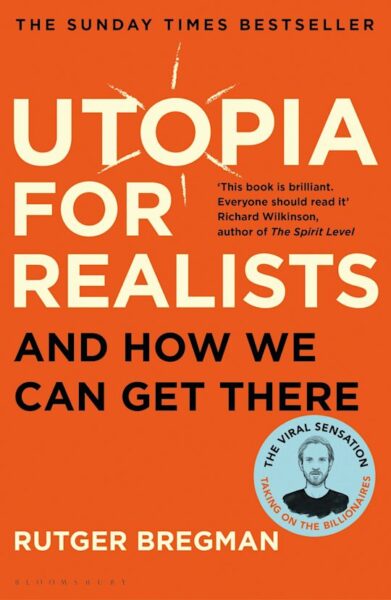
Recommendation: Bregman, R. (2017). Utopia for realists. Bloomsbury.
In this book, Rutger Bregman stirs our imagination by inviting us to re-think the way modern society is organized and by offering us a glimpse into a potentially better future for all. He calls for a new vision that would more effectively address current global challenges such as increasing inequalities or the progressing automation of labor.
But what does he exactly propose?
In short, a 15-hour work week, universal basic income and open borders. The author invites you on a journey between time and spaces with real examples of communities that have taken utopia seriously and have started to experiment with it. (Olga Vlasova)
April: A book about the philosophy of language
 Recommendation: Le Guin, U. (1974). The Dispossessed. HarperCollins.
Le Guin constantly fluctuates the reader´s receptors between the old and the new, roots and progress, personal and professional, politics and philosophy. We follow the life and work of a physicist who travels back and forth between two historically connected but contrasting planets and political systems.
The protagonist commits to seeking the truth not only by understanding his own context of origin but also by defying it; how do we find our truth? And is it ever objective? The novel is considered a post-feminist utopian fiction raising discussions on whether linguistic innovation is necessary for conceptual change.
A story of intergalactic migration trying to answer the long-standing question: to whom does knowledge belong? (Mara Kyrou)
May: A book about the experience of growing up as the child of a migrant
Recommendation 1: Vuong, O. (2019). On Earth We’re Briefly Gorgeous. Penguin.
Vietnamese-American history, language, and generational trauma come together in the form of a poetic letter with utterances such as “I am writing you from inside a body that used to be yours. Which is to say, I am writing as a son.” Dedicated to someone who will never see it: the author’s mother, who never learned how to read.
Through the eyes of a young man named Little Dog discovering his homosexuality in a space for undocumented immigrants, this book tells the story of a Vietnamese immigrant family in the US and their complex relationship with the English language. It chronicles their migration history escaping the atrocities of war, the fragile family dynamics that emerged from that experience, and the love for words that connects the writer with himself, while ironically separating him from his mother. (Juan Felipe Sánchez Guzmán)
 Recommendation 2: Toxische Pommes. (2024). Ein schönes Ausländerkind. Zsolnay.
Ein Schönes Ausländerkind is a fictionalised autobiography of the author’s childhood, after her family fled to Austria due to the Yugoslav Wars. The book made me laugh a lot, as the author (who writes under the pseudonym she uses to post satirical sketches online) pokes fun at the many absurdities of migrant life. But I also found it very powerful in its depiction of a messy, painful, but loving father-daughter relationship where the adult struggles to learn the local language, leading to child language brokering. (Jenia Yudytska)
June: A book about narrative research in a migration context
Recommendation: Stevenson, Patrick (2017). Language and migration in a multilingual metropolis: Berlin Lives. Palgrave Macmillan.
This book offers a highly engaging and innovative exploration of Berlin’s multilingualism through personal migration narratives. Working ethnographically, the researcher situates his analysis in a single shared apartment in Neukölln, using the linguistic repertoires and biographical trajectories of its five residents—a Russian-speaking woman, two Polish-speakers, a Kurdish-speaking man, and a Vietnamese-speaking woman—to demonstrate how migration, identity and sociolinguistic practice intersect in everyday life.
The book portrays the apartment as a microcosm of the city’s wider linguistic landscape, tracing how individuals navigate language ideologies, negotiate belonging, and construct social relations within a complex metropolitan environment. (Martin Serif Derince)
July: A book exploring linguistic diversity from multiple perspectives
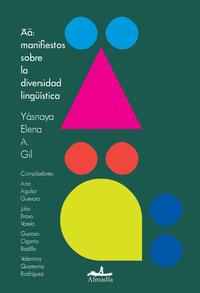 Recommendation: Aguilar Gil, Y. E. (2020). Ää: manifiestos sobre la diversidad lingüística. Almadia.
Language loss, resistance, indigenous literature(s), prejudice, identity, autonyms and exonyms – these are just some of the topics discussed in this collection of essays by Yásnaya Elena Aguilar Gil, an Ayuujk linguist, writer, translator, and activist. An interactive work edited by the author’s colleagues, this book presents texts written for an online magazine over several years alongside links to related social media posts, as well as a speech given by Yásnaya Elena Aguilar Gil at the Mexican Chamber of Deputies and a closing epilogue by herself. A great read – refreshing and profoundly reflexive – for anyone interested in linguistic diversity in Mexico and beyond. (Nicole Marinaro)
August: A book about translation and interpreting
Recommendation: Shuttleworth, M., & Daghigh, A. J. (Eds.). (2024). Translation and Neoliberalism. Springer.
This book examines how neoliberalism shapes translation and interpreting across diverse regions, focusing on four themes: market-driven translation and interpreting curricula, policy impacts on language services, technology’s role in translation and interpreting markets, and intersections of translation and neoliberalism at a discourse level. It offers critical insights for scholars, practitioners, and policymakers into the socio-economic forces transforming translation studies, industries and curricula. (Jinhyun Cho)
September: A book about digital migration studies
Recommendation: Leurs, Koen, & Ponzanesi, Sandra (Eds.). (2025). Doing Digital Migration Studies: Theories and practices of the everyday. Routledge.
This open-access edited volume serves as an introduction to ‘digital migration studies’, an umbrella term for research on migration in relation to digital technologies. The articles examine topics ranging from migrant agency on TikTok to the use of automatic dialect recognition during the asylum procedure.
Although most contributions don’t explicitly focus on language, the breadth of topics and methodologies covered still sparked ideas for new research directions for me as a linguist. (Jenia Yudytska)
October: A book about an under-recognized diaspora
 Recommendation: Bald, V. (2013). Bengali Harlem and the lost histories of South Asian America. Harvard University Press.
Film and other information: http://bengaliharlem.com
Historical Harlem, New York does not conjure up images of South Asians going about their daily lives, but Bengali Harlem tells us the story of immigrants who arrived from the 1800s onwards from the Indian subcontinent.
This book focuses on migrants who were ethnolinguistically Bengalis (from what was known as Bengal) and came as merchants, seamen, or laborers to be absorbed into working class America. In the face of racism and discrimination, they built homes and lives, leaving behind generations of Americans with Bengali cultural and linguistic heritage. (Tazin Abdullah)
November: A book of migrant poetry
Recommendation: Saleh, S. M., Syed, Z., & Younus, M. (Eds.). (2025). Ritual: A Collection of Muslim Australian Poetry. Sweatshop Literacy Movement.
Billed as “evocative, unsettling, and unafraid,” this rich collection of Muslim Australian poetry offers a rich treasure trove of poems to come back to and savour again and again. The poems invite the reader to not only reflect on the diversity of Muslim identities but what it means to live on Indigenous land as a designated migrant within a White settler colony. (Ingrid Piller)
December: Cozy fiction for when you need a break from your research
 Recommendation: Arden, K. (2019). The Winternight Trilogy. Del Rey.
]]>I’m now 1.5 years into my PhD and I find that, now more than ever, I need good fiction to read after a long day of academic reading/writing. The Winternight Trilogy is set in the harsh winters of a folkloric version of medieval Russia and follows Vasya, a young woman whose difficult peasant life collides with those of chyerti, the demons and devils of Slavic folklore.
The settings and creatures described in this trilogy are nothing short of magical, and reading the prose makes me feel like I am tucked away snug in a winter cabin with a roaring fire and hot chocolate.
A lesson that I am learning along my PhD journey is that it is imperative to nourish myself while I work so hard, and reading these books is part of that nourishment for me. Knowing that I have the winter snows and rich folklore of these books to look forward to at the end of the day helps me to persevere through the daily ups and downs of PhD life. (Brynn Quick)

(Image credit: © Gert Albrecht für DIE ZEIT, Stiftung Lesen, Deutsche Bahn Stiftung)
Editor’s note: Shared reading – the practice where adults read to children – has many benefits: it improves children’s language and literacy development, as well as their interactive and communicative skills. Additionally, shared reading can be a lot of fun and, like any joint enjoyable activity, strengthens emotional bonds.
In Germany, shared reading is promoted through a dedicated annual “Vorlesetag” (“Shared Reading Day”). In this post, Larissa Cosyns explains more about the event and shares a reading recommendation.
This post was first published on the Literacy in Diversity Settings (LiDS) Research Center website.
***
This year’s “Vorlesetag” (“Shared Reading Day”) will take place today (November 21) under the motto “Shared Reading Speaks Your Language.” The initiative aims to highlight the unifying power of shared reading and show that every language and every voice counts. Let’s use our voices and read together!
If you’re still looking for a suitable book, you’ll find it in the Global Digital Library. As part of the Global Book Alliance, the digital library wants to provide more reading material in underserved languages. Whether it’s video books in Kenyan sign language or first reader books in Bahasa Indonesian, the digital library offers numerous stories.
I would like to recommend this children’s book from the Global Digital Library: “Making Tormo for the Festival“ by Buddha Yonjan Lama.
Have fun reading together!
Related content
]]>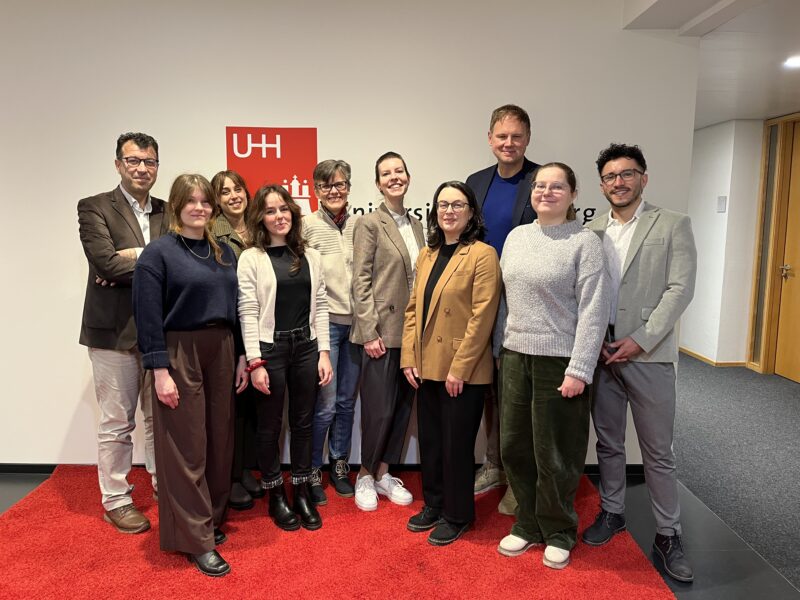
The president of University of Hamburg, Prof Dr Hauke Heekeren, welcomes the new members of Ingrid Piller’s Humboldt Professorship Team
Attentive readers will remember that in May this year we advertised six doctoral and postdoctoral positions to conduct research related to “Linguistic Diversity and Social Participation across the Lifespan” in the Literacy in Diversity Settings (LiDS) Research Center at University of Hamburg, as part of the Alexander-von-Humboldt Professorship awarded to Ingrid Piller.
In response, we received 270 applications. While it was exciting to see that there is so much interest in our work, it was also heart-breaking to have to make so many tough decisions from an amazing pool of highly qualified candidates.
After conducting Zoom and on-campus interviews in July and August, I am now pleased to report that the Dream Team has started their work at the beginning of November. We have six extremely talented and accomplished early career researchers joining the Language-on-the-Move community, and in this post, they are introducing themselves in their own words.
Jenia Yudytska
I’m Jenia Yudytska, a Ukrainian-Austrian postdoc. I did my PhD in computational sociolinguistics at the University of Hamburg, investigating the influence of technological affordances on language in online communication. My current research interest focuses on how migrants use language technologies, particularly machine translation, as a resource in their everyday life. Since 2022, I have also been heavily involved in the organisation of grassroots mutual aid online communities for Ukrainian forced migrants in Austria.
I’m particularly excited for this chance to jump into applied linguistics, and the chance to combine both my love for research and my desire to make a social impact!
Juan Sánchez
¡Hola!
I’m Juan Felipe Sánchez Guzmán, a Colombian student and researcher based in Hamburg. In my home country, I conducted research on gender diversity and language teaching, as well as on the implementation of the Colombian Ministry of Education’s bilingualism programs involving foreign tutors in public institutions within a predominantly monolingual context. Building on my passion for languages, my own migration experience, and those of fellow immigrants, my Master’s research explored the integration of Latinx nurses into the German healthcare system.
I look forward to showcasing through research the values and strengths that multilingual communities bring to education, healthcare, and society as a whole.
Mara Kyrou
My name is Mara Kyrou and I hold an MA degree in Linguistics and Communication from the University of Amsterdam. My Masters research explored language policies, practices and ideologies as perceived by teaching professionals in multilingual non-formal education settings in Greece and the Netherlands. My research interests also include professional and intercultural communication in transnational work contexts, gender theory and theater education. I have also contributed to the design and implementation of language learning programs for students with a (post-)migrant background with international NGOs.
In this research group we are working with (auto-)ethnographies and focusing on globally emerging topics hence we don’t just study things as they are but as we humans are.
Martin Derince
Roj baş!
I am Martin Serif Derince. I carried out my PhD research on Kurdish heritage language education in Germany at the University of Potsdam. I have conducted research and have publications on bilingualism and multilingualism in education, language policy, heritage language education, statelessness, and family multilingualism. After long years of professional work in municipality, non-governmental organizations and community associations dedicated to promoting multilingualism in various contexts, I am excited to explore new terrains in academia, grow together intellectually, and contribute to efforts for social transformation and justice.
Nicole Marinaro
My name is Nicole Marinaro, and I did my PhD at Belfast’s Ulster University’s School of Applied Social and Policy Sciences, focusing on addressing communication difficulties between patients and healthcare professionals. My research interests include language policy, sociolinguistics and linguistic justice, with a focus on the inclusion of linguistically diverse speakers. I am also passionate about language teaching and dissemination of academic knowledge.
I am particularly excited to become part of a diverse and interdisciplinary team, to learn from each other over the next years and to make a real contribution to a more linguistically just society.
Olga Vlasova
My name is Olga Vlasova. My research journey started in Prague at the Charles University where I obtained my BA degree in sociology. Later, I completed my Master’s degree in social policy at the University of Bremen and University of Amsterdam. During these years I have been contributing to research in the fields of migration and labour studies, with a particular focus on solidarity practices with migrant workers in the European labour markets. Apart from that, I’m a passionate volunteer and help newcomers with their integration into Hamburg society.
One thing my life journey has taught me is: “Be brave and follow your ideas and passions!”
What’s next?
Over the next 4 years, our work will be in the following five areas:
- We will conduct a set of interlinked ethnographies to better understand linguistic diversity and social participation across the lifespan
- We will make a novel methodological and epistemological contribution related to qualitative multilingual data sharing
- We will build capacity in international networked education research (see also WERA IRN Literacy in Multilingual Contexts)
- We will work with community stakeholders to help improve language policies and practices and make institutional communication more accessible
- We will share knowledge and contribute to a greater valorization of linguistic diversity
Along the way, we will keep you all posted, of course. Watch this space!
Early next year, we will also advertise another researcher position on our team so that’s another reason to follow our work 
Related content
Alexander-von-Humboldt Professorship Awards 2025
]]>
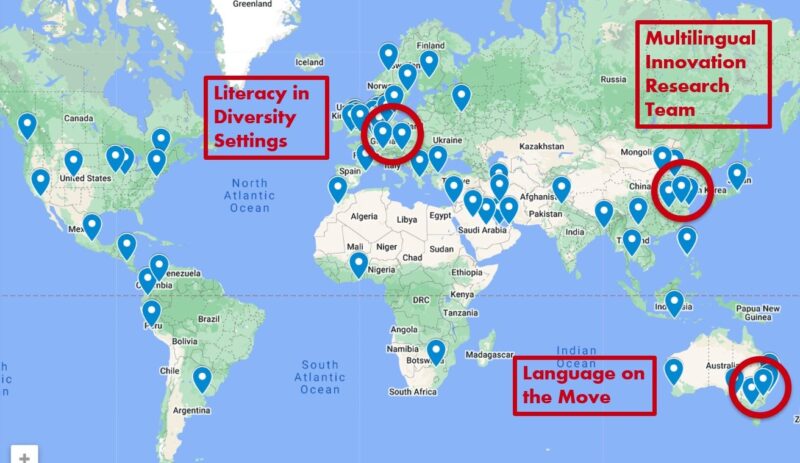
The international research network “Literacy in Multilingual Contexts” builds on the “Next Generation Literacies” network
The World Education Research Association (WERA) recently announced the launch of seven new International Research Networks (IRNs) and we are pleased to share that “Literacy in Multilingual Contexts” is one of them.
What is a WERA IRN?
The WERA IRN initiative brings together global teams of researchers through virtual communication and other channels to collaborate in specific areas of international importance. “Literacy in Multilingual Contexts” joins a growing list of IRNs, contributing to the vision of WERA. The purpose of IRNs is to synthesize knowledge, examine the state of research, and stimulate collaborations or otherwise identify promising directions in research areas of worldwide significance. IRNs are expected to produce substantive reports that integrate the state of the knowledge worldwide and set forth promising research directions.
What does the IRN “Literacy in Multilingual Contexts” do?
The IRN “Literacy in Multilingual Contexts” aims to initiate and extend international collaborative research on literacy in the context of language diversity and migration. The joint focus is on literacy development and practice in multiple languages. Drawing on varied and complementary expertise from Europe, Australasia, Africa and North America, the objectives are:
- to enhance knowledge on literacy and student diversity
- to trace tendencies that go beyond one national, regional or local context
- to examine literacy development across the life-course
- to critically discuss the implications of research findings for policy and practice
Literacy is a foundation for participation in complex societies. The proposed research therefore also contributes to pathways to equity. The network’s activities will reach fundamental theoretical insights, which may be transferred to concepts of teaching/learning in educational institutions. This intervention research will attempt to generalise characteristics of successful multilingual literacy development to be adapted to specific contexts. The proposed IRN comprises senior, experienced and early career scholars (incl. PhD students), aimed towards international and intergenerational knowledge generation.
Literacy as a resource
At the heart of our network is the idea that multilingual literacy is a resource to be celebrated. Literacies across languages and scripts empower learners to create knowledge, to navigate education systems, and to participate fully in social and cultural life.
Members of the network bring expertise from early childhood to higher education, from family and community contexts to digital and AI-mediated literacies. Our shared vision is to develop research that responds to the multilingual realities of migration, mobility, and global diversity.
Building on the “Next Generation Literacies” network
The “Literacy in Multilingual Contexts” network has grown out of the Next Generation Literacies initiative, an international network of researchers working at the intersection of social participation and linguistic diversity.
Based on the trilateral partnership of Fudan University (China), Hamburg University (Germany) and Macquarie University (Australia), Next Generation Literacies brought together an interdisciplinary group of established and emerging researchers to build a truly global network.
After funding for the Next Generation Literacies network ended in 2024, the IRN “Literacy in Multilingual Contexts” keeps that spirit of collaboration alive, while also widening the circle: we are now connected with colleagues from the Network on Language and Education (LeD) in the European Educational Research Association (EERA) and with other WERA initiatives. Under this new umbrella, we will scale up our efforts and make a stronger impact together.
Network Conveners
The network is convened by
- Irina Usanova (University of Hamburg; Lead Convenor)
- Francis M. Hult (UMBC)
- Ingrid Piller (University of Hamburg & Macquarie University)
- Yongyan Zheng (Fudan University)
- Harkaitz Zubiri-Esnaola (University of the Basque Country)
Together with network members, we bring expertise spanning literacy research across continents and research traditions.
Kick-off meeting
On September 24, 2025, we came together on Zoom across many different time zones and continents to virtually celebrate the official launch of the Literacy in Multilingual Contexts IRN.
The kick-off meeting felt like both a reunion and a new beginning: familiar faces from the Next Generation Literacies network reconnecting, and new colleagues from around the world joining the conversation. Together, we are building a vibrant global community of researchers committed to understanding how literacy develops and thrives in multilingual settings. For all of us, it was a reminder of how much we can achieve when we put our multilingual realities at the center of literacy research.
What’s next?
Over the next three years (2025–2028), we will:
- review the state of research on multilingual literacies
- analyze existing datasets across different contexts
- share our work in joint events and publications
- build a sustainable international community dedicated to literacy in diversity
To make this vision concrete, members are invited to join thematic working groups. Topics include multilingual literacy in early childhood, in higher education, in Indigenous contexts, CLIL, multilingual writing and AI, and multilingual policy. Sounds interesting?
An open invitation
The energy of our first meeting showed just how much can be achieved when we bring our different perspectives together. The IRN “Literacy in Multilingual Contexts” is open to any researcher working in these areas. If you are interested in joining, please send your inquiry to Dr Irina Usanova.
Related content
]]> You are invited to join us on Monday, December 08, at Macquarie University for a workshop to explore New Technologies in Intercultural Communication.
Description: Digital technologies are in the process of fundamentally reshaping communication. There are significant opportunities: chatbots can personalize language teaching in a way unimaginable until recently and machine translation promises to widen participation for ever more people, regardless of their language proficiency. Yet these opportunities come with the harms caused by screen addiction, surveillance, and environmental destruction.
In this one-day research symposium we move beyond both the hype and the fearmongering to examine the real-life use of digital technologies in multilingual and intercultural communication. How can digital technologies help to bridge language barriers to social participation? What new barriers do they create? And what research agenda do we need to harness technological transformation for social inclusion in our linguistically and culturally diverse society?
Attendance is free but places are limited. To secure your place, sign up for the event at https://events.humanitix.com/new-technologies-in-intercultural-communication or scan the QR code.
 Date and venue
Monday, Dec 08, 2025
Macquarie University, Wallumattagul Campus, Ryde
Program [updated Nov 21, 2025]
09:30-10:00 Arrival, Meet & Greet
10:00-10:30 Welcome
10:30-11:15 Earvin Cabalquinto (Monash U), The myth of digital inclusion: Locating non-digital influences in the migrant’s home
11:15-12:00 Julia Kantek and Thilakshi Mallawa Arachchi (WSU), Sustaining livelihoods in ‘the shadows’: International students’ use of GenAI as digital shadow care support
12:00-13:00 Lunch break
13:00-13:45 Ana Sofia Bruzon (MQ), Using tech in bilingual transnational parenting
13:45-14:30 Hye Eun Chu (MQ), Bridging Language and Inquiry in Diverse Science Classrooms
14:30-15:15 Yeong-Ju Lee (MQ), Social Media and Language Learning
15:15-15:45 Coffee break
15:45-16:30 Laura Smith-Khan (UNE), “Connectivity is the central thing”: Developing legal literacy post-migration
16:30-17:00 Closing panel: Gerard Goggin (UWS) and Ingrid Piller (UHH&MQ), moderated by Sarah McMonagle (UHH)
17:00-18:30 Reception & networking
Abstracts and bio blurbs
Earvin Cabalquinto (Monash U), The myth of digital inclusion: Locating non-digital influences in the migrant’s home
Abstract: The home is a vital space for shaping an individual’s personal, familial and social relations and growth. In an increasingly digital and global economy, such domestic terrain has been reconfigured into a highly mediated and transnational space. For migrants and their networks who constantly navigate their marginalised position in contemporary societies, a home at a distance embodies the paradox of cross-border and virtual mobility. Homing necessitates digital media use, a tactic for coping with the pains of physical separation. Yet, everyday connections, impacted by intersecting social, economic and political factors, become a source of frustrations and discomfort. In this provocation, I offer a critical reflection of the principles, dynamics, and contradictions of digital inclusion by unlocking the migrants’ mediated home. I draw key insights from more than ten years of multi-sited interviews and visual ethnography among the Filipino diaspora in Australia and their local and transnational networks. Significantly, I attempt to locate and centre the asymmetrical non-digital factors – personal, cultural, economic, and political – that deeply impacts the enactment, embodiment and negotiations of the home among migrants and their distant networks. In sum, the presentation provides a critical vantage point to further rethink digital inclusion by disrupting one-size-fits-all and geographically-bounded solutions and foreground situated, relational, and transnational approaches for understanding and redressing intertwined social and digital inequalities.
Bio: Dr Earvin Charles B. Cabalquinto is an Australian Research Council (ARC) Discovery Early Career Research Award (DECRA) Research Fellow and Senior Lecturer in the School of Media, Film and Journalism at Monash University, Australia. He has held Visiting fellowships in Lancaster University, United Kingdom (2019), University of Jyväskylä, Finland (2021), Canada Excellence Research Chair (CERC) in Migration and Integration, Toronto Metropolitan University, Canada (2024), and Asia Research Institute, National University of Singapore (2025). He is the author of (Im)mobile Homes: Family Life at a Distance in the Age of Mobile Media” (Oxford University Press). He is the co-author of Philippine Digital Cultures: Brokerage Dynamics on YouTube (Amsterdam University Press). He sits in the editorial board of top journals, including the International Journal of Cultural Studies, Convergence: The international journal of research into new media technologies, and Journal of Global Ageing. His research on the impacts of digitalisation on migration has been widely published in top-tier journal outlets and specialised edited collections. His research agenda is driven by critically exploring the dynamics and impacts of digital inclusion and exclusion among migrants and their networks who navigate an increasingly digital and global society. To know more about his projects and outputs, visit www.ecabalquinto.com.
Julia Kantek & Thilakshi Mallawa Arachchi, Sustaining livelihoods in ‘the shadows’: International students’ use of GenAI as digital shadow care support
Abstract: International students are navigating a multitude of structural challenges, including rising living costs, shifting visa conditions, and an intensifying housing affordability crisis. These pressures unfold within a broader post-welfare context, marked by reduced government support for temporary migrants and limited investment in student services. This paper explores how international students use Generative Artificial Intelligence (GenAI) to navigate these challenges. Drawing on focus groups (N=3) and interviews (N=21), we reveal how ChatGPT (and similar GenAI tools) function as digital shadow care infrastructures, helping students ‘get by’ and navigate everyday precarity (legal, financial, and emotional). By situating GenAI within students’ broader care assemblages, this study contributes to digital migration scholarship, highlighting how GenAI tools ‘fill the cracks’ left open by inadequate formal supports, as well as identifying the factors that shape GenAI use within these contexts. Overall, we argue for policies that not only recognise these shadowed practices, but educate and empower migrants to use AI tools safely and effectively.
Western Sydney University Research team: Dr Julia Kantek, Dr Donna James, Dr Thilakshi Mallawa Arachchi & Distinguished Professor Gerard Goggin
Bio: Dr Julia Kantek is a Lecturer in the School of Social Sciences at Western Sydney University. Julia has developed research expertise at the intersection of youth sociology, migration studies, and diaspora engagement. Her work explores the ways various transitions (such as those induced by migration, education, and work) shape belonging, identity formation, and wellbeing. Julia is currently co-leading two funded projects through the Young & Resilient Research Centre and the Institute for Culture & Society at Western Sydney University. One explores how digital technologies function as infrastructures of care for migrants, while the other investigates how young people from Western Sydney navigate work-related aspirations and transitions.
Bio: Dr Thilakshi Mallawa Arachchi is a researcher, educator, and activist with a passion for justice, working to nurture caring, connected communities through collective action. Her interdisciplinary background spans digital media studies, media literacy, migration, feminism, higher education, and climate activism. She completed her PhD at Western Sydney University in March 2025, investigating how cultural institutions, such as public libraries, can co-design equity-centred social media literacy education interventions with women from refugee backgrounds.
Ana Sofia Bruzon, Using tech in bilingual transnational parenting
Abstract: Against the background of the digitisation of all spheres of life, including childhood, this project asks how transnational parents use new technologies to support their children’s heritage language learning and use. Guided by a conceptual framework based in language policy and a sociolinguistic ethnographic approach, interview, questionnaire and observational data were collected from 17 Spanish-speaking families in Australia to examine digital technology use in the family, particularly in relation to heritage language maintenance.
Findings show that each of three focal technologies – TV and film, digital communication platforms, and learning apps – has a primary purpose which is not related to heritage language maintenance but results in specific affordances and constraints for heritage language learning and use. The primary purpose of TV and film is to provide entertainment. This allows for beneficial linguistic input in Spanish but is also constrained by child language proficiency and resistance against particular shows and language choices. Similarly, digital communication platforms serve the primary purpose of connecting with geographically dispersed kin. This provides valuable interactional opportunities in Spanish for children but is limited by the inability of distant kin to engage in child-centred communication strategies and is also subject to practical constraints such as time differences. Finally, learning apps are largely brought into the home by school requirements and serve the primary purpose of learning. Learning apps offer precious explicit and implicit Spanish language learning opportunities but parents worry that they expose children to harms such as excessive screen time.
Overall, the project constitutes a novel contribution to the fields of family language policy and heritage language maintenance by concluding that digital technologies constitute a double-edged sword: their value in supporting multilingual practices in a monolingual society is significant but countervailed by limitations inherent in these technologies, particularly as they relate to broader developmental harms.
Bio: Ana Sofia Bruzon is a PhD candidate in the Department of Linguistics at Macquarie University, Sydney, and a member of the Language on the Move research team. Her research interests include education policy and practice, digital technology in education, and the intersection of language, education and law.
Her PhD focuses on heritage language maintenance, language and education policy, and the digital practices of transnational families. The thesis examines how transnational parents use new technologies to support their children’s language learning and education. Her MRes research, published as Piller, Bruzon, and Torsh (2023), focused on language and education policy and practice, investigating the online linguistic practices of multilingual schools. Ana has a background in law and is a member of the State Bar of California in the U.S., where she practised as an immigration, real estate, and family lawyer. Ana is fluent in English, Spanish, and Italian.
Hye-Eun Chu, Bridging Language and Inquiry in Diverse Science Classrooms
Abstract: Science classrooms are becoming increasingly multilingual and digital, raising urgent questions about how to integrate inquiry-based learning with language support. This presentation synthesises four studies that examine these challenges across Korean and Australian contexts. A survey of 144 Korean teachers revealed strong self-efficacy in inquiry teaching but low confidence in supporting the language needs of culturally and linguistically diverse (CLD) students. Classroom observations in Korea showed that CLD students, despite linguistic difficulties, contributed creative and reflective ideas during model co-construction, enriching group learning. An intervention with Korean elementary students developed a Digital Science Text Reading Literacy (DSTRL) program, which significantly improved their abilities to search, read, and evaluate multimodal science texts. Finally, interviews with Australian and Korean physics teachers highlighted both enthusiasm and concerns about Language-Focused Teaching (LFT), balancing benefits for engagement and conceptual learning against practical constraints. Together, these findings call for teacher professional development that embeds language as integral to inquiry and leverages digital tools for inclusive participation.
Bio: Dr Chu is a Senior Lecturer in Macquarie’s School of Education. Her research has focused on several key areas, including monitoring students’ understanding of science concepts, implementing formative assessment in science classrooms, interdisciplinary approaches to teaching science, affective factors affecting science learning, and the integration of the arts into the teaching of science and related subjects (STEAM). Additionally, she has conducted research in conceptual development in science learning, tracking students’ concept development through text (language) analysis, interdisciplinary teaching of environmental literacy with science, and the influence of student beliefs on science learning. Recently, her work has expanded to include studies on the application of AI in education.
Yeong-Ju Lee, Social Media and Language Learning
Abstract: This presentation draws on my new book ‘Social Media and Language Learning: Using TikTok and Instagram’ (Lee, 2025), which investigates how visual and multimodal technologies transform informal language learning and intercultural exchange. The book analyses two studies: a comparative analysis of online data from Instagram and TikTok posts, and a multiple case study based on ethnographic data of narratives from international students in Australia. These studies show how learners use multimodal features such as sound, captioning, and visual composition to create and share meaning across linguistic and cultural boundaries. Based on these findings, in this presentation I will discuss how social media platforms have become everyday spaces where linguistic agency, creativity, and belonging are negotiated in transnational contexts. I will also consider how AI-driven features in social media such as automatic captioning, real-time translation, and personalised content feeds are creating new opportunities while posing pedagogical challenges for multilingual learning.
Reference
Lee, Y.-J. (2025). Social media and language learning: using TikTok and Instagram. Routledge. https://doi.org/10.4324/9781003543541
Bio: Yeong-Ju Lee obtained her PhD from the Department of Linguistics at Macquarie University in Australia. She teaches courses in Applied Linguistics, TESOL, and Literacy. Her research interests include digital language learning and teaching, especially on social media and AI. She is a Chief Investigator of the Data Horizon Research Centre-funded project on a customised AI chatbot for language learning at Macquarie University, and the Teaching Development Grant-funded project on AI and literacy at Australian Catholic University.
Laura Smith-Khan, “Connectivity is the central thing”: Developing legal literacy post-migration
Abstract: Developing a sound understanding of the law is essential for social participation and access to justice, and in the context of migration, can form a crucial part of integrating and flourishing in a new country. Yet there can be a range of challenges for new arrivals when it comes to developing legal literacy, and for service providers seeking to assist them. This presentation will share emerging findings from pilot research on Australian government and non-government service providers’ efforts to help educate the public about Australia law, legal processes and legal services. Drawing on an examination of research interviews, survey responses and public texts, the preliminary findings indicate that while online resources and technology are one element of such efforts, human connectivity and care remain crucial.
Bio: Dr Laura Smith-Khan is a Senior Lecturer in Law at the University of New England, Australia and an external affiliated member of the Centre for the Social Study of Migration and Refugees (CESSMIR), Gent University, Belgium. Her research is interested in the participation of minoritized groups in legal settings, especially migration processes. She was the 2022 recipient of the Max Crawford Medal, Australia’s most prestigious award for achievement and promise in the humanities. She is co-founder and co-convener of the Law and Linguistics Interdisciplinary Research Network, a member of Language on the Move and Next Generation Literacies and serves on the editorial boards of Multilingua and the Australian Journal of Human Rights.
Dr Smith-Khan has written extensively on language and credibility in Australia’s asylum procedures. Beyond her continuing work in this area, she has undertaken research on the education and communicative practices of migration practitioners, on media representations of migration, and on disability rights in forced migration. Aiming for impact, her research has been cited and adopted by the EU Agency for Asylum, the Australian Human Rights Commission, UNHCR and UNESCO, and is used in undergraduate and postgraduate teaching. She has tertiary qualifications in both law and linguistics and has been admitted to practice as a lawyer.
]]>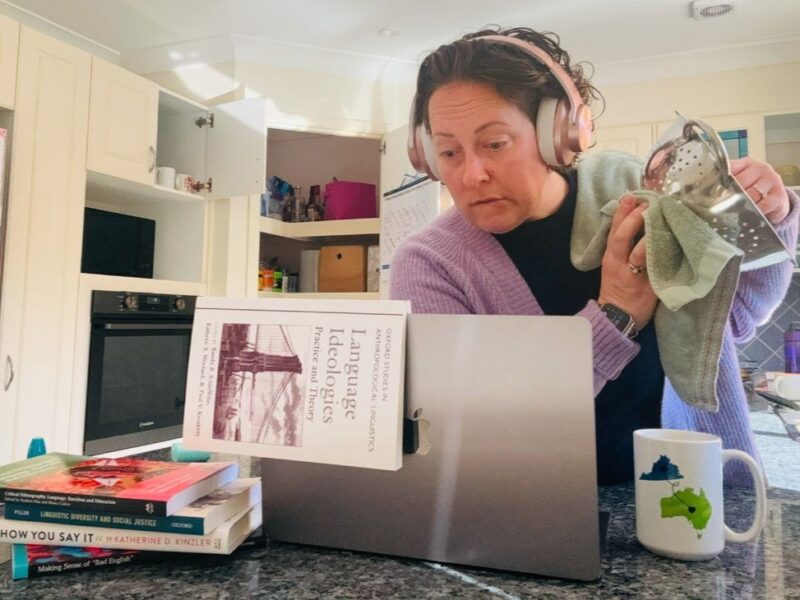
Being an academic mom has given Brynn a huge head start when it comes to managing her supervisors (Image credit: Brynn Quick)
You know that feeling you get in your stomach when you’ve climbed to the top of a rollercoaster, and you look down to see that first huge drop that’s rapidly approaching? That’s exactly what it can feel like to be at the beginning of your PhD. You have a vague idea about the direction that the rollercoaster track will take, but you also know that there will probably be twists, turns and loops (plus some screams and tears) that you can’t anticipate yet.
So, let’s talk about how to make that PhD rollercoaster ride as smooth as possible while also acknowledging that some upside-down moments are inevitable.
One of the most crucial elements of your PhD is your relationship with your supervisor. We’ve all heard the horror stories (The Thesis Whisperer Professor Inger Mewburn has compiled many!). Some PhD students experience bullying, harassment and outright abuse from their supervisors. We all want to avoid a toxic supervisor/student relationship, so it’s vital that every PhD student has a firm idea of how to build and maintain a partnership of trust with their supervisor.
I’m very lucky to have three fabulous supervisors on my team (Distinguished Professor Ingrid Piller is my primary supervisor, and Dr. Hanna Torsh and Dr. Loy Lising are my associates). Recently, Ingrid asked me to talk to other members of our research group about how I “manage” my supervisors while I conduct my research.
In response, I created a slideshow with key principles. What I realised by examining my own management processes was that I hold two principles to be most important:
- Explicitly discuss your expectations of your supervisor, and your supervisor’s expectations of you.
- Honour your supervisor’s time, and they will honour yours.
Let’s talk about these in more detail.
Setting Expectations
We’ve all heard about how communicating clear and mutually-agreed-upon expectations in marriages can lead to healthy partnerships, but many of these same communication principles also apply to working (and therefore, supervisor/supervisee) relationships.
You might send your supervisor a thesis chapter that you’ve just written, and you may assume that they will be able to email you with feedback within a week. However, what you might not know is that your supervisor is also writing their own research paper, preparing a lecture, working on a grant application and getting ready to present at a conference in two weeks.
Therefore, it’s incredibly important that you ask about expectations when you send that chapter. In your email with your thesis chapter, tell your supervisor how many pages (or words) you are sending. Tell them if it’s a first draft, a ninth draft, which changes you have highlighted, what uncertainties you have, etc. Explicitly tell them what task you will work on while you are waiting for their feedback (supervisors love productivity!).
Ask them what date will work with their busy schedules for you to expect feedback by, then trust that they will get back to you by that date. In clearly and explicitly communicating an expectation, you both avoid assuming that the other person has the same expectation that you do, and that reduces the chances of a big misunderstanding down the track.
Another element of setting expectations includes setting and managing expectations of yourself as the PhD student. During our undergraduate and even master’s by coursework degrees, it is often the professor or lecturer who is acting in the role of “manager”. They set reading tasks, and we do them. They assign a 4,000-word essay, and we write it. They tell us to be in class at 8:00am for a final exam, and we sleepily show up with an extra-large coffee. In these degrees, we get used to being told how to successfully be a student. As long as we follow directions, we will probably succeed.
During a research-based degree like a PhD, however, suddenly we become the managers, and this can be whiplash-inducing. Many of us have never had that type of teacher/student relationship before, so we have to learn quickly how to take the lead. This means acting as our own boss in one way – setting daily tasks for ourselves, tracking our own progress, troubleshooting, working towards both external and self-imposed deadlines, etc.
But at the same time, we have to be ready to adapt to expectations that our supervisor has of us and our work. This can be tough when we do eventually get used to being our own boss and managing our own work by ourselves for weeks at a time. This is exactly where clear communication comes into play. Begin and maintain your working relationship with your supervisor from a foundation of honesty and open conversations. If you both respectfully and clearly communicate expectations with each other, the PhD rollercoaster ride will have far fewer stomach-turning drops.
Honouring Time
Time is simultaneously something that we feel like we have far too much of and far too little of during a PhD. The idea of writing for literal years sometimes makes me want to curl into a ball, but also having “only” a few years to complete a PhD feels like a panic attack-inducing Herculean task. But do you know who else has a rough relationship with time? Your supervisor.
Like I said before, they might be teaching/researching/writing/lecturing while supervising. I myself teach every other semester, and doing that while researching (and let’s not even talk about trying to balance family life and parenting in that schedule somewhere!) can be exhausting. So, I honestly don’t know how my supervisors do all that they do in the limited time they have.
Therefore, I try as best I can to honour their time. This means that I keep my emails to them as organised and concise as possible. I come up with agendas for our supervision meetings and take notes during said meetings. Then I make sure to highlight any actionable items that we discussed, and I send the meeting notes to them with a summary of what actions each person has agreed to take by the next time we meet. I also try to figure out as much of the bureaucratic work that is involved in a PhD that I can before involving them (no but seriously, there is SO MUCH bureaucracy).
I have found that by taking these steps to be as proactive as possible and be mindful of my supervisors’ time constraints, they have been reciprocally mindful of mine.
Conclusion: We Can Make the PhD Rollercoaster Ride an Enjoyable One
I’m what we euphemistically call a “mature age student” (I just turned 40 a few weeks ago!). That is to say that this isn’t my first rodeo – I completed my bachelor’s degree in 2007 and was in the workforce and busy raising kids until re-entering academia in 2019. I think that, because of my age and life experiences, I have a unique perspective on the PhD process and working relationships. I truly believe that mutual respect and open communication between supervisors and supervisees is what will make this rollercoaster ride as easy as possible.
If you are on your own PhD rollercoaster, I hope that reading this post will give you the confidence to put “managing up” policies into practice. May your rollercoaster ride be as smooth as possible, and I hope you get to eat some fairy floss after it’s over.
]]>The conversation delves into ideological issues involved in the widespread use of machine translation and the real-life impact for those who may rely on machine translations in various situations. Esther’s research and the wide variety of contributions to the book highlight the need to open a discussion about instilling an ‘ethics of care’ perspective into the use of technology to make AI generated translations more inclusive and relevant for the communities using them.
 If you liked this episode, support us by subscribing to the Language on the Move Podcast on your podcast app of choice, leaving a 5-star review, and recommending the Language on the Move Podcast and our partner the New Books Network to your students, colleagues, and friends.
Transcript (coming soon)
]]>
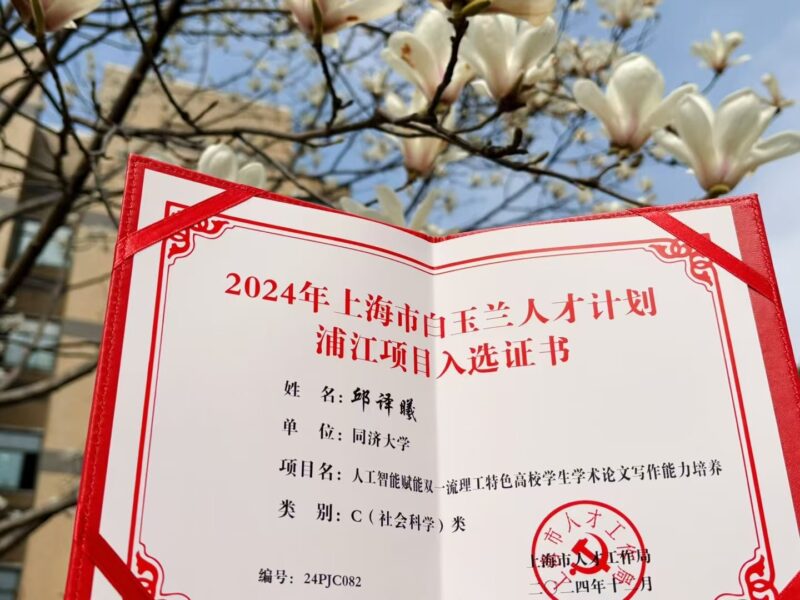
Isabella’s Award Certificate (Image credit: Yixi Qiu)
Congratulations to Language-on-the-Move team member Dr Yixi Qiu (Isabella) for winning an award under the Shanghai Magnolia Pujiang Talent Program (上海白玉兰浦江人才计划) for her project “人工智能赋能双一流理工特色高校学生学术论文写作能力培养” (“AI Empowerment for Enhancing Academic Writing Skills among Students in Double First-Class STEM Universities”).
The Shanghai Magnolia Pujiang Talent Program was launched in 2005 by the Shanghai Municipal Human Resources and Social Security Bureau and the Science and Technology Commission. It aims to attract and support overseas-returned scholars to contribute to research, innovation, and social development in Shanghai.
For Isabella, who is now an Assistant Professor at the School of Foreign Studies, Tongji University, this is a fantastic recognition and remarkable opportunity to reestablish herself in Shanghai after her time in Sydney.
人工智能赋能双一流理工特色高校学生学术论文写作能力培养 (“AI Empowerment for Enhancing Academic Writing Skills among Students in Double First-Class STEM Universities”)
Isabella’s project focuses on integrating generative AI into academic writing pedagogy, with the goal of supporting STEM students in developing stronger writing competence. Drawing on our team’s long-term research program into the relationship of linguistic diversity and social participation, “AI Empowerment for Enhancing Academic Writing Skills among Students in Double First-Class STEM Universities” conceptualizes writing as more than a technical skill. Instead, Isabella approaches it as a means of expressing agency, negotiating identity, and participating in academic and social life. The aim is to explore the potential of AI to support multilingual students in accessing richer linguistic, social, and epistemic resources, for personal and collective growth.
For background, “Double First-Class University” refers to a university in China that has been selected for development under the Double First-Class Initiative (双一流), launched by the Chinese government in 2015. The goal is to cultivate: First-Class Universities and First-Class Disciplines. These universities and their designated disciplines are given special funding and policy support to become world-leading in research, education, and global influence. Examples of such institutions include Tongji University, where Isabella is based, and Fudan University, where she did her PhD.
Next Generation Literacies and the power of global networking
Isabella’s project was partly inspired by her membership in the Next Generation Literacies network. This network connects the Fudan Multilingual Innovation Research Team under the leadership of Professor Yongyan Zheng and the broader Shanghai Multilingualism Research Alliance with the Language-on-the-Move team at Macquarie University, and the Literacy-in-Diversity-Settings (LiDS) Research Center at University of Hamburg. Next Generation Literacies is a part of the strategic trilateral relationship of these three universities but includes researchers from many other universities from around the globe.
More exciting hot-off-the-press news for the network: Next Generation Literacies has been the launch pad for a new International Research Network (IRN) devoted to “Literacy in Multilingual Contexts” under the umbrella of the World Education Research Association (WERA). The “Literacy in Multilingual Contexts” IRN will be led by LiDS member Dr Irina Usanova. Watch this space to learn more about the IRN as it constitutes itself!
The magnolia and the river
The magnolia (白玉兰) is the official city flower of Shanghai symbolizing openness and elegance, while Pujiang (浦江) refers to the Huangpu River, which flows through the heart of the city. Together, the Magnolia Pujiang Talent Program reflects Shanghai’s vision of cultivating global talent rooted in local vitality.
An impressive example of our maxim to think globally and to act locally. Congratulations again, Isabella! 恭喜!
]]>In this episode of the Language on the Move Podcast, Dr Agnes Bodis talks to Dr Masaki Shibata from Monash University in Melbourne, Australia. Dr Shibata researches beach signs in Australia and how they are understood by beachgoers and what consequences this has for beach safety.
If you enjoy the show, support us by subscribing to the Language on the Move Podcast on your podcast app of choice, leaving a 5-star review, and recommending the Language on the Move Podcast and our partner the New Books Network to your students, colleagues, and friends.

Surf Rescue Australia (Image credit: Australian Government, Study Australia)
References
Shibata, M. Peden, A., Watanabe, H., Lawes, J..(2024) “Do red and yellow flags indicate a danger zone?”: Exploring Japanese university students’ beach safety behaviour and their perceptions of Australian beach safety signage. Safety Science. DOI: https://doi.org/10.1016/j.ssci.2024.106606
Shibata, M. Peden, A., Lawes, J., Wong, T., Brander, R.(2023) “What is a shore dump?: Exploring Australian university students’ beach safety knowledge and their perceptions of Australian beach safety signage”. Safety Science. DOI: https://doi.org/10.1016/j.ssci.2023.106366
Transcript (coming soon)
]]> Christian is a Lecturer in Sociolinguistics at the University of Edinburgh whose research explores the social meaning of linguistic variation. His research specifically focuses on the interrelation of digital culture and language variation and change with a concentration on the linguistic and digital practices of young people.
Some references made in this episode include:
- Language and the Internet (2001) by David Crystal
- The recontextualization of Multicultural London English: Stylising the ‘roadman’ (2023) by Christian Ilbury
- The Dolly Parton meme
- What’s the difference between AAVE and Gen-Z slang?
- Shetland Islands accent
If you enjoy the show, support us by subscribing to the Language on the Move Podcast on your podcast app of choice, leaving a 5-star review, and recommending the Language on the Move Podcast and our partner the New Books Network to your students, colleagues, and friends.
Transcript (coming soon)
]]>Dr Nashid Nigar and Professor Alex Kostogriz
***
Imagine stepping into a classroom where students expect you to embody English in its “native” form, fluency, and culture. For many non-native English-speaking teachers (NNESTs) in Australia, this expectation is a daily challenge. Yet, these teachers refuse to let such pressures define them. Instead, they embrace a “hybrid professional becoming”—an ongoing process of identity formation—seeing themselves, in many ways, as “cyborgs” in the classroom.
Inspired by Donna Haraway’s Cyborg Manifesto, NNESTs use the cyborg metaphor to navigate and redefine their professional lives. They mix their multilingual and multicultural lived experiences with digital tools and fluid teaching methods, transcending rigid binaries of “native” versus “non-native” speakers. In this role, they create richer, more inclusive learning environments that challenge hegemonies.
Breaking Down the Native-Speaker “Myth”
Australian classrooms are highly diverse, yet the teaching workforce remains predominantly English monolingual and native-speaking. Many students here learn English as an additional language, making teachers’ lived experiences crucial for bridging linguistic and cultural gaps. However, native-speakerism—an age-old ideology favouring native English speakers—still shapes perceptions. NNESTs are often viewed through a deficit lens, yet they challenge this by showing that effective English teaching goes beyond birthplace or accent.
.jpg)
Phở bò (Image credit: Vinnie Cartabiano, Wikipedia)
Consider Natalie, a teacher from Bangladesh. Despite her experience, she often felt misjudged: “I didn’t just sense that students valued native English-speaking teachers more—I was even asked to be replaced by native speakers before I had a chance to start speaking”. Though these intersectional judgments were hard to ignore, Natalie turned them into a source of multiplicity. “It made me work harder to show that my teaching had depth and cultural awareness,” she explains.
To engage her students, Natalie wove stories, humour, and cultural anecdotes into her lessons, using language-bridging strategies to foster inclusivity. For her Vietnamese students, she joked about the pronunciation differences between “phở” (a noodle soup) and the English word “fur”, drawing laughter as they discussed similar linguistic misunderstandings. For her Lebanese students, she shared stories about common culinary traditions, sparking discussions about cultural similarities and differences. By weaving in phrases like “cảm ơn” (thank you) with her Vietnamese students and “Malual noor” (family is wealth) with her Sudanese students, she created a space where language and cultural understanding flourished, bridging worlds in a shared learning journey.
Embracing the Cyborg Identity in Teaching
Haraway’s Cyborg Manifesto frames the cyborg identity as one of assembling diverse parts into a constantly evolving whole. For NNESTs, this hybrid identity defies narrow definitions of an English teacher. Their methods connect students with English while honouring their own cultural heritage, engaging students in ways that promote inclusivity.
Mahati, an Australian qualified teacher from India, exemplifies this hybridity. Though passionate about teaching, adjusting to Australian classrooms wasn’t easy. After working various odd jobs, she found her place in adult migrant education. “Teaching for me is not just a job—it’s my second home” (मेरे लिए पढ़ाना सिर्फ एक नौकरी नहीं है—यह मेरा दूसरा घर है।), she shares. Entwining her cultural heritage in literature and music with modern teaching tools, Mahati creates meaningful connections with her students. “We end sessions with fun songs from Sing with Me Book 1, and I incorporate technology to keep students engaged”, she explains. This approach enriches her classroom with a dynamic, inclusive atmosphere.
Reflective Practice: A Tool for Hybrid Becoming
Reflection is essential to this cyborg-like emergence. For NNESTs, critical reflection goes beyond simple self-assessment; it’s a transformative process to reshape and redefine their roles, tailoring their approaches to the diverse needs of multilingual classrooms and imagining themselves as cosmopolitan teachers of English.
Natalie’s experience with reflective practice exemplifies this plasticity. Despite her extensive teaching background, she continually revisits her lessons to meet her students’ evolving needs. “One of my students once laughed at me for mispronouncing a Vietnamese dish,” she recalls with a smile. “It was a learning moment for both of us—I embraced it and encouraged my students to teach me more about their culture”. Through such exchanges, Natalie moves beyond rigid teaching roles, fostering an environment of mutual learning and responsiveness.
Janaki’s story further illustrates this process. Initially, she felt out of place teaching refugees and migrants in the AMEP (Adult Migrant English Program), many of whom had experienced significant hardship. “It’s been humbling—I had to understand their backgrounds and be patient”, she shares. Reflecting on her experiences, Janaki adapted her methods, drawing on colleagues’ advice and exploring new strategies to better serve her students.
Technology: Expanding the Cyborg Identity
Technology plays a crucial role in helping these teachers develop their cyborg identities. Digital tools enable them to adapt and extend their teaching practices, creating a more inclusive classroom environment.
Namani, a young teacher who initially felt intimidated by her non-native status, illustrates this shift. She struggled with technology, worried about being seen as less competent. “I was so concerned if something went wrong with a digital tool”, she recalls. But instead of avoiding it, she mastered tools like MS Teams and Zoom, transforming her classroom. “Once I felt confident, I realized technology was actually empowering me to be a better teacher”, she reflects.
Frida took this approach even further during the pandemic, recording demo classes to improve timing and engagement. Her experience with technology underscores the cyborg concept, intermingling cultural knowledge with technical proficiency to support students. Using online platforms, she stayed connected despite the distance, teaching her students not just English but also essential digital literacy skills.
Moving from Marginalization to Empowerment
The cyborg identity empowers NNESTs to transcend limitations imposed by native-speakerism. By embracing hybridity, they resist marginalization and actively redefine their roles, affirming their experiences as cosmopolitan educators of English. The cyborg metaphor captures a journey from marginalization to empowerment, where NNESTs reclaim the narrative and leverage their unique identities as strengths.
Laura’s journey illustrates this shift. Coming from a small town in the Philippines, she initially faced students who doubted her due to her accent. “I noticed some of my students were unsure of me, maybe because of my accent”, she recalls. Though it initially unsettled her, Laura decided to use it as a teaching tool. “I always wanted to be a teacher—even as a kid, I’d teach my dolls and pretend to mark papers”, she says with a smile. By sharing her story, Laura highlighted the richness of multilingualism, encouraging students to explore their identities and celebrating diversity in her classroom.
One of Jasha’s most powerful stories involves a Lebanese student whose linguistic journey reflected the beauty of multilingualism. “She spoke French and Arabic at home, then moved to Israel, where her three boys started school”, Jasha recalls. By the time they relocated to Australia, the boys had developed a unique assemblage, mixing French, Arabic, Hebrew, and English in daily conversations. “Listening to them was an absolute joy—I’d try to catch familiar English words,” she shares. This experience reinforced Jasha’s philosophy: learning English best occurs immersively, by discussing texts without a dictionary and encouraging students to “think” in English through activities like jumbled sentences and interactive games. Her approach to grammar focuses on context rather than correctness. “Grammar is just a means to an end”, she says, embedding it within the meaning her students wish to convey.
Toward a New Paradigm in English Language Teaching
The lived experiences of these NNESTs underscore the need for a shift in English language teaching paradigms. Embracing cyborg identities, these teachers demonstrate that an educator’s value lies not in their accent or birthplace but in their hybridity, engagement, and inspiration. Recognizing NNESTs’ hybrid professionalism can help educational institutions move beyond outdated binaries and create spaces where diverse voices are celebrated.
Through their stories, NNESTs like Natalie, Mahati, Janaki, Namani, Laura, and Jasha embody Haraway’s cyborg vision: educators who transcend boundaries, integrate facets of their identities, and reshape the future of education. By embracing cyborg identities, they enrich the classroom and create a new model for English teaching in today’s interconnected world. In their journey from marginalization to empowerment, these teachers remind us that education is a space for hybridity, inclusivity and horizons of possibility—qualities that benefit students, educators, and society alike.
Reference
The blog is based on:
Nigar, N., Kostogriz, A., & Hossain, I. (2024, aop). Hybrid professional identities: Exploring non-native English-speaking teachers’ lived experiences through the Cyborg Manifesto. Pedagogy, Culture & Society, 1–23.
Author Bios
Dr Nashid Nigar teaches at the Faculty of Education, University of Melbourne, and has diverse experience in English language and literacy teaching, academic writing, and teacher education. Her recently completed PhD thesis, focusing on language teacher professional identity at Monash University, was graded as Exceptional—Of the highest merit, placing within the top 0.1% to fewer than 5% of international doctorates. Her ongoing research interests include language teacher professional identity and language/literacy learning and teaching.
Alex Kostogriz is a Professor in Languages and TESOL Education at the Faculty of Education, Monash University. Alex’s current research projects focus on the professional practice and ethics of language teachers, teacher education and experiences of beginning teachers.
]]>Hanna and Prash discuss English language in higher education research and practice, in the understudied context of the South Pacific, and Prashneel’s new book, English Language-Mediated Settings and Educational Inequality: Language Policy Agendas in the South Pacific published by Routledge in 2025.
Transcript
 Hanna: Welcome to the language on the move, podcast a channel on the new books network. My name is Dr. Hanna Torsh, and I’m a lecturer in linguistics and applied linguistics at Macquarie University, in Sydney, Australia.
My guest today is Dr. Prashneel Ravisan Goundar. Dr. Prashneel is an academic based in the graduate research School in the University of New England. His research interests span applied linguistics, sociolinguistics, and educational linguistics. Today we’re going to talk about his new monograph, which will be published next month. English language, Mediated Settings and educational Inequalities published by Routledge. Welcome to the Show Presh.
Prash: Hi, Hanna, thank you for having me.
Hanna: It’s lovely that you could be here, and I really am really excited about introducing your work to our audience, so can you start us off by telling us a little bit about yourself, and how you got interested in the topic of your book.
Prash: Well, thanks personally to you for inviting me and reaching out. It’s always good to expand on your work and put yourself out of your comfort zone and rethink what you have done. So, the book obviously was part of my PhD. Thesis. But I’ll start just a little bit about myself.
So, I’m originally from Fiji. and I moved to Armidale, which is in the New England region in 2022 to complete my PhD. I’d started working on my PhD in Fiji, but because it was during the Covid period in 2020, and there were restrictions on travel and all of that, so I couldn’t move until mid of 2022, when things got a bit better. Back home back in Fiji I was an academic as well. I taught linguistics and applied linguistics courses for a decade or so. and part of what we had to do was we had to make sure that we upgraded our qualifications. We were given a timeline to do this upgrade, and I started looking at research topics.

Fijian streetscape (Image credit: Felix Colatanavanua via Wikipedia)
The way it kind of worked was the former Prime Minister of Fiji had gone into a function and had spoken at length about the English language problems that he had come across, and he had mentioned some of the civil servants, teachers or professionals who were writing emails. He noticed a lot of spelling mistakes, sentence structure errors, grammatical errors, and things like that. That’s when my my research skills kind of just picked up on this. And I started to think, well, he’s saying that. But does he have any form of data to back up his ideas? Or why have we come to that conclusion? Why is that the case? So that’s when I started to think aloud about this, and I thought this was going to be an interesting topic to investigate.
I sent research proposals over to a few universities, and that landed at UNE and my primary supervisor Finex Ndlovu he picked up on that, and he said, well, this looks like an interesting topic, but there would be other elements that I would like to add on to that. And that’s how I started working on my PhD which I finished in 2023. And that’s when we then started to see how the thesis could then be turned into a monograph and published as a book. So, I sent out the proposal to 2 publication houses and Routledge had sent it out for review, and they got back, and the review was very positive. And I thought, okay, now this is the time to start revising and reworking on how I can reach out to a wider audience who would be interested in this language, planning language policy, medium of instruction book. So that’s how it came about.
Hanna: Fantastic. Well, we’re glad that it did! It makes me feel like very old to think that you were doing this in Covid, because in my mind, Covid was just, you know, last year. But you’ve done so much since then, so I’d like to start in terms of delving into your book to focus on two of the things that I found really innovative and exciting about your research. And that is, of course, that it explores a really under-researched context. So that’s the first thing. And then the second thing is that it’s very participant centred. So, it really allows the participants to have a voice. Could you speak to those two aspects, or expand on them a little bit for our audience?
Prash: Absolutely, so if I did a quantitative study and just looked at a language test to see what the students were doing, or how they were coming into the university with a particular school, I think the study would not have been of merit in the sense that we are just looking at it from the statistics point of view. To just say, this is the level the students have entered the university, this is the level that they are leaving out from the University. What I wanted to go into was why they were at that particular level. What actually happened at the back end of it. And this is where the whole story about the Prime Minister comes into place is that something must have happened along the way for them to have a particular level of English when they entered a university, and that space was under researched.
Other researchers or scholars in Fiji had looked at primary school level of English, they had looked at high school level of English, or they had used interventions in those spaces, but they did not move on to the university and try to investigate. We have students who end up at the 3 main universities in Fiji where they all have English as the medium of instruction. But Fiji is so diverse. The linguistic background spans over 300 islands that we have, and you have students who would come from maritime schools who are very in rural areas. And then you have students who come from urban schools, and they enter the university. But for someone to just say, oh, well, you all come from schools. You should have the same level of English is very unfair. It’s an injustice, because that’s not how it works. So that’s the whole space that I really wanted to tap into and see what we could do to address these issues or what we could do to find out what these issues were, and that’s where the methodology came into place.
So I’ll tell you a funny story about this when I wrote the proposal, and I had sent it out to my supervisors, and I said, This is what I would like to do, and this is what I want to find out, and I remember them writing back to me and saying, Well, have you thought about how you’re going to give voice to the students. and that kind of put me into. Okay, how do I do that? So, I started again, looking at different methodologies. The most suitable one I found was grounded theory, methodology, and why it was suitable was it generates. The findings are centred with the data. So, the data actually generates the themes. The data actually brings about all the information that you could possibly gather. Then I started reading more about grounded theory, and then I noticed it was not used in the South Pacific context. When it came to language testing regimes, it wasn’t in that space. So, I said, okay, this is a new element. That’s coming into the picture and grounded theory, because it is of 3 different coding systems that go into its open coding, selective coding, and theoretical coding, these 3 different stages let the findings shine in their own spaces. Because you have this open coding where we had rural schools’ data. We had data about urban schools. We had data about tertiary institutions. And then we streamlined what we got from there into the selective coding space to look at. Okay, this is from, you know, these 3 streams. Then we grouped it to put rural schools and urban schools together. Whether it’d be primary schools or high schools. We put that information together. Then we moved on to getting the higher education data together as well. So, these were the new elements that kind of came about in the book. The methodology allows the participants to go on and speak about that information that they have.
So, we were able to have the total participants I had in the study which was 120, who did 2 language tests, one at the beginning of the year, and at the end of the year. We had writing interventions that I used to give them feedback on how they were progressing. And then, when we looked at the data at the end again qe showed improvements, but then I still wanted to know what had happened. So, we chose 30 participants to have an interview, and they were all randomly selected. It wasn’t someone who has performed the best was selected, or people who were low. And then I started to talk to them about their background educational background in terms of their primary school and high school level of English. What had happened, and those findings then told us a whole new picture.
Recently, even last year, if Fiji has started looking at examination results, and they have tried to look at what’s happening, and they want to have an educational review. So, I recently wrote a newspaper article. and I explained in that review that it’s not just blaming the students and saying that we need to do this review because the students did not perform well or we need to do the review because the teachers are not doing their job. What are the elements that are contributing to the unsatisfactory level that the Ministry of Education or the Fijian Government is looking at? And so, I put my whole findings forward. And a lot of people sent me an email. And they said, yeah, it was spot on that these are the things that in reviews in previous years people have not considered, and they have just put a blame on somebody in that aspect. So yes, the voices that have come from the grounded theory methodology. Now, I’m trying to look at avenues where I can put this through…
Hanna: Yes, contribute your voice to the debate?
Prash: Yes, exactly.
Hanna: So you looked at a 120 students, you tested them at the beginning, and at the end of their first year at university. And then you interviewed 30 students. So, to kind of understand their experiences with English language, learning in all those diverse contexts.
Prash: Absolutely.
Hanna: It’s so relevant to other contexts in English language teaching all over the world where you do have this diversity of educational spaces, particularly in rural and regional areas, but also with you know, with diverse access to resources in all sorts of different spaces, like, even in the same city, you can have very diverse access to resources in the same educational contexts.
Prash: Yes, that’s so true.
Hanna: It’s important, and, as you say, that you are now introducing this into the political space is also so fascinating, and that it wasn’t there before is shocking. But it’s fantastic when you know your research has an impact or can have an impact. So, I guess for our audience, we’d really like to know a little bit more about what you found. So, my next question is, you talk about these different ways in which students in different parts of Fiji, in the primary system, and the high school system, too, I’m imagining, have this unequal access to essentially quality, English language, learning. Can you tell us a bit more about what your main findings were? What were some of the things that you found, and what were some of the main barriers. preventing equal access for all students to quality. English language learning, and teaching?
Prash: You have already mentioned, coming from same region schools, but they have different kind of access to resources. That’s exactly what we discovered in this particular project. So, I spoke to the students. One of the students told me, he came from a rural school. So, the two main islands in Fiji they have Viti Levu, and Vanua Levu. So, he came from one, and he said to me, he said. when I was in second grade, the library had 10 books. When I left the 8th grade to move to high school the library still had the same 10 books. There was no movement in the in the 6 or 7 years that the student was there, so I said there was no new books? He said, no. Ten books for 300 students who would have studied in that whole period. So if we are saying English should be improved, and it can be improved by reading. Well, do we have the resources to give to the students? You can’t just say read, read, but well, let’s look at our backyard. We don’t have those books to give.
Related to that the students told me, about what they found in their library. This is another student, but it’s related to what I just spoke about. The library only had books for upper primary. They didn’t have any books for lower primary. So, if you have students who are from one to four in those classes. They didn’t have books to look at, and it’s the same with other schools. People had books for lower primary, no books for upper primary students, or vice versa. In the high school context as well.
Students also told me that because they came from maritime schools or they came from rural schools there, what happens is they come from very small communities, and it’s so small that you kind of know everybody in the community. So, the students are also very familiar with the teacher who was teaching, so the teacher would not use English to teach English instead of using, you know, English to teach a reading of English class or a grammar of English class the teacher was using a vernacular. What led on from there was when this particular student she moved to high school. She said “I was in culture shock because all the students were speaking in English, and I’m coming from a rural primary school”, an island primary school, and she was so depressed she told me. She said she spent the first year of high school in isolation. She would sit under the tree and just try, and you know, be herself, or she would go to the library because she had no voice. She didn’t know how to communicate. There was a huge language barrier for her.
She wasn’t able to even have a simple conversation with the teacher to talk to the teacher, and I remember her telling me she said, I tried to go and talk to the teacher. I tried to make time to go into the teacher, but the teacher has so many classes. The teacher has so many students, she said. I couldn’t get through to talk to her on how I could improve my conversation skills, or in general, you know my skills in the English language. That was the other situation. A similar one. Another student said to me, she said, I didn’t care that we had to speak in English. I spoke in iTaukei, which is an indigenous Fijian language, she said. I spoke with people of other languages who would speak in English, but I had no words, so I would speak to them in the iTaukei language and just try and make a conversation. But it was hard. It was very hard. It was depressing, for some of the students. How would you go about solving this kind of issue?
So, what I do recommend in the book is that for the students who are coming from these schools, once we know that yes, they are having this kind of issue, we need to set up basic academic kind of skills training for these students so that we nurture them to then progress gradually into the class, and they don’t feel that isolation. They don’t feel that they cannot talk. And the other aspect about resources was very interesting. So, as I said, it’s always vice versa. You cannot have a balance in this. One of the students from a rural school said. which was, I found it a bit funny the way he explained it, he said “oh, well, we didn’t have a lot of resources.” This is a very rural school in Fiji, he said, “we only had seven laptops”, and I said to him, “seven laptops in a rural school. I think you were well in place”, you know. At the same time I spoke to another student who came from the same region but attended an urban school with no computer access. They didn’t have any Internet; they didn’t have any computer access. So, the distribution of resources is unequal here. So how do we look into that.
Another student told me, she spoke to someone who came from another urban school and she also attended an urban school. Sha said “we did not have the same textbook access, they had more textbooks than us, or they had more teaching and learning resources, such as charts. They had access to those things as well”. So, I noticed that students actually make this comparison when they are there in the same space. They do talk about all of these things. And yeah, these are different barriers that they have in trying to excel in exams, because in high schools as well, the medium instructions is in English. But if we don’t look at it right from the beginning when they come here. And that’s when you know the blame game starts. And in the last examination results that came out for Fiji they were 76% pass rate. And everybody was, why is it so low? Why is it? 76? But yes, you’re not looking at the circumstances that the students go through that the teachers go through. Because yes, you can say to the students, but then the teachers can also be like, well, be didn’t have the books to do this.
Another interesting issue is the shortage of teachers which has two aspects. One is a literal shortage. One student said they didn’t have an English teacher for two terms completely, because the teacher fell ill. Now there was no one to step in to look after these students for two terms, and it was an examination class to prepare for an external exam. So, in the third term they got a substitute teacher. But instead of learning, it was just rushing through to cover whatever they could cover to sit for the exam. Who can you point to in in that space? Well, should we say that the school would have had to make contact with the Ministry of Education to try and look for someone to come into this place should we point to the teacher and say, well, if you were unwell, you should have informed us in advance. Should you point to the head of department and say, why didn’t you have a contingency plan in place to get someone to cover that shift as well? It’s a whole structure, who do you kind of get into that space as well. So yeah, it was fascinating to listen to their stories.
Hanna: It’s so relevant as well, these structural educational issues. And they’re also often interconnected with issues around medium of instruction in lots of contexts. We could, we could talk about that for the whole podcast, but I want to move on to your monograph. You used a language testing tool to assess students at the beginning of the semester, and at the end of the year which hadn’t been used in in fact, I think you said it hadn’t been used in the region outside of Europe and the “global north”. The Common European Framework of Reference. So can you tell us a bit about why you chose that tool, and how you argue it should be used to better meet the needs of learners in the Fijian context, because it was developed in quite a different context, as we know.
Prash: That’s a very interesting question that you have asked, because a lot of people come back to me and say, oh, so how did you choose this or what made you think about this one? So, when we had conversations about this, I needed to have a tool that I could use to measure students at the beginning of the year and at the end of the year to check. So, what could work in that? So, I started to investigate language testing regimes, and the book covers all of these aspects about the history of all of those, and what I found was tests such as TOIC test, TOEFL test or IELTS test, Cambridge examination language tests, they all went back to the CEFR, which is the Common European Framework of Reference for languages. The CEFR was where all these other tests got ideas from, and they built onto that. So, I said, instead of using, let’s say, a TOEFL test to do the testing instead of looking at IELTS test to do the testing, why not look at how the CEFR can be used in this context. And then I understood that the CEFR has got so many different sorts of scales for different aspects.
So, if you’re looking at writing, my study looked at academic writing. It had about six different ways of looking at writing. And because it comes from because it comes from Europe it had gone through about 2,000 different descriptors before it was designed. And that’s when I said, okay, if there’s so many languages in Europe, and they have looked at 2,000 different descriptors to come up with this standard one. This could now be suitable for the Fijian context because of the different languages that are being used in this context. And what I found is you already alluded to is that in the South Pacific context that had not been used. The CEFR was very new in that aspect, and the IELTS test is an ongoing thing. So, in Fiji or in Australia the IELTS test is used generally for migration purposes for scholarship purposes. But that’s not what my target audience was my target audience was looking at higher education students and trying to align their educational needs. And this particular framework, the descriptor. So, there are 6 descriptors to this. A1 and A2 indicate that the students are basic users. And then you have B1 and B2, which say, the students are independent users. And then you have C1 and C2, which say, these students are proficient users. And that’s exactly what we wanted to find out from the student when they entered the university, what kind of user can we classify them into? And this really kind of matched into that. And when we it was so nicely utilized when we looked at it at the end of the year we found improvement they had made on the scales.
So, the 120 students who set the test at the beginning of the year, what I found was that 62 of them were at A1 level. And 49 of them were at A2 level. Both were at basic user levels. So, throughout the year, what we did was we had writing interventions for academic writing to improve this skill, because that’s the lower end of the scale, and we tried to see how we can improve on that. So, they had paragraph writing activities that they did. They had some rewriting activities. They worked on academic writing. There were three interventions, academic writing, essay, writing, that they did, and at the end of the year, when we checked how the cohort had done so from the 120, 12 of them moved from A1 to A2, but the significant change that came was 90 moved to B2. And then that’s becoming an independent user. Interestingly, 8 of them moved from A2 at the beginning of the year to C1 as proficient users. But of course, this is just to do with their writing skills. We’re not looking at anything else, so we can’t say, well, very brilliant. They are very proficient speakers. But no, no, we’re just looking at the writing part, so I don’t want to excite the audience too much.
Just to see it function in in that aspect was really something good that came about. So, I sent the book to the Deputy Prime Minister in Fiji, and he has written a blurb in the book as well, and it was good that it’s getting to people who make decisions to see where I can come in, and how I can contribute to that conversation as well.
Hanna: Congratulations! That is fantastic result, isn’t it, that the Deputy Prime Minister not only has read your book but has endorsed it.
Prash: Yes, yeah, absolutely. Absolutely.
Hanna: So, my last question, which is for those of us who are, you know, interested in researching in this space for emergent researchers, for students, linguistics and applied linguistics, and also language teaching students. What is the kind of key findings that you would like us to take away from your exciting and wonderful new book?
Prash: So, I’m trying to share and not over share, so that readers would want to read the book, and I don’t want to give too much away. What I would say, is like the book has connected three different spaces. That is the higher education, language testing regimes, and the grounded theory methodology. So, it’s an interconnection of these three different things that have come about in this book and I think readers and emerging scholars or established scholars like yourself. The book will give you how grounded theory can be applied into language, education, research. When I started looking at grounded theory methodology, it was mostly used with clinical psychology, or it was used in the sciences to get their data. And I read through Urquhart’s book, Cathy Urquhart. She has got a fantastic book that looks at grounded theory methodology. And the book was my bible, because it showed you the steps that you need to do to arrive at the data, how you collect information, and then how you analyse and interpret the data.
One of the [thesis] examiners praised the methodology of the research and said that he didn’t think that theory could be utilized in this way in a language testing or language education, research, so to say, so that that I thought was a very good compliment. I think leaders will then be able to use that space as well, coming towards higher education because they have been findings of different spaces in that language, medium of instruction, language policy. And this here, this is trying to get the student to say, well, what do you think we can do to improve? Or what is the problem that you are facing at this particular juncture. and what I found with the the university students, the way they talked about coming into lectures, and not being able to understand the delivery of the lectures. They said we wanted to just leave everything and go out. We couldn’t process the kind of language that was coming through to us, and then to start writing that seemed a bit challenging for them.
However, one of the things that I think scholars will be happy to hear, I asked the students. I said, what did you think the language test that you did, what did you think about the academic writing interventions which I monitored throughout there. The students gave very honest feedback in that aspect. Some of them said it was very challenging, which is fine, because you want to know what they felt. Some of them said that they found it useful because each had a task that they had to do. And then, obviously, I was giving feedback to them on how they would improve on the next task, or that particular task. They found that very helpful. They said the writing in interventions they found it to be helpful because essentially academic skill, academic writing skills is not just a 1 1-year thing or not a one semester kind of thing. Students go on to the 3 year or 4-year program, but they need to be able to submit assignments. They need to know how they go about making an argument or supporting a discussion. So, this whole book kind of outlines how helpful this were to them.
So that’s one of the things I could say. The other aspect that the students brought about was not only having teachers but having motivated and passionate teachers. That also really contributes to how the students perform in the class. And I mean, I don’t want to boast here, but I’ll tell you. I used to teach the academic English course many years ago, and I would have a lecture at eight o’clock, and there were 700 students in this class. One day I noticed the attendance would be 90%. There would be 90% students in the class. The students told me that, sir, the subject is very boring, but you make it so exciting that we show up. We want to know, and they would not feel sleepy in the class, because I would deliver the language academic English in such a way that it sorts of hit them, that why, they were in the class, or why they were doing that. So, I think if that filters down, or if that tickles down to primary school teachers or high school teachers, and they are that they know they don’t just there, because in a fortnight they’re going to be paid. They they’re there because they make a difference to the life of the student that it takes them. You know, from primary to high school, from high school to university, and it’s just going to be good in that aspect to look at it. So those are the key things.
Hanna: I think that’s fantastic place to end Prash! That’s so important. And I think it’s lovely also, for I know some of my students who are English language teachers or teachers in training will be listening to this. And I think that’s a really lovely point to end on which is that, yeah, it’s not just about having teachers, of course, although, of course, that is of paramount importance. But it’s about having passionate and motivated teachers. And that’s very impressive to get 700 students to turn up at 8 o’clock in the morning. I think that speaks. That’s a great compliment for any teacher.
Thanks again, Prash, and thanks very much to our audience for listening. If you enjoyed the show, please subscribe to our channel, leave a 5-star review on your podcast app of choice and recommend the language on the move podcast because we talk about fantastic topics like this. And our partner, the new books network to your students, colleagues and friends until next time.
]]>
Tazin and Brynn, two of our enthusiastic podcast hosts
Editor’s note: Time flies: the Language-on-the-Move Podcast in collaboration with the New Books Network just turned one! Time to celebrate and reflect!
We celebrate a passionate team of hosts who created 43 insightful episodes about language in social life which have been downloaded 57,000 times across a range of platforms.
By download numbers, our top-5 episodes were:
- Muslim Literacies in China: Tazin Abdullah in conversation with Ibrar Bhatt
- Can we ever unthink linguistic nationalism? Ingrid Piller in conversation with Aneta Pavlenko
- Politics of language oppression in Tibet: Tazin Abdullah in conversation with Gerald Roche
- Making sense of “Bad English:” Brynn Quick in conversation with Elizabeth Peterson
- Lies we tell ourselves about multilingualism. Ingrid Piller in conversation with Aneta Pavlenko
Providing a service to our communities by sharing knowledge about intercultural communication, language learning and multilingualism in the context of migration and globalization is a key benefit of the Language-on-the-Move Podcast.
Another benefit accrues to our hosts who get to chat with key thinkers in our field. In this post, two of our hosts, Brynn Quick and Tazin Abdullah, share their reflections on the occasion of our 1st birthday. Enjoy and here’s to many more milestones!
***
Brynn Quick and Tazin Abdullah
***
Over the past year, many of us on the Language on the Move Team have been excitedly hosting podcasts about a wide range of topics in language and social life! As we dive into recording and producing our podcasts for the year ahead, we would like to share why this continues to be a rich and rewarding experience for us as PhD students at the beginning of our research journeys.
- Wider horizons: Sounds cliché but oh, so true! Each time we host a podcast, we spend a significant amount of time doing background research. We research our guests, their interests, and their work. The opportunity created for reading is amazing. Not only do we dip our toes into the vast ocean that is all things language, we learn new things to enhance our own research and add to our reference lists!
- Bigger networks: We establish relationships with our guests and connect with others in their networks. Our guests are great – they stay in touch! As the podcast is promoted on various platforms, we make connections with linguists around the world and are able to remain updated on developments in our field and directions that different researchers are taking.
- Informal mentors: Did we mention our guests are great? Our guests indulge us in lively and interesting conversations not just during the podcast but also off air. Every guest shares their experiences, offers us advice and stays open to us reaching out if we have any questions on their area of expertise or if we need to understand some part of the academic journey.
- Technical skills: Who knew how much work goes into the editing and production of a podcast episode? But this has also been a great learning experience, dabbling with technology and learning the ins and outs of various platforms – another transferable skill for emerging researchers.
- Successful collaboration: The podcast is just one more example of how collaboration between fellow researchers results in an overall increase in both productivity and learning. Many times, we have reflected amongst ourselves about the way our podcast works. We support, mentor and acknowledge each other and, like a feel-good movie, are left wanting to collaborate some more.
- Future collaborations: And yes, it has opened doors for us to future collaborations, to be able to reach out through our now wider networks and pursue our wide-ranging interests in linguistics and adjacent disciplines.
- Non-traditional research outputs: Finally, what we love looking at – our updated research output lists every time a podcast drops! And an added bonus for those of us who prefer talking about research rather than writing about it, this format speaks right to us! As non-traditional research outputs, podcasts have offered us a practical way for us to engage with our learning in real-world settings, to use and develop our various skills, and contribute to research at the same time.
We give our podcast hosting experience a 5-star rating! If you enjoy the Language on the Move podcasts, please leave us a 5-star review on your podcast app of choice, and recommend the Language-on-the-Move Podcast and our partner the New Books Network to your students, colleagues, and friends.
Full list of episodes published to date
- Episode 43: Multilingual crisis communication: Tazin Abdullah in conversation with Li Jia (22/01/2025)
- Episode 42: Politics of language oppression in Tibet: Tazin Abdullah in conversation with Gerald Roche (14/01/2025)
- Episode 41: Why teachers turn to AI: Brynn Quick in conversation with Sue Ollerhead (09/01/2025)
- Episode 40: Language Rights in a Changing China: Brynn Quick in conversation with Alexandra Grey (01/01/2025)
- Episode 39: Whiteness, Accents, and Children’s Media: Brynn Quick in conversation with Laura Smith-Khan (24/12/2024)
- Episode 38: Creaky Voice in Australian English: Brynn Quick in conversation with Hannah White (18/12/2024)
- Episode 37: Supporting multilingual families to engage with schools: Agi Bodis in conversation with Margaret Kettle (20/11/2024)
- Episode 36: Linguistic diversity as a bureaucratic challenge: Ingrid Piller in conversation with Clara Holzinger (17/11/2024)
- Episode 35: Judging refugees: Laura Smith-Khan in conversation with Anthea Vogl (02/11/2024)
- Episode 34: How did Arabic get on that sign? Tazin Abdullah in conversation with Rizwan Ahmad (30/10/2024)
- Episode 33: Migration, constraints and suffering: Ingrid Piller in conversation with Marco Santello (14/10/2024)
- Episode 32: Living together across borders: Hanna Torsh in conversation with Lynnette Arnold (07/10/2024)
- Episode 31: Police first responders interacting with domestic violence victims: Tazin Abdullah in conversation with Kate Steel (29/09/2024)
- Episode 30: Remembering Barbara Horvath: Livia Gerber in conversation with Barbara Horvath (10/09/2024)
- Episode 29: English Language Ideologies in Korea: Brynn Quick in conversation with Jinhyun Cho (08/09/2024)
- Episode 28: Sign Language Brokering: Emily Pacheco in conversation with Jemina Napier (30/07/2024)
- Episode 27: Muslim Literacies in China: Tazin Abdullah in conversation with Ibrar Bhatt (24/07/2024)
- Episode 26: Life in a New Language, Pt 6 – Citizenship: Brynn Quick in conversation with Emily Farrell (17/07/2024)
- Episode 25: Life in a New Language, Pt 5 – Monolingual Mindset: Brynn Quick in conversation with Loy Lising (11/07/2024)
- Episode 24: Language policy at an abortion clinic: Brynn Quick in conversation with Ella van Hest (05/07/2024)
- Episode 23: Life in a New Language, Pt 4 – Parenting: Brynn Quick in conversation with Shiva Motaghi-Tabari (03/07/2024)
- Episode 22: Life in a New Language, Pt 3 – African migrants: Brynn Quick in conversation with Vera Williams Tetteh (27/06/2024)
- Episode 21: Life in a New Language, Pt 2 –Work: Brynn Quick in conversation with Ingrid Piller (19/06/2024)
- Episode 20: Life in a New Language, Pt 1 – Identities: Brynn Quick in conversation with Donna Butorac (12/06/2024)
- Episode 19: Because Internet: Brynn Quick in conversation with Gretchen McCulloch (03/06/2024)
- Episode 18: Between Deaf and hearing cultures: Emily Pacheco in conversation with Jessica Kirkness (01/06/2024)
- Episode 17: The Rise of English: Ingrid Piller in conversation with Rosemary Salomone (21/05/2024)
- Episode 16: Community Languages Schools Transforming Education: Hanna Torsh in conversation with Joe Lo Bianco (07/05/2024)
- Episode 15: Shanghai Multilingualism Alliance: Yixi (Isabella) Qui in conversation with Yongyan Zheng (02/05/2024)
- Episode 14: Multilingual Commanding Urgency from Garbage to COVID-19: Brynn Quick in conversation with Michael Chestnut (27/04/2024)
- Episode 13: Making sense of “Bad English:” Brynn Quick in conversation with Elizabeth Peterson (13/04/2024)
- Episode 12: History of Modern Linguistics: Ingrid Piller in conversation with James McElvenny (10/04/2024)
- Episode 11: 40 Years of Croatian Studies at Macquarie University: Ingrid Piller in conversation with Jasna Novak Milić (08/04/2024
- Episode 10: Reducing Barriers to Language Assistance in Hospital: Brynn Quick in conversation with Erin Mulpur, Houston Methodist Hospital (26/03/2024)
- Episode 9: Interpreting service provision is good value for money. Ingrid Piller in conversation with Jim Hlavac (19/03/2024)
- Episode 8: What does it mean to govern a multilingual society well? Hanna Torsh in conversation with Alexandra Grey (22/02/2024)
- Episode 7: What can Australian Message Sticks teach us about literacy? Ingrid Piller in conversation with Piers Kelly (21/02/2024; originally published 2020)
- Episode 6: How to teach TESOL ethically in an English-dominant world. Carla Chamberlin and Mak Khan in conversation with Ingrid Piller (20/02/2024; originally published 2020)
- Episode 5: Can we ever unthink linguistic nationalism? Ingrid Piller in conversation with Aneta Pavlenko (19/02/2024; originally published 2021)
- Episode 4: Language makes the place. Ingrid Piller in conversation with Adam Jaworski (18/02/2024; originally published 2022)
- Episode 3: Linguistic diversity in education: Hanna Torsh in conversation with Ingrid Gogolin (17/02/2024; originally published 2023)
- Episode 2: Translanguaging: Loy Lising in conversation with Ofelia García (16/02/2024; originally published 2023)
- Episode 1: Lies we tell ourselves about multilingualism. Ingrid Piller in conversation with Aneta Pavlenko (15/02/2024)