The conversation explores the distinctive historical context of Australia’s Northern Territory as a location for Christian missionary activity. Tazin and Laura talk about the multiple tensions and elements involved in language interactions between monolingual English-speaking missionaries and multilingual Indigenous communities, against the background of settler colonialism.
Found in Translation: Many Meanings on a North Australian Mission was published by University of Hawai’i Press in 2018.
About the book
Found in Translation is a rich account of language and shifting cross-cultural relations on a Christian mission in northern Australia during the mid-twentieth century. It explores how translation shaped interactions between missionaries and the Anindilyakwa-speaking people of the Groote Eylandt archipelago and how each group used language to influence, evade, or engage with the other in a series of selective “mistranslations.”
In particular, this work traces the Angurugu mission from its establishment by the Church Missionary Society in 1943, through Australia’s era of assimilation policy in the 1950s and 1960s, to the introduction of a self-determination policy and bilingual education in 1973. While translation has typically been an instrument of colonization, this book shows that the ambiguities it creates have given Indigenous people opportunities to reinterpret colonization’s position in their lives.
Laura Rademaker combines oral history interviews with careful archival research and innovative interdisciplinary findings to present a fresh, cross-cultural perspective on Angurugu mission life. Exploring spoken language and sound, the translation of Christian scripture and songs, the imposition of English literacy, and Aboriginal singing traditions, she reveals the complexities of the encounters between the missionaries and Aboriginal people in a subtle and sophisticated analysis.
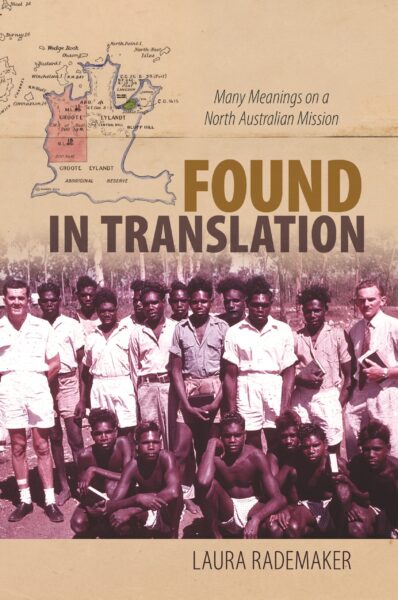 Rademaker uses language as a lens, delving into issues of identity and the competition to name, own, and control. In its efforts to shape the Anindilyakwa people’s beliefs, the Church Missionary Society utilized language both by teaching English and by translating Biblical texts into the native tongue. Yet missionaries relied heavily on Anindilyakwa interpreters, whose varied translation styles and choices resulted in an unforeseen Indigenous impact on how the mission’s messages were received. From Groote Eylandt and the peculiarities of the Australian settler-colonial context, Found in Translation broadens its scope to cast light on themes common throughout Pacific mission history such as assimilation policies, cultural exchanges, and the phenomenon of colonization itself.
This book will appeal to Indigenous studies scholars across the Pacific as well as scholars of Australian history, religion, linguistics, anthropology, and missiology.
Related content
- Grey, A. (2025a). Podcast Episode 63: Australia’s National Indigenous Languages Survey: Alexandra Grey in conversation with Zoe Avery
- Grey, A. (2025b). Making linguistic diversity visible in Parliament
- Jacobsen, B. (2017). Aboriginal languages matter – but to who?
- Kavanagh, B. (2018). Are Aboriginal languages really useless in the workplace?
Transcript
Tazin: Welcome to the Language on the Move podcast, a channel on the New Books Network. My name is Tazin Abdullah, and I’m a PhD candidate in linguistics at Macquarie University in Sydney, Australia.
My guest today is Dr. Dr. Laura Rademaker. Laura is a DECRA research fellow at the School of History at the Australian National University in Canberra. She works in the areas of interdisciplinary histories as well as oral history and memories, with a special interest in ‘cross-culturalising’ history. Her interests include religion, gender, secularisation, and ‘deep history’. She is an editor of History Australia, monographs editor for Aboriginal history Monographs and secretary of the Religious History Association.
On this episode, we will find out about Laura’s work, with a special focus on her 2018 book Found in Translation: Many Meanings on a North Australian Mission. Laura’s work in this book provides a highly engaging exploration of the intersection between English, Christianity, and Australian citizenship. Set against the interactions between Christian missionaries and Indigenous Australians, we learn about the deep intricacies of the relationship between language and place.
I’m very excited about this podcast, and Laura, welcome to the show. Thank you so much for joining us today!
Dr. Laura Rademaker: Thank you so much for having me. It’s a real honour.
Tazin: To begin with, could you tell us a little bit about yourself, your research, and how you came to be interested in historical language contact?
Dr. Laura Rademaker: Sure, so I’m a historian down at ANU, as you said. I’m not an Indigenous person myself. I became interested in, I guess, the interactions that happened at Christian missions in Australia, particularly after I – so, I did an honours thesis way back when in the day. It was soon after the apology to the Stolen Generation, by Prime Minister Kevin Rudd, and I learned from this that. So, I come from a church background. I learned from this that my own church had been part of, had been complicit in the removal of children.
And I did a thesis looking at the white women who, I mean, you could say looked after, you could say, were guardians who were the, you know who I mean. Looking after isn’t the right term, really. Like, these are kidnapped children, but the women who took in these children in a remote mission on Groote Eylandt. But doing that thesis, it was increasingly led to question, how did how did these people from completely different cultural backgrounds – how did they communicate with each other? How did they understand each other? What did they make of each other? You know, had these children from remote communities who didn’t speak English, maybe spoke a little bit of pidgin and later Creole, and these white women coming up from Sydney and Melbourne who only spoke English and had very fixed ideas about what they wanted to impart to these children. I wondered, what did these children make of all of that, and what did the Aboriginal communities who surrounded them, and who were sort of looking on to the mission, what did they make of that?
Also, way back, you know, even longer before this Honours thesis, I was a rotary exchange student, in Denmark.
Tazin: Oh, wow!
Dr. Laura Rademaker: And I learnt to speak Danish when I was there. Well, you know, imperfectly, and my Danish is rubbish today, don’t ask me to speak Danish. But something that I really took out of that experience was the significance for people, especially people who speak a language which is not, you know, not widely spoken. It really mattered to the Danes that I was that I was learning their language, and they were really excited that someone would learn Danish, which they thought was of no use, apart from, to have better relationships with Danish people. And so that’s kind of stuck in my mind, that, the significance of languages for smaller communities.
Tazin: That’s amazing, especially in the context of today, when people learn language from apps The difference between what you described – learning a language while interacting with people, as opposed to learning a language from an app. It’s amazing that that’s what inspired you.
Dr. Laura Rademaker: Yeah, and it’s actually something that came up in the research. I mean, we’ll talk about this later, but I was interested in why some missionaries learned Aboriginal languages and why others didn’t, and the relational dynamic is really what’s important.
I think teaching someone your language is an act of hospitality, is an act of generosity, it’s relational, and you can’t barge into a language community without an invitation or a welcome. Or at least that’s the way I see it. And so having these unique and precious languages as a way for Indigenous people to control who entered their worlds, and to exclude people who are not welcome.
Tazin: Wow! Well, turning to your book, I would like to ask you about a quote from the preface, and I use this because I found it very meaningful, personally, and, you know, I felt like it is the basic philosophical question about translation. So in the preface, you say: “Whether translation – and all the ambiguities that might attend it – was a blessing or a curse is a matter of interpretation.” Could you tell us about this?
Dr. Laura Rademaker: Yeah, I mean, this was really the, you know, my core interest that was driving this. I’m interested in the way that translation you know, of languages, but also more broadly in a sort of a metaphorical sense of cultures. Well, the way it creates something new in the encounter. You can say, you can say all translation is imperfect, but even the label imperfect kind of puts a value judgment on it, that it’s deficient.
But it’s those so-called imperfections, that actually – where there’s something creative in this cross-cultural encounter that can come out, and there can be learning from different peoples. And I think in my research, what I was really interested in exploring was the way that First Nations people were able to take what missionaries brought and create something new on their own terms because of the ambiguities of translation.
Yeah, but we tend I mean, you tend to put those terms like imperfect or unfaithful and things like this that really do have that value judgment, and I wanted to really push back on this.
But in the – sorry, I’m going on.
Tazin: Go on, please. This is very interesting.
Dr. Laura Rademaker: In the context of colonialism and imperialism and these missions which were really trying to form people into being a particular kind of person and a particular kind of Christian, there was the desire to have a so-called perfect translation and convey this unchanging message that would be received in a, you know, in a predictable way. But that’s because of the ambiguities of translation, that wasn’t possible. And that’s happened again and again, not just in Australia.
Tazin: Yes, of course.
Dr. Laura Rademaker: In many contexts.
Tazin: Yeah, and then the way that, I guess, it was received, and whether it was beneficial to the people receiving it, is, as you say, a matter of interpretation.
Dr. Laura Rademaker: Yes, exactly, exactly. And the communities have different, you know, individual members and communities have different views on this as well.
Tazin: Yes, of course, yeah, that’s amazing. You write about the Northern Territory – that’s your research site – as iconic, being Australia’s settler colonial frontier. What is unique about the context that you have written about? And why were language and translation so significant in this context?
Dr. Laura Rademaker: Sure. Look, I, as a kid, my family did a lot of. We did a lot of road trips and camping trips and stuff, and, I travelled to the Northern Territory quite a bit as a child. And I guess for me, it has this nostalgic, you know, it’s still that, you know, I kind of had bought into that almost frontier romantic mindset. This wild landscape that was, you know, somehow represented the true, the real Australia.
I hope that I’ve been able to mature from that and become a bit more critical of the way that those visions actually sort of reinforce a settler colonial, a colonial ideology that the country is naturally belonging to white people, And anyway, this romantic vision of empty space ready to be sort of civilized or tamed or something. Anyway, so that, you know, I came to it with that background.
But, in terms of, as a researcher and as an historian, what’s really exciting is I guess the way for many communities in the Northern Territory, colonization, the beginning of colonization is still such recent history. You know, when I was doing oral histories up on Groote Eylandt. the people I spoke with, it was their parents who had first encountered white people in their country, and they remember as children the missions first being set up. This was the first non-Indigenous community setting up on their country, you know, in the1920s, 30s, 40s. That was a living memory. So it’s really, really recent history, and as an historian, this is, you know. Being able to sit down and talk with people about what that experience was like and, what it meant to their communities is fascinating and sheds light on earlier periods for which we can’t do oral histories. The mission encounter in Australia, the Christian missions, and happens so much later in Australia.
One of the stats that I sort of throw around is, in the 1950s and the 1960s, Aboriginal people in the Northern Territory were the most missionized people in the entire world. There was, I think there was one missionary for every, sort of, five to six Aboriginal people in the Territory. Like, it was crazy.
Tazin: Wow!
Dr. Laura Rademaker: The level of intensity of this, civilizing, Christianising project that was going on up there. So, it was a really intense encounter, as well as a really recent history that then can help us understand, sort of, much more global experiences, that happened in other places.
I mean, I can go on. The other thing about the Northern Territory is so many Aboriginal languages in the Territory are still so strong. They’re spoken by children, they’re, you know, they’re still people’s first languages. And one thing that I think is really helpful for me as a researcher is to have that experience of being the outsider and being unsettled as the English speaker. It reminds me that English is not naturally the language of this country. But I as an English speaker, English doesn’t necessarily belong, and I have to be the learner. I have to sometimes make a fool of myself because I don’t understand, or I’m trying to say something that, you know, is pronounced the wrong way, or means something different.
But that, I think I mean, I hope that comes through in my writing, having that experience, and seeing – unsettling how natural English feels in this place.
Tazin: Yeah, well, I mean, I from what you just said, I guess I’m taking away again how recent the history is, as you said, because sometimes we get this idea that all of these things happened in the past.
Dr. Laura Rademaker: No, no, no.
Tazin: And it’s way back there, but it’s not, and the impacts, as you have written in your book, actually last till today.
Dr. Laura Rademaker: I mean, colonization is still continuing, I would say,. But also, yeah, there’s people, you know, in living memory who can speak about massacres, knowing about massacres and things like that, really not very long ago at all.
Tazin: Much of that knowledge would also be in their languages, in their original, in their native languages. Wow!
I understand that the early missionary ventures in Australia were not very successful. How did the Christian missionaries attempt to engage with Aboriginal communities? What were the, you know, the tensions, the multiple elements that influenced their language use and interactions?
Dr. Laura Rademaker: Yep. Yeah, so this is something I’ve puzzled over for a while, and I’m still, still thinking through trying to understand as an historian.
So, the Christian missions in Australia were quite famously unsuccessful at the time. I’m talking about the early 19th century, and this was often blamed on Aboriginal people themselves, especially as you move through the 19th century, there was the argument that Aboriginal people lacked the cognitive ability to understand Christianity. That they maybe had, didn’t even have souls, that they were not, you know, religious beings, they couldn’t have, they weren’t, you know, their culture was supposedly so backwards. Things like this, you know, really horrifically racist, ideas.
But it is, I mean, when you look to the, you know, to the nearby Pacific at the same time, in the early 19th century, Christianity and demand for translated Bibles was really expanding quite quickly. So what, you know, what could possibly explain this?
One thing, sort of, structurally about Australia is that the Christian missions arrived more or less simultaneously, or just after settler colonisers who were claiming Aboriginal land. And so, the massacres, the displacement, the dispossession of land, the disease, all of this proceeds or is concurrent with missionaries. And I think in that context, I mean, Aboriginal people could see the contradiction, right? And the missionaries were ultimately, as much as many of them were quite critical of the violence and, you know, supported humanitarian causes – they were ultimately allied with the British Empire, which was responsible for all of this that was taking place.
And so to convert to Christianity in that context is a capitulation to this such a, this devastating destruction. At the same time, there was there wasn’t much I mean, in terms of Protestant tradition, translating the Bible is kind of the number one thing you do when you arrive in a new culture because you want the Christian message to be taken up in the culture of the people that you’re trying to convert. And this didn’t, I mean, there were there were small attempts in Australia, but there was no translated Bible until I think it wasn’t a full Bible in an Aboriginal language until 2002, or maybe it was 2005. Anyway, it was in the 2000s – very, very recent.
There were early missionaries who translated segments of scriptures, but there wasn’t, sort of large-scale Bible translation work in Australia. And this, I would say, was due to the belief that Aboriginal people were were destined to extinction. Or that if they were to survive, their future was going to be in English, and they were going to assimilate into white Australia. And so we have these sorts of colonising assumptions about the naturalness of English, the dominance of English, the naturalness of British possession of Australian soil right there from the beginning in these decisions not to translate, and the belief in the universality of English.
Tazin: And do you think the other aspect may have been the multiplicity of Aboriginal languages as well? Because there wasn’t just one language.
Dr. Laura Rademaker: Yes, that’s true, and I should have said that, yes, I mean, there’s many Aboriginal languages are closely related and mutually intelligible, but there’s so many languages.
But I would also say that was used as an excuse. It was there was sort of often the, well, well, there’s this language and that language, which language do we do? But it’s better that everybody just speak English. And so, it sort of cuts both ways.
Tazin: That’s so interesting, and I’ll pick up on that with you a bit later, because, you know, there’s so many parallels with language, in the use of English in Australia even now. But before that, I actually wanted to say that I learned a lot from reading your book. And one of the most interesting things I learned was that the Anindilyakwa speakers had, for centuries, already been engaging in the translation and interpretation of language and culture. So there was language contact between tribes, and with those from other lands, such as the Makassans.
And I was reading, I pictured, you know, people who were multilingual in a society where there already existed a sophisticated exchange between languages. And in this setting came the missionaries with English, a language, as you said, tied to settler colonialism and to citizenship in, you know, in Australia. Would you please tell us about this?
Dr. Laura Rademaker: Yeah, so this is, I mean, again, I’m not a First Nations person. I don’t speak for First Nations people, but this is all across, you know, the top end of the Northern Territory, multilingualism in Indigenous communities is the norm, and has been the norm for centuries for Indigenous communities. Marriage is often exogamous. You marry outside your clan, which is also normally, often, means that you marry outside your language group, and so there’s multilingualism within the family. Your mother and your father and your grandmother and your grandfather might all speak different languages, and this idea that you would be confined to just one language would be completely bizarre and unusual.
And, as you, as you mentioned, the Makassan traders, so they came from Sulawesi, from Indonesia. They’ve been coming for hundreds of years across the top end, and there’s, and they were multilingual as well. Their crews spoke sort of a Malay pidgin, but there was multiple languages on board these ships. And they exchanged with Anindilyakwa people on Groote Eylandt, about Yolngu people, Tiwi people as well, and you can find, like, words.
You probably know this, you can find words from their languages in these Aboriginal languages, and the one that I talk about in my book is Jura, which is common across the Northern Territory, a word that means paper, or book, or writing. Comes from Arabic originally. It has made its way into Aboriginal languages.
So there’s this really intense cross-cultural exchange around the idea of language communication, writing books. So Aboriginal people were aware of this long before the colonisers came, and had traditions of translating and interpreting, had norms about who would speak for whom, people were esteemed as interpreters, and linguistic expertise were recognized and valued. But there’s also sort of an embedded reciprocity and interdependence in when you have this inbuilt multilingualism in your community. When you become dependent on each other in a way that you might not, where you have a monolingual community. People have particular language expertise and are used to translating and interpreting, singing for different countries in ceremony. That would require someone who’s an expert in this or that language, so they can sing the right song for that song line. It all requires, you know, this incredible linguistic expertise, which is seen as a strength.
But for the English speakers, of course, all this is seen as a little bit messy and complicated, and wouldn’t it be much more efficient if everyone just spoke the one language. I think it was hard for the colonisers, for the missionaries, to see that this multilingualism might be a strength rather than an obstacle to overcome. And the Commonwealth’s government introduced a syllabus for Aboriginal schools in the 1950s that was very explicitly about introducing English. And they did say, oh, there’s so many languages, what are we going to do? It’s too hard to learn all the languages. We just need one language, and that language should be English, because this is the language of Australian citizenship.
Now I feel like I’ve rabbited on for quite a bit!
Tazin: Please, please go on. This is very interesting!
Dr. Laura Rademaker: Yeah, yeah, I guess in the work, I wanted to challenge the assumption that those who people who don’t primarily speak English as their first language or primary language were necessarily victims or vulnerable, that this multilingualism was a real strength. And that the assertion that English is, should be a universal language. And that we are stronger by all speaking the same language. Yeah, that’s a cultural assumption, and it’s also an imperial assumption in this context as well.
Tazin: And yeah, and this particular aspect of your work, you know, is particularly interesting for me and our team at Language on the Move, because a lot of our research strongly focuses on the implications for contemporary, multilingual or linguistically diverse communities in places like Australia, where English is, you know, remains a dominant language. English in Australia continues to relate to citizenship. And speakers of other languages, they have different identities assigned to them, depending on the language, often very negative identities, right? And there are high-status languages and low-status languages. There’s all those things, and perhaps we sideline what other languages have to offer. We lose what could be meaningful exchanges.
What can we learn from your work, and what can readers take from this very insightful historical account to inform our research in contemporary Australia?
Dr. Laura Rademaker: Yeah, I guess it’s what you were saying, that, that English doesn’t need to be the only or the dominant language. That there is great strengths and creativity and resources in being a multilingual community. And Australia historically has always been multilingual. You know, this English is not the language that is connected to this land. It’s not the language of the country. It’s the language that we, you know, it’s the dominant language at the moment, but it’s not the language of country. And I wanted to recover that and recapture that.
I also, as I said, I guess I wanted to challenge assumptions that, those who don’t speak English as their primary language are necessarily victims or vulnerable, that language. It can be a tool, it can be a weapon. There’s a way that evading English can be a choice, an assertion, a reclaiming of identity, a form of resistance.
I don’t know, you would have seen in the book, I opened this story about the first missionaries arriving on Groote Eylandt, and they wanted to translate the, the Sunday School song, Jesus Loves Me. And so, they approach the old man at the camp, and this missionary says, you know, “Jesus loves me, this I know” [Laura sings the line] and he wants to know the word for ‘me’. And the way he tells it is that he pointed to his chest and said, you know, me, how do you say me? And the old man gave him the word for chest hair. And so, the missionary started singing in Anindilyakwa, Jesus loves my chest hair.
Now, the missionary, he told this story many times, and he used it in his fundraising as kind of an amusing story about how these poor, ignorant, you know, ignorant First Nations people, supposedly, you know, were so naive or gullible or silly that they didn’t understand what he was getting at, and isn’t it a great story! But the way that I read it, and the way that I think makes sense, having met with the old people of this community, and I brought this interpretation to them and said, oh, yes, this is probably what happened is that the First Nations community, the old people were playing a joke on the missionary.
They used their language to set him up to make a fool of themselves and to assert themselves as the knowledge holders. Anyway, so I guess this is a long roundabout way of saying I want to, yeah, recover the agency of groups that are outside the dominant language community, and show how they’ve shaped Australian history as well, and show how their languages have been a source of strength.
Tazin: Yes, and I did find that story very amusing as well. So glad you began with that story. It was hilarious, and what you know, what a great way to understand what happened in that interaction, the way you described it. Tell us what is next for you and your work. What other research projects are you working on now?
Dr. Laura Rademaker: Sure, well, I’m continuing that work, with the same community up on Groote Eylandt, but also with some other Northern Territory communities on the Tiwi Islands, and Gunbalanya in West Arnhem, and I’m looking at a broader project on First Nations self-determination. But I’m also, I guess I’m really interested in the history of Christianity and Aboriginal land. The ways that religion has been used to deny Aboriginal land and
enable dispossession, but also the way that First Nations people have drawn on their spiritual resources and spiritual claims to make claims to land as well. So I’m very much in the thick of religious thinking at the moment, but, this work on translation is still very much on my mind and informing what I’m doing, the ways that concepts get translated across cultures, and then can be turned back against the dominant culture. I’m really interested in the ways that First Nations people have done that throughout history.
Tazin: And it’s wonderful for us to have this knowledge of history of languages in Australia. So,thank you very much for your work, Laura, and we really look forward to reading more of it.
Dr. Laura Rademaker: Oh, thank you so much. It’s been a pleasure.
Tazin: And thank you for listening, everyone. If you enjoyed the show, please subscribe to our channel, leave a 5-star review on your podcast app of choice, and recommend the Language on the Move podcast and our partner, The New Books Network, to your students, colleagues, and friends. Till next time!
]]>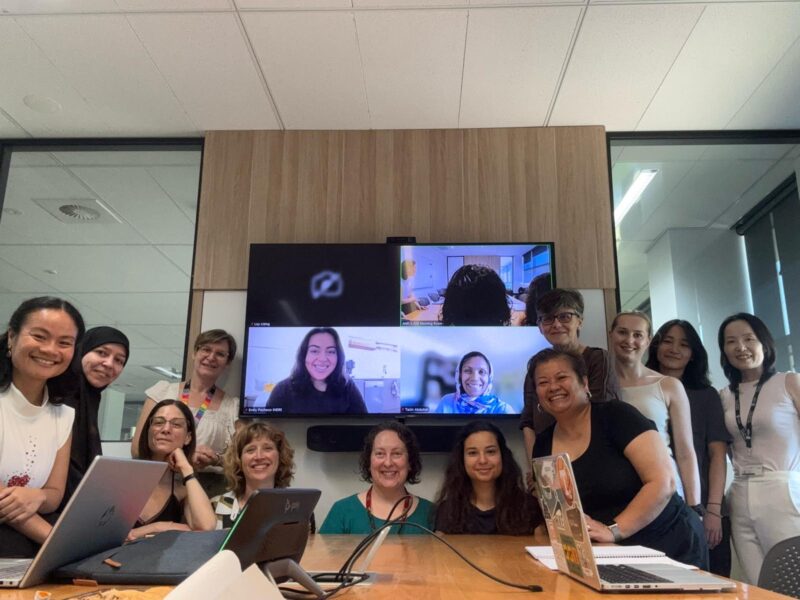
The team behind the Language-on-the-Move Podcast (Image credit: Language on the Move)
Final piece of good news for the year before we head into a publishing break over January: we’ve just heard that the Language-on-the-Move Podcast has won the 2025 Talkley Award 


The Talkley Award is issued by the Australian Linguistic Society (ALS) and “celebrates the best piece or collection of linguistics communication produced in the previous year by current ALS members. The Award acknowledges that the discipline of linguistics needs champions to promote linguistics in the public sphere and explain how linguistic evidence can be used to solve real-life language problems.”
This is a wonderful end-of-year present for our team in recognition of the work and care we’re putting into creating the podcast. Special thanks and congratulations also to our podcast publishing partner, the New Books Network.
After the 2012 Talkley Award went to Ingrid Piller for the Language on the Move website, this is the second time the award goes to our team – an amazing recognition of the long-term impact Language on the Move has had on public communications about linguistic diversity and social justice.
Thank you to all our supporters who nominated us for the award! Special thanks to Dr Yixi (Isabella) Qiu and her students in the Guohao College Future Technology Program at Tongji University. After using the Language-on-the-Move Podcast as a learning resource, they have been among our biggest fans 


To celebrate with us, listen to an episode today! You an find your list of choice below.
As always, please support us by subscribing to the Language on the Move Podcast on your podcast app of choice, leaving a 5-star review, and recommending the Language on the Move Podcast and our partner the New Books Network to your students, colleagues, and friends.
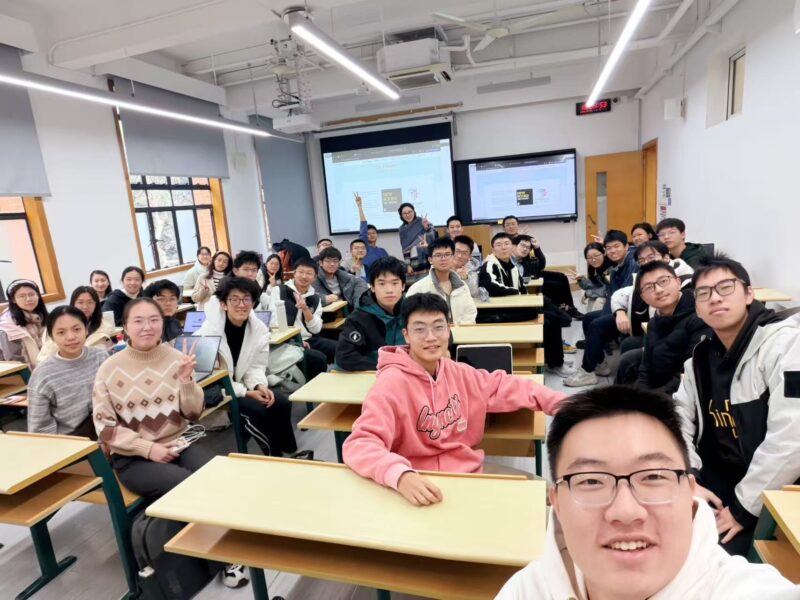
Students of the Guohao College Future Technology Program at Tongji University in Shanghai are among the fans of the Language-on-the-Move Podcast (Image credit: Dr Yixi (Isabella) Qiu)
List of episodes to date
- Episode 64: Your Languages are your superpower! Agnes Bodis in conversation with Cindy Valdez (17/11/2025)
- Episode 63: Australia’s National Indigenous Languages Survey: Alexandra Grey in conversation with Zoe Avery (28/10/2025)
- Episode 62: Migration is about every human challenge you can have: Brynn Quick in conversation with Shaun Tan (17/09/2025)
- Episode 61: Cold Rush: Ingrid Piller in conversation with Sari Pietikainen (09/09/2025)
- Episode 60: Sexual predation and English language teaching: Hanna Torsh in conversation with Vaughan Rapatahana (02/09/2025)
- Episode 59: Intercultural Communication – Now in the 3rd edition: Loy Lising in conversation with Ingrid Piller (26/08/2025)
- Episode 58: Erased voices and unspoken heritage: Alexandra Grey in conversation with Zozan Balci (20/08/2025)
- Episode 57: The Social Impact of Automating Translation: Tazin Abdullah in conversation with Ester Monzó-Nebot (03/08/2025)
- Episode 56: Multilingual practices and monolingual mindsets: Brynn Quick in conversation with Jinhyun Cho (18/07/2025)
- Episode 55: Improving quality of care for patients with limited English: Brynn Quick in conversation with Leah Karliner (26/06/2025)
- Episode 54: Chinese in Qatar: Tazin Abdullah in conversation with Sara Hillman (19/06/2025)
- Episode 53: Accents, complex identities, and politics: Brynn Quick in conversation with Nicole Holliday (12/06/2025)
- Episode 52: Is beach safety signage fit for purpose? Agnes Bodis in conversation with Masaki Shibata (05/06/2025)
- Episode 51: The case for ASL instruction for hearing heritage signers: Emily Pacheco in conversation with Su Kyong Isakson (28/04/2025)
- Episode 50: Researching language and digital communication: Brynn Quick in conversation with Christian Ilbury (22/04/2025)
- Episode 49: Gestures and emblems: Brynn Quick in conversation with Lauren Gawne (14/04/2025)
- Episode 48: Lingua Napoletana and language oppression: Tazin Abdullah in conversation with Massimiliano Canzanella (07/04/2025)
- Episode 47: Teaching international students: Brynn Quick in conversation with Agnes Bodis and Jing Fan (31/03/2025)
- Episode 46: Intercultural competence in the digital age: Brynn Quick in conversation with Amy McHugh (12/03/2025)
- Episode 45: How does multilingual law-making work: Alexandra Grey in conversation with Karen McAuliffe (05/03/2025)
- Episode 44: Educational inequality in Fijian higher education: Hanna Torsh in conversation with Prashneel Goundar (25/02/2025)
- Episode 43: Multilingual crisis communication: Tazin Abdullah in conversation with Li Jia (22/01/2025)
- Episode 42: Politics of language oppression in Tibet: Tazin Abdullah in conversation with Gerald Roche (14/01/2025)
- Episode 41: Why teachers turn to AI: Brynn Quick in conversation with Sue Ollerhead (09/01/2025)
- Episode 40: Language Rights in a Changing China: Brynn Quick in conversation with Alexandra Grey (01/01/2025)
- Episode 39: Whiteness, Accents, and Children’s Media: Brynn Quick in conversation with Laura Smith-Khan (24/12/2024)
- Episode 38: Creaky Voice in Australian English: Brynn Quick in conversation with Hannah White (18/12/2024)
- Episode 37: Supporting multilingual families to engage with schools: Agi Bodis in conversation with Margaret Kettle (20/11/2024)
- Episode 36: Linguistic diversity as a bureaucratic challenge: Ingrid Piller in conversation with Clara Holzinger (17/11/2024)
- Episode 35: Judging refugees: Laura Smith-Khan in conversation with Anthea Vogl (02/11/2024)
- Episode 34: How did Arabic get on that sign? Tazin Abdullah in conversation with Rizwan Ahmad (30/10/2024)
- Episode 33: Migration, constraints and suffering: Ingrid Piller in conversation with Marco Santello (14/10/2024)
- Episode 32: Living together across borders: Hanna Torsh in conversation with Lynnette Arnold (07/10/2024)
- Episode 31: Police first responders interacting with domestic violence victims: Tazin Abdullah in conversation with Kate Steel (29/09/2024)
- Episode 30: Remembering Barbara Horvath: Livia Gerber in conversation with Barbara Horvath (10/09/2024)
- Episode 29: English Language Ideologies in Korea: Brynn Quick in conversation with Jinhyun Cho (08/09/2024)
- Episode 28: Sign Language Brokering: Emily Pacheco in conversation with Jemina Napier (30/07/2024)
- Episode 27: Muslim Literacies in China: Tazin Abdullah in conversation with Ibrar Bhatt (24/07/2024)
- Episode 26: Life in a New Language, Pt 6 – Citizenship: Brynn Quick in conversation with Emily Farrell (17/07/2024)
- Episode 25: Life in a New Language, Pt 5 – Monolingual Mindset: Brynn Quick in conversation with Loy Lising (11/07/2024)
- Episode 24: Language policy at an abortion clinic: Brynn Quick in conversation with Ella van Hest (05/07/2024)
- Episode 23: Life in a New Language, Pt 4 – Parenting: Brynn Quick in conversation with Shiva Motaghi-Tabari (03/07/2024)
- Episode 22: Life in a New Language, Pt 3 – African migrants: Brynn Quick in conversation with Vera Williams Tetteh (27/06/2024)
- Episode 21: Life in a New Language, Pt 2 –Work: Brynn Quick in conversation with Ingrid Piller (19/06/2024)
- Episode 20: Life in a New Language, Pt 1 – Identities: Brynn Quick in conversation with Donna Butorac (12/06/2024)
- Episode 19: Because Internet: Brynn Quick in conversation with Gretchen McCulloch (03/06/2024)
- Episode 18: Between Deaf and hearing cultures: Emily Pacheco in conversation with Jessica Kirkness (01/06/2024)
- Episode 17: The Rise of English: Ingrid Piller in conversation with Rosemary Salomone (21/05/2024)
- Episode 16: Community Languages Schools Transforming Education: Hanna Torsh in conversation with Joe Lo Bianco (07/05/2024)
- Episode 15: Shanghai Multilingualism Alliance: Yixi (Isabella) Qiu in conversation with Yongyan Zheng (02/05/2024)
- Episode 14: Multilingual Commanding Urgency from Garbage to COVID-19: Brynn Quick in conversation with Michael Chestnut (27/04/2024)
- Episode 13: Making sense of “Bad English:” Brynn Quick in conversation with Elizabeth Peterson (13/04/2024)
- Episode 12: History of Modern Linguistics: Ingrid Piller in conversation with James McElvenny (10/04/2024)
- Episode 11: 40 Years of Croatian Studies at Macquarie University: Ingrid Piller in conversation with Jasna Novak Milić (08/04/2024
- Episode 10: Reducing Barriers to Language Assistance in Hospital: Brynn Quick in conversation with Erin Mulpur, Houston Methodist Hospital (26/03/2024)
- Episode 9: Interpreting service provision is good value for money. Ingrid Piller in conversation with Jim Hlavac (19/03/2024)
- Episode 8: What does it mean to govern a multilingual society well? Hanna Torsh in conversation with Alexandra Grey (22/02/2024)
- Episode 7: What can Australian Message Sticks teach us about literacy? Ingrid Piller in conversation with Piers Kelly (21/02/2024; originally published 2020)
- Episode 6: How to teach TESOL ethically in an English-dominant world. Carla Chamberlin and Mak Khan in conversation with Ingrid Piller (20/02/2024; originally published 2020)
- Episode 5: Can we ever unthink linguistic nationalism? Ingrid Piller in conversation with Aneta Pavlenko (19/02/2024; originally published 2021)
- Episode 4: Language makes the place. Ingrid Piller in conversation with Adam Jaworski (18/02/2024; originally published 2022)
- Episode 3: Linguistic diversity in education: Hanna Torsh in conversation with Ingrid Gogolin (17/02/2024; originally published 2023)
- Episode 2: Translanguaging: Loy Lising in conversation with Ofelia García (16/02/2024; originally published 2023)
- Episode 1: Lies we tell ourselves about multilingualism. Ingrid Piller in conversation with Aneta Pavlenko (15/02/2024)
Cindy is passionate about inclusion, helping other educators develop leadership in EAL/D and cater for the academic and wellbeing needs of multilingual learners, including students from refugee backgrounds. She is an author of professional publications, served as President of the Association for Teaching English to Speakers of Other Languages (ATESOL) NSW and is Member of the Board of Directors of Primary English Teaching Association of Australia known as PETAA.
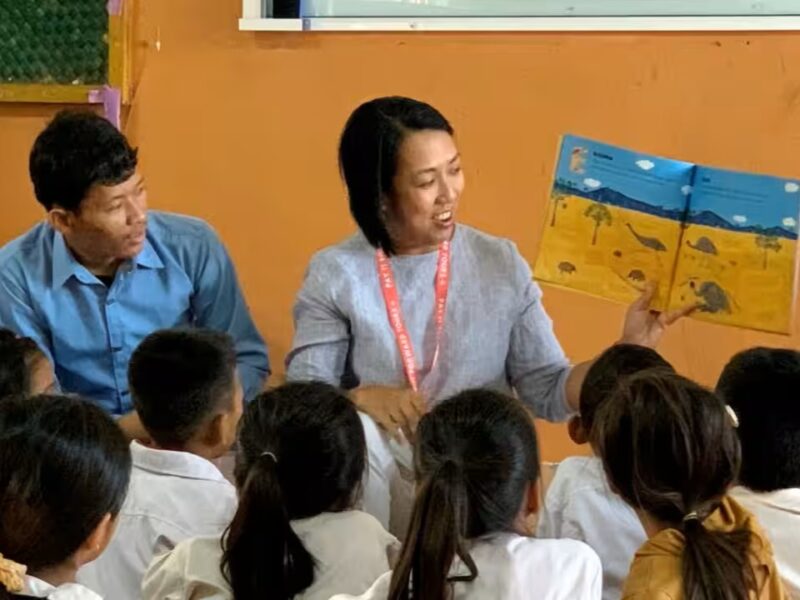
Cindy Valdez teaching in Cambodia (Image credit: Cindy Valdez via SBS)
Additional materials
- “They changed me”: Filipina educator on helping refugee students survive peace, SBS Filipino (2023)
- Valdez Adams, C. (2022) “Including” English as and Additional Language or Dialect (EAL/D) Learners in Your Classroom. Journal of Professional Learning 2
If you liked this episode, support us by subscribing to the Language on the Move Podcast on your podcast app of choice, leaving a 5-star review, and recommending the Language on the Move Podcast and our partner the New Books Network to your students, colleagues, and friends.
Transcript (to follow soon)
]]>NILS4 will be conducted in late 2025 to 2026 and reported upon in 2026.
There’s currently a national target in Australia about strengthening Aboriginal and Torres Strait Islander languages by 2031. This is Target 16 in a policy framework called Closing the Gap. Zoe and I talk about how language strength can be measured in different ways and how the team have chosen to ask about language strength in this survey in ways that show clearly that the questions are informed by the voices in the co-design process.
Then we discuss the parts of the survey which ask about how languages can be better supported, for example in terms of government funding, government infrastructure, access to ‘spaces for languages’ and access to language materials, or through community support. The latest draft of the survey also mentions legislation about languages as a possible form of support. This is great; the data should encourage policy makers not to intuit or impose solutions, but rather to listen to what language authorities are saying they need. What I especially noticed in this part of the survey was the question about racism affecting the strength of a language – or reducing racism as a form of supporting languages – so I ask Zoe to tell me what led the team to include it.
We go on to discuss the enormous efforts and progress underway, and the love which many Aboriginal and Torres Strait Islander communities around Australia have for language maintenance or renewal. People may get the impression that language renewal is all hardship and bad news because a focus on language ‘loss’, ‘death’, or oppression pervades so much of the academic and media commentary. But Zoe and I both recently met in person at a fabulous, Indigenous-led conference in Darwin called PULiiMA in which delegates from 196 Aboriginal or Torres Strait Islander languages participated. That’s just one indication of the enormous effort and progress around Australia, mainly initiated by language communities themselves rather than by governments. We talk about why, in this context, it’s important that this survey also has section about languages ‘flourishing’ and being learnt.
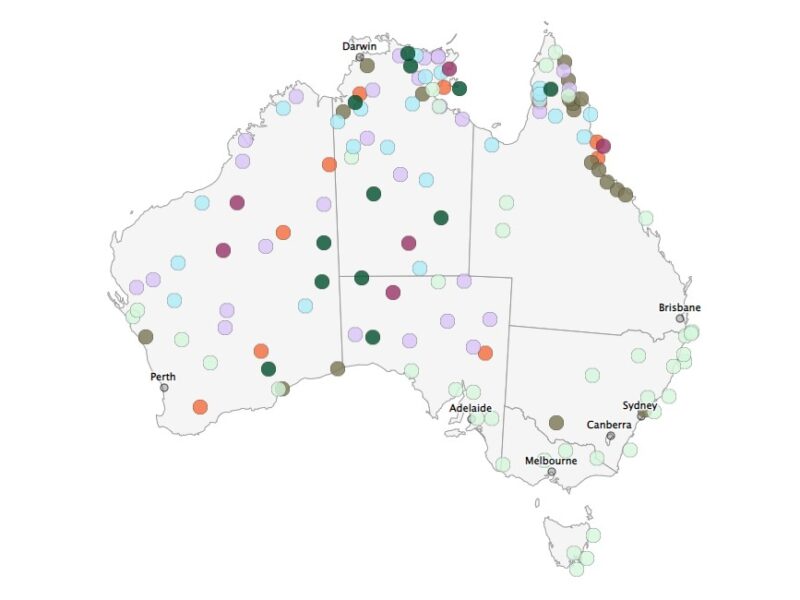
Language groups that participated in NILS3
We discuss the plans for reporting on the survey; incorporating the idea of ‘language ecologies’ was one of the biggest innovations in the National Indigenous Languages Report (2020) about the 3rd NILS and continues to inform NILS4. Finally, we talk about providing Language Respondents and communities access to the data after this survey is completed, in line with data sovereignty principles.
The survey should be available for Language Respondents to complete, on behalf of each language, in late 2025. AIATSIS will facilitate responses online, by phone, on paper and in person. If you would like to nominate a person or organisation to tell us about an Aboriginal or Torres Strait Islander language, please contact the team at [email protected]. Respondents will have the option of talking in greater depth about their language in case studies which AIATSIS will then include as a chapters in the report, as part of responding to calls in the co-design process to enable more access to qualitative data and data in respondents’ own words.
If you liked this episode, support us by subscribing to the Language on the Move Podcast on your podcast app of choice, leaving a 5-star review, and recommending the Language on the Move Podcast and our partner the New Books Network to your students, colleagues, and friends.
Transcript
Alex: Welcome to the Language on the Move Podcast, a channel on the New Books Network.
My name is Alex Grey, and I’m a research fellow and senior lecturer at the University of Technology in Sydney in Australia. This university stands on what has long been unceded land of the Gadi people, so I’ll just acknowledge, in the way that we do often these days in Australia, where we are. Ngyini ngalawa-ngun, mari budjari Gadi-nura-da and I’d really like to thank
Ngarigo woman, Professor Jaky Troy, who, in her professional work as a linguist, is an expert on the Sydney Language, and has helped develop that particular acknowledgement.
My guest today is Zoe Avery, a Worimi woman and a research officer at the Centre for Australian Languages. That centre is part of the Australian Institute for Aboriginal and Torres Strait Islander Studies, which we’ll call AIATSIS. Zoe, welcome to the show!
Zoe: Thank you! I’m really excited to be here and talking about my work that I’m doing at AIATSIS.
Alex: Yeah, so in this work at AIATSIS, you’re one of the people involved in preparing the upcoming National Indigenous Languages Survey. This will be the fourth National Indigenous Languages Survey in Australia. The first one came out now over 20 years ago, in 2005.
This time around, you and your team have made some really important changes to the survey design through the co-design process. Let’s talk about that. Can you tell us, please, what is the National Indigenous Languages Survey, what’s it used for, and how this fourth iteration was co-designed?
Zoe: Yeah, so, the National Indigenous Languages Surveys, or I’ll be calling it NILS throughout the podcast, they’re used to report the status and situation of Indigenous languages in Australia, as you mentioned. This is the fourth one. The first one was done all the way back in 2004 and, the third NILS was done about 6 years ago, in 2019. So it’s been a while, and it’s kind of just to show the progress of how, languages in Australia are being spoken and used, and I suppose the strength of the languages, which we’ll kind of go into a bit more detail. But the data is really important, because it can be used by the government to develop, appropriate language revitalisation programs or understand the areas that require the most support, but it can also be used by communities, which is really important as well.
And so, NILS4 has been a little bit different from the start compared to previous NILS, because the government has asked us to run this survey in order to measure Target 16 of Closing the Gap, which is that by 2031, languages, sorry, by 2031, there is a sustained increase in the number and strength of Aboriginal and Torres Strait Islander languages being spoken.
So, the scope for this project is much bigger than the past NILS, and AIATSIS has really prioritised Indigenous leadership in the design, and will be continuing to prioritise Indigenous voices in the rollout and reporting of the results of the survey.
So, because this is a national-level database, and we want to make sure as many languages as possible are represented, including previously under-recognized and under-reported languages, including sign languages, new languages, dialects. It’s really important that we have Indigenous voices, prioritized throughout this entire research process. And we want to make sure that the questions that are being asked in the survey are questions that the community want answers to, whether or not to advocate, to the government that these are the areas that need the most support, the most funding, or whether or not the community want that data for themselves to help develop, appropriate, culturally safe programs.
So what we did is we had this big co-design process, this year to design the survey. We had 16 co-design workshops with Indigenous language stakeholders across Australia, and this was, these workshops were facilitated by co-design specialists Yamagigu Consulting. We had, in total, about 150 people participate in the co-design process, and of these 150 people, about 107 of these were Indigenous. And so these Indigenous language stakeholders included elders, language centre staff members, teachers, interpreters, sign language users, language workers, government stakeholders, all sorts of different people that have a stake in Indigenous languages, for whatever reason. And we had 8 on-country workshops, which were held in cities around Australia, and 8 online workshops as well, which helps make it easier for, people that kind of came from different places, and weren’t able to come to an in-person workshop.
Alex: That’s a huge… sorry, just congratulations, that sounds like it’s been a huge undertaking. So many people, so many, so many workshops, well done.
Zoe: Yeah, it has been huge, and we’ve had so many different people from a variety of different language contexts, participate as well. So, the diversity of language experiences that were kind of showcased at these workshops was immense and has had a huge impact on drafting the survey, which is obviously the whole point of the workshops, but yeah … We took all the insights from the co-design workshops, we analysed them, thematically coded everything, and started incorporating everything into the survey. And then we went back to the people who participated in the co-design workshops and held these validation workshops so we could show them the draft of the survey, show them how we had planned on incorporating all of their insights, you know, that we weren’t just doing it for the sake of ticking a box to say, yes, we’ve had Indigenous engagement, but we were actually really wanting to have Indigenous input from the start, and right until the end of the project. And we had really good feedback from the validation workshops, and it is, you know, not just a massive task running these workshops, but also, making sure that everybody’s listened to, and sometimes they were kind of contrasting views about how things should be done, and yeah, we wanted to make sure that we had as much of a balance as possible.
We also consulted with the Languages Policy Partnership, which are kind of key workers in Indigenous languages policy and, advocacy. They’re kind of leaders in the Closing the Gap Target 16 that I was just talking about, so their input and advice has been really important to us, as have consultations with the Australian Bureau of Statistics and the Mayi Kuwayu Study of Aboriginal and Torres Strait Islander Wellbeing. So yeah, there’s been a lot of input, and we’re really excited that we’re at the point now where we’re finishing the survey! Dotting all the I’s, crossing all the T’s and getting ready to start rollout soon.
Alex: Yeah, well, I mean, one would hope good input, good output! You know, such a huge process of designing it. You should get really well-targeted, really informative, useful results.
And you’ve mentioned a few things there that I’ll just explain for listeners, because not all our listeners will be familiar with the Australian context. It’s coming through that there’s enormous diversity of Indigenous peoples and languages in Australia, so to explain a little bit, because we won’t go into this in much detail in this interview, Zoe’s mentioned new languages like, contact languages, Aboriginal Englishes, Creoles, like Yumplatok, which comes from the place called the Torres Strait. If you’re not familiar with Australia, that area is between Australia, the Australian mainland, and Papua New Guinea, in the northeast. And then there’s an enormous diversity of what are sometimes called traditional languages across Australia, both on the mainland and the Tiwi Islands as well. So we have a lot of Aboriginal language diversity, and then in addition, Torres Strait Islander languages, and then in addition, new or contact varieties.
Zoe: Sign languages.
Alex: And sign… of course, yes, and sign languages. Thank you, Zoe. And then you’ve mentioned Target 16. So we have in Australia a policy framework called Closing the Gap. For the first time ever, the current Closing the Gap framework includes a target on language strength.
But as the survey goes in to, language strength can be measured in different ways. So how have you chosen to ask about language strength in this survey, and why have you chosen these ways of asking?
Zoe: Yeah, so, along with, kind of, Target 16 of Closing the Gap, there’s an Outcome 16, which is that Aboriginal and Torres Strait Islander cultures and languages are strong, supported, and flourishing. So it’s important for us in the survey to, kind of, address those kind of buzzwords, strong, supported, and flourishing. But it is very clear, from co-design, that the widely used measures of language strength don’t necessarily always apply to Australian Indigenous languages. So these kind of widely used and recognised measures of how many speakers of a language are there, and is the language still being learned by children as a first language? These are not the only ways of measuring language strength, and we really wanted to make sure that we kind of redefined language strength in the survey based off Indigenous worldviews. So, language is independent [interdependent] with things like community, identity, country, ceremony, and self-determination.
How do we incorporate that into the survey? So we’re still going to be asking questions, like, how many speakers of the language are there? What age are the people who are speaking the language, but we’re also going to be asking questions on how many people understand the language, because people may not be able to speak a language due to disability, cultural protocol reasons, or due to revitalisation, for example. But they can still understand the language, and that can still be an indication of language strength. We’re also asking questions about how and where it’s used. So, do people use the language while practicing cultural activities, in ceremony, in storytelling, in writing, just to name a few? We know that Indigenous languages are so strongly entangled with culture and country, and it’s difficult to measure the strength of culture and country. But we can acknowledge the interdependencies of language, culture, and country, and by asking these kinds of questions, we can get some culturally appropriate and community-led ways of defining language strength.
Alex: And that’s just going to be so useful for, then, the raft of policies that one hopes will follow not just the survey, but follow the Target 16, and even once we get to 2031, will continue in the wake of, you know, supporting that revitalisation.
Zoe: Yeah, absolutely, and I think that, another thing that we heard from co-design, but just also from Indigenous people, in research and advocacy, that language is such a huge part of culture and identity, that by, you know, developing these programs and policies to help address, language strength, all the other Closing the Gap targets, like health and justice and education, those outcomes will all be improved as well.
Alex: Yeah, I guess that’s why, in the policy speak, language is part of one of the priority response areas for the Closing the Gap. And I noticed this round of the survey in particular is different from what I’ve seen in the earlier NILS in the way it asks questions, which also appears to reflect the co-design. So, for example, these questions about language strength, they start with the phrase, ‘we heard that’ and then a particular kind of way of thinking about strength. And then another way of thinking about strength might be presented in the next question: ‘We also heard that…’. So on, so on. So, is this so people trust the survey more, or are you conscious of phrasing the survey questions really differently compared to, say, the 2019 version of the survey?
Zoe: Yeah, absolutely we want people to trust the survey, and understand that we respect each individual response. Like, as much as it’s true, we’re a government agency, and we’ve been asked to do this to get data for Closing the Gap, we want language communities to also be able to use this data for their own self-determination, and we want to try and break down these barriers for communities and reduce the burden as much as possible. So, making sure that the survey was phrased in accessible language, and the questions were as consistent as possible.
But yeah, we wanted to make sure that we were implementing insights from co-design, but making it clear in the survey that we didn’t just kind of come up with these questions out of nowhere, that these were co-designed with community and represent the different priorities of different language organisations, workers, and communities across Australia. So, we want the community to know why we’re asking these questions. And also, why they should answer the questions. Because ultimately, that’s why we’re asking the survey questions, because we want people to answer the questions.
Alex: Yeah, yeah, and I think that also comes through in the next part of the survey as well, which is about how languages can be better supported, which again gives a lot of, sort of co-designed ideas of different ways of support that people can then talk to and expand on, so that what comes through in your data, hopefully, is really community-led ideas of what government support or community support would look like, rather than top-down approaches.
So, for example, the survey asks about forms of government funding, reform to government infrastructure, access to what the survey calls ‘spaces for languages’. I really like this idea as a sociolinguist, I really get that. Access to language materials through community support. The survey also mentions legislation about languages as a possible form of support. So this should encourage policymakers not to intuit or impose solutions, but rather to listen to the survey language respondents and what they say they need.
What I especially noticed in this part of the survey was the question about racism affecting the strength of language. Or, if you like, reducing racism as a way of supporting language renewal. I don’t think this question was asked in previous versions of the survey, right? Can you tell us what led your team to include this one?
Zoe: Yeah, so, this idea of a supported language, as I measured… as I explained before, is one of the measures in, Outcome 16 of Closing the Gap, and that we want policymakers to listen to what the language communities want and need in regards of support, because, you know, in Australia, there’s so much language diversity, it’s not a one-size-fits-all approach. Funding was something that all language communities had in common, whether it was language revitalisation they needed funding for, resources and language workers, but also languages that, one could say are in maintenance, so languages considered strong languages, that have a lot of speakers, they also need funding to make sure that their language, isn’t at risk of being lost, and that, it can stay a strong language.
So, there are other kinds of ways that a language can be supported, and if we’re talking about, kind of racism and discrimination as a way that a language isn’t supported. It was important for us to kind of ask that question, because in co-design it was clear that racism and discrimination are still massively impacting language revitalisation and strengthening efforts. The unfortunate reality of the situation of Australian languages, Indigenous languages, is that due to colonisation, Indigenous languages have been actively suppressed.
We want to make sure that respondents of the survey have the opportunity to, kind of, participate in this truth-telling. It is an optional question. We understand it can be somewhat distressing to talk about language loss and the impacts of racism and things like that, but if respondents feel comfortable to answer this question, it does give communities the opportunity to share their stories about how their language has been impacted by racism. So, yeah.
Alex: I really think that’s important, not just to inform future policy, but the act of responding itself, as you say, is a form of truth-telling, and the act of asking, and having an institute that will then combine all those responses and tell other people. That’s an act of what we might call truth-listening, which is really important in confronting the social setting of language use and renewal. This goes back then, I guess, to strength. It’s not just how many people learn a language, or how many children exist who grow up in households speaking a language. There has to be a social world in which that language is not discriminated against, and those people don’t feel discriminated against for wanting to learn that language or wanting to use it.
Now, people may get the impression that language renewal is all hardship and bad news because of a focus on ‘language loss’, in quotes, or language ‘death’, or oppression. This pervades so much of the academic and media commentary. But you and I, Zoe, we met recently in person at a fabulous Indigenous-led conference in Darwin called PULiiMA and there, there were delegates from 196 Aboriginal or Torres Strait Islander languages participating. So, that’s just one indication of the enormous effort and progress in this space around Australia, and mainly progress and effort initiated by language communities themselves, rather than governments.
So in that context, it’s important, I think, that this survey also has a section about languages flourishing, the positive focus. Languages are being learnt and taught and used and revived and loved. Tell us more about the design and purpose of the ‘flourishing’ sections of the survey.
Zoe: Yeah, I just want to say that how awesome PULiiMA was, and to see all the different communities all there, and there was so much language and love and support in the room, and everyone had a story to tell about how their language was flourishing, which was so awesome to hear. A flourishing language in terms of designing a survey and asking questions about, is a language flourishing, is a tricky thing to unpack, because in co-design, we kind of heard that a flourishing language can be put down to two things, and that’s visibility and growth of a language. And so growth of a language is something that you can understand, based off the questions that we’ve already asked, in kind of the strength of a language, how many speakers, is this number more or less compared to last time, the last survey? We’re also asking questions about, ‘has this number grown?’ in case it kind of sits within the same bracket as it did in the last survey.
And visibility is, kind of the other factor, which can be misleading sometimes as well. We’re asking questions about you know, is it being used in place names, public signage, films and media. Just to name a few. But a language that is highly visible in public maybe assumed to be strong, but isn’t strong where it matters, so, being used within families and communities. So, this section is a little bit smaller, because it kind of builds on the questions in previous sections.
It will be interesting to see, kind of, the idea of a flourishing language, and we do have the opportunity for people to kind of expand on their, responses in, kind of, long form answers, so people can explain, in their own words, in detail, if they choose to, kind of, how they see their language as being flourishing,
But, yeah, for a language to be strong and flourishing, it needs to be supported, and that’s something that was very clear in co-design, and people wanting things like language legislation, and funding, and how these things can be used to support the language strength, and to allow it to flourish. So in this section, we also have, kind of, an opportunity for people to give us their top 3 language goals. So whether that’s, they want to increase the number of speakers, or they want to improve community well-being. All sorts of different language goals and the opportunity for people to put their own language goals and the supports needed to achieve those language goals. So, the people who would benefit from the data from this survey, the government, policy makers, communities, they can see what community has actually said are their priorities for their language, and what they believe is the best way to address those language goals. So, encouraging self-determination, within this survey.
Alex: And following on from that point, I have a question in a second about, sort of, how you report the information, and also data sovereignty, how communities have access to, in a self-determined way, use this resource. But I just wanted to ask one more procedural question first. So, you shared a complete draft with me, and we’ve spoken about the redrafting process, so I know the survey’s close to ready, but where are you at the team at AIATIS is up to now – and now, actually, for those listening in the future, is October 2025. Do you have an idea of when it will be released for people to answer, and who will you be asking to answer this survey?
[brief muted interruption]Zoe: Yeah, so we’ve just hit a huge milestone in the research project where we’re in the middle of our ethics application. So, we’ve kind of finished drafting the survey, and it’s getting ready for review from the Ethics Committee at AIATSIS. And hopefully, if all goes well, we’ll be able to start rolling out the survey in November [2025].
So yes, it’s been a long time coming. This survey’s been in the works for many years. I’ve only personally been working on this project for a little under 12 months, but there have been many people before me working towards this milestone.
And the people that we want to be completing this survey are what we’re calling language respondents. So we don’t necessarily want every Indigenous person in Australia to talk about their language, but rather have one response per language by a language respondent who can kind of speak on the whole situation and status of their language, and can answer questions like how many speakers speak the language. So that could be anyone from an elder to a language centre staff member, maybe a teacher or staff member at a bilingual school. We’re not defining language respondent and who can be a language respondent because we understand that that’s different, depending on the language community, and if there are thousands of speakers of a language, or very few speakers of a language. We also understand that there could be multiple people within one language group that are considered language respondents, so we’re not limiting the survey to one response per language, but that’s kind of the underlying goal that we can get as many responses from the different languages in Australia, but at least one per language.
Alex: That makes sense. So, it’s sort of at least one per speaker group, or one per language community.
Zoe: Yeah.
Alex: Yep. Yeah. Yep. And then… so the questions I foreshadowed just before, one is about the reporting. So, I noticed last time around the National Indigenous Languages Report, which came out after the last survey – so the report came out in 2020 – that incorporated this really important idea of language ecologies, and that was one of the biggest innovations of that round of the survey. And that was, I think, directed at presenting the results in a way that better contextualized what support actually looks like on the ground, rather than this very abstracted notion of each language being very distinct and sort of just recorded in government metrics, but [rather] embedding it in a sense of lots of dynamic language practices, from people who use more than one variety.
So do you want to tell us a little bit more about how you’ve understood that language ecologies idea? Because I see that comes up in a question as well, this time around in the survey, and is it in the survey because you’re hoping to use that in the framing of the report as well?
Zoe: Yeah, so the third NILS, which produced the National Indigenous Languages Report in 2020, contributed massively to increasing awareness of language ecologies, and this idea that a language doesn’t exist within a bubble. It has contextual influences, particularly when it comes to multilingualism and other languages that incorporate, are incorporated into the community. So NILS4 aims to build on this work, in collecting interconnected data about what languages are being used. Who are they being used by? In what ways? Where are they being used at schools? At the shops, in the home. Different languages, as you mentioned before, different varieties of English, so that could be Aboriginal English, for example, or Standard Australian English. It could be other Indigenous, traditional Indigenous languages, so some communities are highly multilingual and can speak many different traditional languages. Some communities may use sign languages, whether that’s traditional sign languages or new sign languages, like Black Auslan. And kind of knowing how communities use not only the language that the survey is being responded to about, but also other languages, which will help with things like interpreting and translating services, education services, all sorts of different, things that, by understanding the language ecology better and the environment that the language exists in, yeah —
Alex: That makes sense, and there you’ve mentioned a few things that I didn’t really ask you about, but I’ll just flag they’re there in the survey too, translation and interpreting services, education, government services, and more broadly, workforce participation through a particular Aboriginal or Torres Strait Islander language. That’s important data to collect. But the last sort of pressing question I have for you in this podcast is not about language work but about data sovereignty. This is a really big issue in Australia, not just for this survey, but for all research, by and with Indigenous peoples, and particularly looking at older research that was done without the involvement of Indigenous people, where there’s been problems with who controls and accesses data. So, what happens to the data that AIATSIS collects through this survey?
Zoe: Yeah, so data sovereignty is obviously one of our priorities and communities fundamentally will own the data that they input into the survey. And there will be different ways that, this information will be shared or published, depending on what the respondent consents to. So, part of the survey includes this consent form, where they basically, can decide how their data will be used and shared. And so the kind of three primary ways that the data will be used is: it will be sent to the Productivity Commission for Closing the Gap data, as I mentioned before, we have been funded in order to produce data for Closing the Gap Target 16, and so the data that’s sent to the Productivity Commission will be all de-identified. And this will be all the, kind of, quantitative responses, so nothing that can kind of be identified will be sent to the Productivity Commission. And this kind of data is kind of the baseline of what people are consenting to by participating in the survey. If they don’t consent to this, then, they don’t have to do the survey, their response won’t be recorded.
And then the other kind of two ways that AIATSIS will be reporting on the data is through the NILS4 report that will be published next year [2026], and also this kind of interactive dashboard on our website. So people will be able to kind of look at some of the responses. And communities will have the option on whether this data is identified or de-identified, so some communities may wish to have their responses identifiable, and people will be able to search through and see kind of data that relates to their communities, or communities of interest, or they might choose to kind of remain anonymous and de-identified, and so these are going to be mostly quantitative responses as well.
However, we are interested in, kind of publishing these case studies in the NILS report, which will be opportunities for communities to tell their language journey in their own words. And so this is a co-opt, sorry, an opt-in co-authored chapter in the NILS report, that, yeah, language communities can not just have data, or their responses, but have the context provided, the story of their language and their data. And that was something that was really evident in co-design, that the qualitative data needs to exist alongside the quantitative data, and that’s a huge part of data sovereignty as well, like, how communities want to be able to share their data. So, we’re really excited about this kind of, co-authored case study chapter in the report, because community are excited about it as well. They want to be able to tell their story in, in their own words.
And so, that’s kind of how the data will be used and published, but, there are other ways that the community will be able to kind of access their data that they provide in the survey. So, that’s also really important to us, and we’re following the kind of definitions of Indigenous data sovereignty from the Maiam Nayri Wingara data sovereignty principles. So, making sure that, yeah, community have ownership of their data, and they can have access to it, are able to interpret it, analyse it. And this is kind of being done from the beginning of co-design all the way up to the reporting, and that, yeah, community have control over their data at all points of this process.
Alex: It sounded like just such a thoughtfully managed and thoughtfully designed survey, so thanks again, Zoe, for talking us through it, and all the best for a successful rollout. The next phase should be really interesting for you to actually get people reading and responding, and I’ll be looking out for the survey results when you publish them later in 2026. Is there anything else about the survey that you’d like to tell our listeners?
Zoe: I think that we’ve had a really, productive conversation about our survey. We’re really excited to start rolling it out, and we’re really excited for people to look out for the results as they start to be published and shared next year. So, yeah, if anybody has any questions, or would like more information, I encourage everyone to kind of check out our website and send us an email. But yeah, thank you for having me, and for letting me chat about this project. It’s been a huge part of my life for the past few months, and excited for the rest of the world to get to experience this data, which is hopefully going to have such a big impact on communities having this accurate, reliable, comprehensive national database, that can be used for, yeah, major strides in Indigenous languages in Australia.
Alex: Well, we’ll definitely put the AIATSIS website, which is AIATSIS.gov.au, in the show notes, and then when the particular survey is out for people to respond to, we’ll put that in the notes on the Language on the Move blog that embeds this interview as well. And then people will be able to, as I understand it, respond online to the survey, or over the phone, or in person, and in a written form as well. So, as that information is available, we’ll share that with this interview.
So, for now, thanks so much again, Zoe, for talking me through this survey, and thanks everyone for listening. If you enjoyed the show, please subscribe to our channel, leave a 5-star review on your podcast app of choice, and of course, please recommend the Language on the Move podcast and our partner, The New Books Network, to your students, your colleagues, your friends. Speak to you next time!
Zoe: Thank you.
]]>In the episode, Brynn and Shaun discuss his award-winning 2006 book The Arrival, which is a migrant story told as a series of wordless images. In the book, a man leaves his wife and child in an impoverished town, seeking better prospects in an unknown country on the other side of a vast ocean. He eventually finds himself in a bewildering city of foreign customs, peculiar animals, curious floating objects and indecipherable languages. With nothing more than a suitcase and a handful of currency, the immigrant must find a place to live, food to eat and some kind of gainful employment. He is helped along the way by sympathetic strangers, each carrying their own unspoken history: stories of struggle and survival in a world of incomprehensible violence, upheaval and hope.
 For more Language on the Move resources related to this topic, see Life in a New Language, Discrimination by any other name: Language tests and racist immigration policy in Australia, Intercultural Communication – Now in the third edition, and Judging Refugees.
If you liked this episode, support us by subscribing to the Language on the Move Podcast on your podcast app of choice, leaving a 5-star review, and recommending the Language on the Move Podcast and our partner the New Books Network to your students, colleagues, and friends.
Transcript (coming soon)
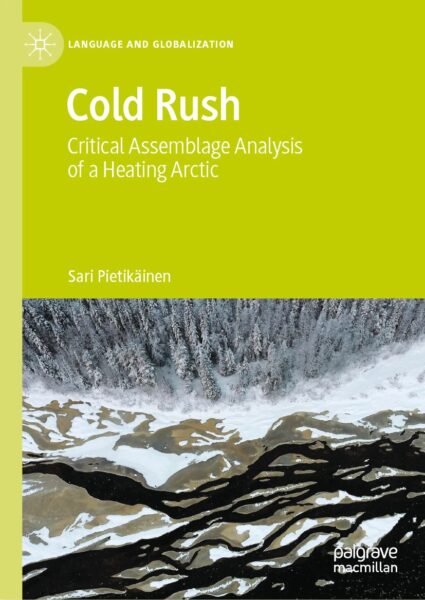
]]>This book is an original study of “Cold Rush,” an accelerated race for the extraction and protection of Arctic natural resources. The Northernmost reach of the planet is caught up in the double developments of two unfinished forces – rapidly progressing climate change and global economic investment – working simultaneously in tension and synergy. Neither process is linear or complete, but both are contradictory and open-ended.
This book traces the multiplicity of Cold Rush in the Finnish Arctic, a high-stakes ecological, economic, and political hotspot. It is a heterogeneous space, understood as indigenous land within local indigenous Sámi people politics, the last frontier from a colonial perspective, and a periphery under the modernist nation-state regime. It is now transforming into an economic hub under global capitalism, intensifying climate change and unforeseen geo-political changes.
Based on six years of ethnography, the book shows how people struggle, strategize, and profit from this ongoing, complex, and multidirectional change.
The author offers a new theoretical approach called critical assemblage analysis, which provides an alternative way of exploring the dynamics between language and society by examining the interaction between material, discursive, and affective dimensions of Cold Rush. The approach builds on previous work at the intersection of critical discourse analysis, critical sociolinguistics, nexus analysis and ethnography, but expands toward works by philosophers Michel Foucault, Gilles Deleuze, and Felix Guattari.
This book will be of interest to researchers on language, discourse, and sociolinguistics interested in engaging with social critique embedded in global capitalism and accelerating climate change; as well as researchers in the social and human sciences and natural sciences, who are increasingly aware of the fact that the theoretical and analytical move beyond the traditional dichotomies like language/society, nature/human and micro/macro is central to understanding today´s complex, intertwined social, political, economic and ecological processes.
 If you enjoy the show, support us by subscribing to the Language on the Move Podcast on your podcast app of choice, leaving a 5-star review, and recommending the Language on the Move Podcast and our partner the New Books Network to your students, colleagues, and friends.
Reference
Pietikäinen, S. (2024). Cold Rush: Critical Assemblage Analysis of a Heating Arctic. Palgrave Macmillan.
Additional resources
Cold Rush project website
“Language and tourism” on Language on the Move
Transcript (coming soon)
]]>In his long career Dr Rapatahana has taught English as a foreign language (EFL) in countries in the Pacific, Southeast, East and West Asia, where he noticed that sexual exploitation was common practice by former colleagues. This prompted him in his retirement to write a book about this difficult and important topic, where he draws on a wide range of sources, from academic papers to media reports, and from blogs to organisations which report on sexual violence against children, to assemble a compelling case for the widespread occurrence of sexual predation in the EFL sector.
The conversation addresses his new book, Sexual Predation and TEFL: The teaching of English as a Foreign Language Enables Sexual Predation (Brill, 2024) which explores how teaching English overseas intersects with and enables widespread sexual exploitation.
Trigger warning: this interview discusses sexual exploitation and related content that listeners/readers may find distressing.
If you liked this episode, support us by subscribing to the Language on the Move Podcast on your podcast app of choice, leaving a 5-star review, and recommending the Language on the Move Podcast and our partner the New Books Network to your students, colleagues, and friends.
 For more Language on the Move resources related to this topic, see The dark side of intercultural communication, Orientalism and tourism, The dark side of TESOL and Child pornography and English language learning.
Transcript
Hanna: Welcome to the Language on the Move podcast, a channel on the New Books Network. My name is Hanna Torsh, and I ‘m a lecturer in Linguistics and Applied Linguistics at Macquarie University. My guest today is Dr. Vaughn Rapatahana, Te Ātiawa. Dr. Rapatahana is an author, poet, and editor who commutes between homes in Hong Kong, the Philippines, and Aotearoa, New Zealand. He is widely published across several genres in both his main languages, te reo Māori and English, and his work has been translated into Bahasa Malaysia, Italian, French, Mandarin, Romanian, and Spanish. He earned a PhD from the University of Auckland, and is a co-editor of two books, one called English Language as Hydra, and the other called Why English? Confronting the Hydra, published by Multilingual Matters in 2012 and 2016.
Today, we are going to talk about his new monograph, which was published in December 2024, entitled, Sexual Predation and TEFL: The teaching of English as a Foreign Language Enables Sexual Predation, published by Brill.
Welcome to the show, Vaughan!
Vaughan Rapatahana: Thank you. Thank you for having me.
Hanna: I’d like to start by asking you to tell our audience a little bit about yourself, and how you got interested in the topic of your book.
Vaughan: I first started teaching English overseas, I put teaching in quotation marks, because I’m not sure if it’s actually teaching which we’ll talk about later, in the Republic of Nauru in 1979, so I’ve been doing that on and off over the years, ever since, until I retired completely from working in 2019 because I ‘m an old man now. But I’ve taught English overseas which I would equate to teaching English as a foreign language in many overseas locales, including the Middle East, Brunei, Jerusalem, Xi’an in China, Hong Kong, Philippines, where have I missed? Probably other places. And of course, in Aotearoa itself, because as you pointed out my first language is te reo Māori, so I’ve taught English as a second language in schools, Kaupapa, where Māori is the first language, so that’s here in Aotearoa, New Zealand. I’ve always been interested in this topic.
Because I have met up with people who are sexual predators during my sojourn overseas. I’ve read lots of news reports, and I guess, like the proverbial rolling stone, the more I read and experience, the more I became interested, and wrote about it, and researched about it, and collated notes, and added to them all the time. It got to the stage I wanted to write a book about it, which I managed to do successfully.
Hanna Torsh: For those who haven’t read the book, one of the things you do at the beginning is you define some of these key terms. So, how do we define sexual predation, and then how do we define TEFL?
Vaughan: I’ve defined them in the book more widely than people probably accept them. Sexual predation, as I’ve noted here, is a control or power-based, exploitative, predatory, abusive form of behaviour, deliberate, often pre-planned. It’s all too often, sadly, by males. whether they be teachers or members of the public in countries where students have gone to learn the subject, or to learn English. It includes all forms of sexual harassment, so I’ve equated harassment and predation together. Doesn’t necessarily have to be physical, can be verbal, can be just the gaze. the sexualized gaze. So that’s sexual predation. And it’s generally male preying on female, whether they’re students, fellow teachers. socio-economically deprived women in countries where male teachers have gone to teach the language. And LGBTQ teachers and students as well are often other victims. So that’s predation. TEFL stands for Teaching English as a Foreign Language.
But it’s not merely teachers, male or female, going overseas, to teach English. or students from countries where English is not a first language going to countries where it is, it’s also not just in schools, it’s in tuition centres, it’s, in aid programs, like Peace Corps, and volunteerism, the whole industry of volunteerism, which are advertised, especially online, where young people especially go overseas. sort of like a white saviour complex to go over and help the poor local indigenous person learn English. They think they need it, they think they need to do it, they think they are the white saviour. It’s in orphanages, orphanages, so there’s a big, huge orphanage tourism aspect. to things like the Peace Corps. Also, what Haley Stanton so cogently has written about recently, TEFL tourism, where people go overseas to teach English, but at the same time have a fun time in places like Thailand, going to the beach partying. dropping drugs, having indiscriminate sex. So, TEFL is much wider than just one person going to another country in a school. It’s huge, in volunteerism, TEFL tourism, orphanage tourism, Peace Corps, teaching English, or trying to teach English, or pretending to teach English, often by totally unqualified people. who only are there because they can speak English, is also TEFL.
Hanna: I think that’s really valuable, that definition, because it reminds us that we’re not just talking about classrooms and teachers and students, we’re talking about a whole industry and all the associated practices, many of which, as you say, take place in spaces that are less formal, that are less regulated, and often are associated with cultural practices that are nothing to do with teaching and learning. And how do you think that the way you’ve examined it is different from the kinds of stereotypes and common beliefs that people might have about this issue?
Vaughan: Because I think, as I’m trying to point out, it’s a much wider issue than dirty old men going overseas, traveling child sex offenders deliberately saying they’re going to teach English so they can go and pray on children. That is many people ‘s perception of sexual predation and TEFL. And it’s a key one, and it’s a very sad, unfortunate one, and it’s statistically not stopping, and there’s so many news reports about such people. The preferential sex offender, but it’s also all the other areas I ‘m talking about, it’s the TEFL tourists going overseas and smoking dope, and going to a brothel, and engaging in underage sex with the local prostitutes. That’s just one example of sexual predation in TEFL.
So, it’s much wider than the dirty old men. It includes, as I said before, often Asian girls, teenagers, young women, going overseas, thinking they need to learn English, and being molested or raped or in severe cases, murdered by males in the local population. It also includes what I call Charisma Man, that’s NET ‘s (native-speaking English teachers) who’ve got this wonderful aura about them because they’re in another country, and they ‘ve suddenly become charisma men, getting accolades from the local populace women and girls they wouldn’t get in their own countries, and taking advantage of it, and sort of boasting about their accolades and their sexual prowess in those new countries. So, these are just some of the things sexual predation and TEFL involve. It’s a much wider, much more complicated, with many aspects to it, and that’s why the book is so thick, well over 400 pages, because there’s so much in it.
Hanna: And unfortunately, we’re only able to talk about a few of those issues today, but I hope that readers do go and engage with the much wider scope that you’ve explored in your very thorough book. One of the things that struck me while reading your book is that this is an important conversation to be having, but this is one of the few publications that I’ve certainly, in my career in applied linguistics and TESOL, ever come across, so it’s a very under-researched context. And the second point is it draws an important connection between the kinds of, exploitation that you’re talking about. and this phenomenon that many of our audience might know, called linguistic imperialism. Could you expand on those two aspects for the audience? So, the first one is, you know, why is this one of the few books I ‘m seeing on this topic? And the second one is, what is this connection between sexual predation and linguistic imperialism?
Vaughan: There’s a blind spot, especially amongst practitioners of the tongue. That’s English as first language speakers and writers and authors and teachers. They don’t want to hear about this sort of aspect, sexual predation, in their industry. They want to go overseas and earn big money and have a good time, or have a stable career, because they’re not all TEFL tourists, of course. Many are stable, middle-class individuals who are having lucrative overseas careers. The last thing they want to hear about is, bad guys in their profession. And the legal aspects, publishers are wary as well, they don’t want to get too involved, especially if names are concerned, or news reports. There’s a certain amount of embarrassment, but mainly I think it’s just pushing it under the table, ignorance, and denial.
As NET myself in some of those countries, or all those countries I mentioned, I often used to write to the South China Morning Post when I lived in Hong Kong, and still return there all the time, saying, why have you got these NET teachers in your country earning such huge money with huge, gratuities and airfares every two years. What are they actually doing? Do the local population really need English? Of course, my answer was always no. Those letters were published in the South China Morning Post, and of course a huge barrage of letters coming in from other native English-speaking teachers who are then saying, of course we’re needed here, and of course the Hong Kong Chinese need to learn English. So, there’s that denial and defiance and sweeping under the table. But I know what I was talking about, because my family is Hong Kong Chinese. They can speak English; their first language is Cantonese. They had no need for native-speaking English teachers in their schools, absolutely no need at such huge expense. So, there’s the first part of the question. That’s why there’s very little written about it. It’s about time there was, and this is the book which I ‘m very proud of, because I think it’s my most important work, and I’ve written well over 50 books. This is my key one.
Hanna: Over 50 books, and this is the most important one. So, there’s a real vested interest there in people not exploring and uncovering these practices?
Vaughan: And the employing countries who think they need to have English to become wonderful countries turn a blind eye as well, because they think they need to have English, so they don’t have good hiring practices. This is a huge generalization. There are so many loopholes. People can get rehired, a traveling child sex offender who ‘s teaching English can go from one country to another, and there’s no overall global mechanism to even know that they’re moving from one country to another. So, the actual employing countries are just as bad as the employer countries. There’re so many loopholes involved. One example about such sinister predators, the preferential sex offenders, they can change their names, get new passports, and travel overseas again and escape the sexual offender registers in their own countries, like the UK, which is still ineffective in that area.
It’s an exploitative industry, summarized by my other two books published by Multilingual Matters, The [English] Hydra, this huge mechanism, earning huge amounts of money for certain vested interests, basically white, middle-class, Western, concerns, the Hydra is spreading linguistic imperialism, native-speaking English teachers, huge testing industry, textbooks, and they’re going to turn a blind eye because of the money. Yes? And then, at the same time, the local people, the local countries, the cultures were not gifted English as a first language and never historically have been them, are being lulled into the sense that they need to have English. It’s pushed onto them. And a white face will always get a job, even if they have no qualifications. So, it’s exploitation, imperialism continuing. Robert Phillipson must take a lot of accolades there, and he was one of my co-authors in the first book, English Language Hydra. I’ve worked together with Robert and the late and lamented Tove Skutnubb-Kangas, his wife, we all worked together on those two early hydra books.
So going back to your second part of your question. I mentioned a term English language sexual imperialism, which, to me, is part and parcel of the hydra, part and parcel of linguistic imperialism. They go together. So, when English language is spread and forced and sold to places that think they need to have English. Sexual imperialism happens at the same time. through some of the channels I’ve already mentioned before, they go hand in hand in hand. I ‘ll read you a quote, if you don’t mind, from Joanne Nagel in 2003, “the history of European colonialism is not only a history of language dominance, it is also a history of sexual dominance.” I agree completely. So, they’re hand in glove via all the different ways I’ve mentioned in this book. So, in my own quote: “When the language is presented in English as a foreign language situation, at least potentially, so are patriarchal, sexist, chauvinist tropes and the correlated behaviours.”
Linguistic imperialism and sexual imperialism go together. And it’s been going on for hundreds of years, from the white man going to Africa and bringing his own sexual tropes there. That’s still going on. The male preoccupation with the exotic Asian female, for example. This is 2025, but nothing ‘s changed.
Hanna Torsh: In your book, you give us concrete examples of the kind of link that you’re talking about between English language teaching and sexual imperialism. In your book, you talk about the ways in which, the career of teaching English overseas is sexualized, even before potential teachers begin teaching. Can you tell our audience what you found that out about that?
Vaughan: It comes from just lots of experience, lots of reading, lots of research, and just the sheer obvious facts. For example, English itself is a sexualized language, just given the components, structures of the tongue itself are sexualized. If you want to read Lewis and Lupyan in 2020, a very good article about that, just how pronouncedly sexist English language as a language is, in terms of its words and the word use. Many TEFL textbooks, even in 2025, are still predominantly sexed or gender biased. That’s even if some of those countries receiving English as a supposed gift, even have textbooks. And if they do, they’re usually old ones, and there might be one shared between 50 students.
The gender bias is apparent and still obvious. Males still continue to dominate in management, and TEFL conferences. Varinder Unlu, came up with the website ELTToo, and about the sexist basis of the English language teaching industry, the EFL, TEFL conferences and management structures. And she got repudiated and reprimanded by too many males for doing so, which goes back to that vested interest, not wanting to know and hiding it away.
English is taught in a sexualized fashion. For example, as in Spanish TV, a woman strips as she’s teaching English. Bizarre, but true. And it’s advertised, especially tuition centres, for example, in Japan, some of the advertisements are so blatantly sexualized and sexist. Dozens of examples are shown in the book. Another key point is the sex tourism. There’s a huge global trend, and it’s not just English teachers going overseas to partake in sex tourism, but the fact that so many people from Western countries and local countries might go to Southeast Asia for sex tourism encourages the teaching of English to cater for those tourists. The “sex pats”, another term, who just goes overseas to partake in sexualized adventures with the young, people who have no money, who are in the sex trade, because they have to be to survive, people like that. And the statistics shown by concerns that are trying to combat sexual predation in TEFL, like ECPAT and APLE Cambodia. There’re so many examples that they publish on their website and in their reports, shows the problem isn’t going away, it’s probably escalating. Despite the best efforts of places like EPAC and Apple to do something about it, and the poor efforts by local governments and countries sending the offenders overseas.
Hanna Torsh: And can you just, for the audience, explain what those acronyms are?
Vaughan: Good question. ECPAT is not just one organization, it’s an overall name for organizations that fight child exploitation, and protecting children being exploited. And APLE Cambodia is a specific example that works under EPAC, but it’s its own separate body in Cambodia, fighting child exploitation and protecting children over there. Many cases are of English-speaking teachers, tutors, or people going over and opening orphanages, or pretending to do aid out in rural communities, but actually are there as sexual predators, preying on youth. Often some of them are so cheeky as to marry a local say, Cambodian woman, and then exploit the woman ‘s children. So that’s APLE, Preda in the Philippines is another organization doing the same thing, preventing child exploitation, including by white men going there and running sex rings, paedophile rings, which is all in the book.
Hanna Torsh: Yeah, great, thank you. We are running out of time, Vaughan, and it’s such a big topic, but I ‘d like to end by asking, you’ve talked about the issue being bigger than the kinds of extreme, horrific crimes you’ve just talked about, that it’s actually permeating the whole industry, and that there’s this close relationship between English language teaching and sexual predation. What would you like our audience to go away with, in terms of the key message of your book, bearing in mind that a lot of our audience are emerging and established researchers in Applied Linguistics and TESOL.
Vaughan: Be aware of the problem, be far more aware. Report any incidents of sexual predation, even if they seem minor. If you think a student’s being harassed by a male teacher, or you think of fellow female teachers being harassed by a male teacher, or by local members of the community, report it. Get your own professional bodies to be far more proactive. They’re not proactive in fighting this massive problem across the board, all the different types of behaviours of sexual predation and TEFL, and it’s all its various guises. Close loopholes globally, not so easy, but let ‘s get, say, UK government to say, how come sex offenders who are on the sexual offenders list can still go overseas and teach by changing their names through a passport? And be caught years later in another country altogether. And these are all documented cases.
And my final key point has always been, do we really need to teach English in other countries beyond first language countries? And my point is, no, no, no, no, no, no, no, we don’t need English even to be taught. There’s no clear requirement for EFL in many places anyway. You can circumvent the hydra by just doing away with it. People can develop their own languages, because as Tove Skutnabb-Kangas said many, many years ago, linguicism comes in when linguistic imperialism comes in, and linguicism is the loss of your own Indigenous tongue, because English is taking over. We don’t need the hydra.
Hanna: You also make the point in your book that local teachers are often underpaid and undervalued relative to, imported teachers. And I thought that was a powerful message too, and linked to the idea of decolonizing, English language.
Vaughan: And it rankles with them. I was earning much more money than most of my fellow teachers in Hong Kong, and I wasn’t working the hours that they were putting into, or were expected to put in, and they weren’t getting the big, huge gratuities. Total exploitation. Totally unnecessary, but as I keep on saying, there’s a vested interest going on there, and they aren’t going to shut up. They want the money. Although in the last two years, finally, maybe they went back and read my letters to the South China Morning Post. the Hong Kong government now has now de-escalated the financial benefits for the NET scheme there and has now thrown open the budget that was formerly there for nets to be hired by schools, to the schools themselves to hire NETs, but at a lower rate. Why? Because fiscally, Hong Kong can ‘t afford what they were spending before, billions and billions of Hong Kong dollars on net teachers. So, ironically, socioeconomically, the net scheme is becoming disempowered because Hong Kong can ‘t afford to pay anymore.
Hanna Torsh: Wow. A good outcome for local teachers, potentially, and for schools, if they’re getting more of that funding. So that’s perhaps a nice place to finish up. Look, thank you so much, Vaughan, for this important work. It certainly got me thinking about my own teaching career as an English language teacher, and the various associations that I ‘m part of, and how particularly how this issue of sexual predation intersects with a lot of the work we talk about on LOM on native speakerism and now this new emerging, body of work on decolonizing English. So, lots of important food for thought. Thanks again. Do you have any final comments you would like to make before we say goodbye?
Vaughan: Tēnā koe. Thank you very much for the opportunity. I guess I ‘m going to have to say, find the book and read it, because it’s new, and it’s important. And it’s not been expressed sufficiently, or powerfully before. It’s telling things that people don’t want to hear, quite frankly.
Hanna Torsh: I couldn’t agree more. And if you’re like me working at a university, request that your library order Vaughan ‘s important book.
So, thanks again, Vaughan, and thanks everyone for listening. If you enjoyed the show, please subscribe to our channel, leave a 5-star review on your podcast app of choice, and recommend the Language on the Move podcast and our partner, The New Books Network, to your students, colleagues, and friends.
Till next time.
]]>A comprehensive and critical overview of the field of intercultural communication
- Key concepts and discussions illuminated with international case studies of intercultural communication in real life
- Includes learning objectives, key points, exercises and suggestions for further reading in each chapter
- A new chapter devoted to intercultural crisis communication; expanded coverage of language in migration; and new studies and examples of virtual, online and computer-mediated communication throughout.
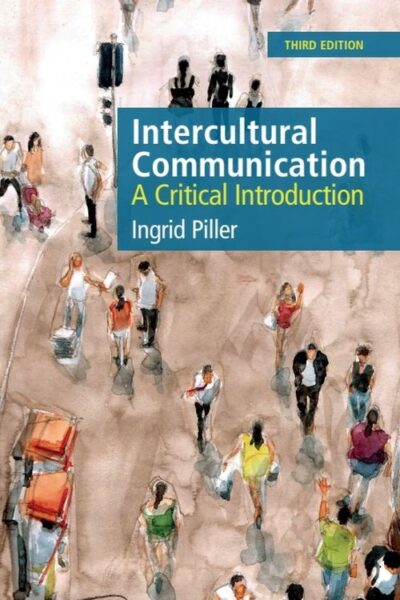
Combining perspectives from discourse analysis and sociolinguistics, the third edition of this popular textbook provides students with an up-to-date overview of the field of intercultural communication. Ingrid Piller explains communication in context using two main approaches. The first treats cultural identity, difference and similarity as discursive constructions. The second, informed by multilingualism studies, highlights the use and prestige of different languages and language varieties as well as the varying access that speakers have to them.
If you liked this episode, support us by subscribing to the Language on the Move Podcast on your podcast app of choice, leaving a 5-star review, and recommending the Language on the Move Podcast and our partner the New Books Network to your students, colleagues, and friends.
Get 30% off if you order now
Order through the Edinburgh University Press website and enter discount code NEW30 to get 30% off.
Transcript (coming soon)
]]>The conversation focuses on a study of adults with three languages ‘at play’ in their childhoods and lives today, exploring how visible racial differences from the mainstream, social power, emotions, and familial relationships continue to shape their use – or erasure – of their linguistic heritage.
Zozan’s book opens with a funny and touching account of how her own experiences as a person of “ambiguous ethnicity” shaped this research. We begin our interview on this topic. Zozan points out that the last Australian Census showed that 48.2% of the population has one or both parents born overseas. Yet, she argues, “our teachers and our education system are unprepared, perpetuating the power relations that reinforce injustice and inequality towards half of the population”.
Then we focus on what diversity feels like to her research participants and how “mixedness” or “hybridity” is not normalised, despite being common. We build on a point Zozan makes in her book, that throughout their daily lives the participants “have to position themselves because our [social and institutional] understanding of identity is narrow-mindedly focused on a single affiliation. […] While all participants are engaged in such strategic positioning, my findings emphasise that this can come at a great personal expense, something which is not sufficiently recognised by scholarly work in this field thus far.”
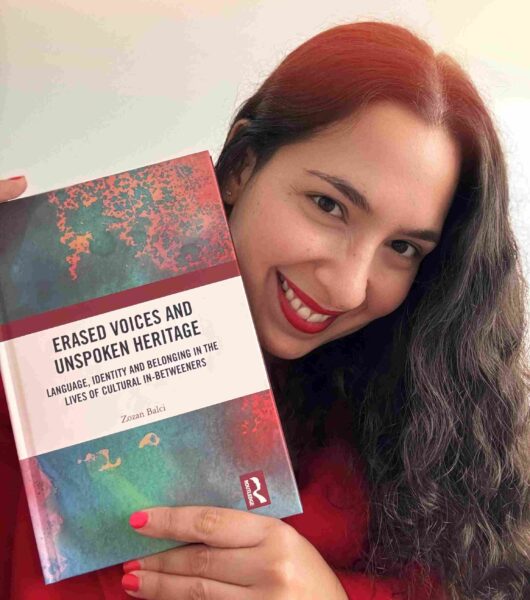
Dr Zozan Balci with her new book (Image credit: Zozan Balci)
We then delve into the emotions experienced and remembered by participants in relation to certain language practices in both childhood and more recent years, and the way these shape their habits of language choice and self-silencing. While negative emotional experiences have impacted on heritage language transmission and use, Zozan’s study shows how people who had distanced themselves from their heritage language – and its speakers – then changed: “it only [took] one loving person […] to reintroduce my participants to a long-lost interest in their heritage language”. We focus on this “message of hope” and then on another cause of hope, being the engaged results Zozan’s achieved when she redesigned a university classroom activity to un-teach a deficit mentality about heritage languages and identities.
Finally, we discuss Zozan and her team’s current “Say Our Name” project. This practically-oriented extension of Zozan’s research addresses one specific aspect of linguistic heritage and identity formation: the alienation experienced by people whose names are considered ‘tricky’ or ‘foreign’ in Anglo-centric contexts. The project has created practical guides now used by universities and corporations and the City of Sydney recently hosted a public premiere of the Say Our Names documentary. Soon, Zozan will be developing an iteration of the project with the University of Liverpool in the UK.
Follow Zozan Balci on LinkedIn. She’s also available for guest talks and happy to discuss via LinkedIn.
If you liked this episode, support us by subscribing to the Language on the Move Podcast on your podcast app of choice, leaving a 5-star review, and recommending the Language on the Move Podcast and our partner the New Books Network to your students, colleagues, and friends.
Transcript
ALEX: Welcome to the Language on the Move podcast, a channel on the New Books Network. I’m Alex Grey, and I’m a research fellow and senior lecturer at the University of Technology Sydney in Australia. My guest today is Dr. Zozan Balci, a colleague of mine at UTS. Zozan is an award-winning academic, a sociolinguist, and a social justice advocate. Zozan, welcome to the show.
ZOZAN: Hello, thank you for having me.
ALEX: A pleasure! Now, Zozan, you teach in the Social and Political Science program here at UTS, and I know you have a lot of teaching experience, but today we’ll focus on your sociolinguistics research. In particular, let’s talk about your new book. How exciting! It’s called Erased Voices and Unspoken Heritage: Language, identity, and belonging in the lives of cultural in-betweeners. You’ve just published it with Routledge.
The first chapter is called A Day in the Life of the Ethnically Ambiguous, and you begin by talking about your own, as you put it, “ambiguous ethnicity”. So let’s start there. Tell us about how your own life shaped this research, and then who participated in the study that you designed.
ZOZAN: Yeah, thank you so much, and yes, “ethnically ambiguous” is kind of like the joke that I always introduce myself with. So, I was born and raised in Germany to immigrant parents, so although I’m German, I look Mediterranean. And so people mistake me from being from all sorts of places. I’ve been mistaken for pretty much everything but German at this point. So, you know, I personally grew up, in my house, we spoke 3 languages, so we spoke German, Italian, and Turkish, which is essentially how my family is made up. And, you know, this has kind of resulted in a bit of a… I’m gonna call it a lifelong identity crisis, because, you know, that’s a lot of cultures in one home.
And it also has played out in language quite interestingly, and I just kind of wanted to see with my study if others struggle with the same sort of thing, other people who are in this kind of environment, and I found that they do. And so in the book. I tell the stories of four people, all who have two ancestries in addition to the country they are born in, so there’s three languages at least at play. And all are visible minorities, so they… they don’t look like the mainstream culture in their… in the country where they were born. And all struggle having so many different cultures and languages to navigate. And, you know, it’s quite interesting, in some of the cases, the parents are from vastly different parts of the world, so the kid actually looks nothing like one of their parents.
So, one example is my participant, Claire. She has a Japanese mother and a Ugandan father, and so she speaks of the struggle of looking nothing like a Japanese person, so in her words, all people ever see is that she’s black.
And so there is some really heartbreaking stories about, you know, how challenging that is, growing up in Australia when you look nothing like your mum, and…You know, it’s also hard to assert your Japanese heritage when people look at you and don’t accept that you are half Japanese, even though she strongly identifies with it, for example. So, there are a couple of participants like that.
One of my participants, Kai, is probably the one I personally relate to the most. His mother is Greek, and his father is Swedish, and he looks very Mediterranean like me. So, he talks a lot about, you know, the guilt towards his heritage community, also internalized racism, and that is something I could probably personally very much relate to. So these are the kinds of stories that are in this book.
ALEX: They’re wonderful stories because you frame them in such a clear way that connects them to research and connects them to bigger ideas than just the personal experience of each participant, but it becomes very moving. These participants clearly have a great rapport with you. When Claire talks about speaking Japanese and the impact being a visible minority and visibly not Japanese, it seems, to other people, has on her. That’s incredibly touching, but also the effect that has on her mum, and her mum’s desire to pass on heritage language to Claire.
But the opening few pages are also, I have to say, really funny and interesting. They drew me in, I wanted to keep reading. So I’ll just add that in there to encourage listeners to go out and seek more of your voice after this podcast by reading the book.
Now, in this book, your intention, in your own words, is to explain what diversity feels like, and to normalize mixedness. And you point out that this is really important, pressing, in a place like Australia, but many places where our listeners will be around the world are similar. In Australia, about half the population are what we might call second-generation migrants, with at least one parent born overseas. And so you go on to say, this book aims to have a genuine conversation about what diversity and inclusion look like.
So, tell us more about what hybridity is. This is a concept you use for the, if you like, the sort of
embodied personal diversity of people, and what it feels like for your participants, and whether hybrid identities are recognised and included.
ZOZAN: Yeah, you know, it’s actually quite interesting, because when people hear that you’re culturally quite mixed, they kind of misunderstand what it’s like. So, you know, your mind doesn’t work in nationalities or languages, right? So in the case of my study, where three cultures or languages, are at play, you know, those… these participants don’t consider that they have three identities. Like, that is not how a mind works.
So rather, you are a person who has mixed it all up. So you don’t just think in one language, unless you have to. Like, for example, right now, I’m speaking to you in English, because I have to, but, you know, when I’m just chopping my vegetables and thinking about my day, I don’t think in only English. It’s a mix, in a single sentence, I would mix. If I speak to someone who can understand another language that I speak, I would probably mix those two. Like, it’s just… but I don’t do this, like, oh, let me mix two languages. Like, I’m not consciously doing that. And the same goes for behaviours or practices.
So, the way I kind of, you know, an analogy that I think you can use here, maybe to make it easier to understand, is if you think of, you know, say you have your 3 cultures, and there are 3 liquids, and so you pour them all in a cup and make a cocktail, right? So you mix them all up. And…
ZOZAN: you know, it’s… It’s very hard, then, to tell the individual flavour of this new cocktail now, right? It’s all mixed. But, you know, that’s not something that people understand. They want… they want the three liquids, the original liquids, what is in there? And often, you know, they will tell you that you probably ruined the drink by mixing them.
Laughter
ALEX: We laugh, but your participants have really experienced words to that effect, sure.
ZOZAN: Absolutely, and so, you know, you are often forced into a position, so you are forced to pretend you’re a different drink, because it’s very hard to, you know, separate the liquids once they have been mixed, right? And, you know, now I’m also Australian, so a dash of a new liquid has been mixed into it, you know, making the whole drink more refreshing, I think.
But, you know, unfortunately, most people still have very rigid ideas about identity, including our parents, right? So my parents cannot relate to my experience at all. They are not mixed. My teachers didn’t get it at school, right? Only people like me get it. But it’s important that we all kind of start thinking a little bit about what we’re asking people to do, because, you know.
when I went to school, for example, I could only be German, so I had to leave my other languages and my behaviours at home, because, you know, of assimilation, right? You need to assimilate to everybody else.
And then in my house with my parents, you need to leave the German outside, so it’s considered disrespectful if I say I’m German, right? So my parents would hate to hear this podcast, for example. Because to them, it’s like renouncing your heritage, right? So it’s about… you need to preserve what we have given you. And so you are kind of this person who’s like, well…
I don’t see it the way… I’m not three things. This is all me, and it’s actually people trying to over-analyse what kind of nationality this behaviour is, or this language is. In your head, you’re not actually doing that. You’re just one person who is a cocktail.
ALEX: That makes a lot of sense when you explain it, but in the findings, it becomes really clear that that’s actually very hard for people to assert as an identity. As you say, with parents, with teachers, with the public at large. You call it strategic positioning, the way people have to downplay, or almost ignore, or not show their language, or not show their other aspects of their… their different heritages, and that that can come at great personal expense.
And you point out that, in fact, while a lot of the research literature may celebrate this mixedness or this hybridity, the fact that it comes at personal expense and is difficult is not really acknowledged very much.
Now in this work you’re also drawing on some really foundational theories of language and power. So it’s not just about feeling bad or feeling excluded. The way people are able to mix their heritage languages and other aspects of their heritage, and the way they’re not able to comes within a power play and that draws really on the work of Pierre Bourdieu. I won’t delve really deeply into his theory of habitus, but I’ll quote this explanation of yours, which I loved: “the habitus can be understood as a linguistic coping mechanism, which is very much shaped by the structures around us. We develop language habits, whether within the same language or in multiple languages, which secure our best position or future in a particular market.”
And then really innovatively, you link the formation of these habits to our emotional experiences, drawing on the work of another theorist, Margaret Wetherall. Please talk us through how these theories help explain the way your participants pretended, as children, not to speak their heritage languages. This is just one aspect of how these emotions have influenced their… their behaviours, but I think many of our listeners will have done the same thing as children themselves, or relate now to knowing children who do this.
ZOZAN: Yeah, absolutely, and I think, you know, you almost need to go back to basics. Like, we use language to communicate, and we communicate to connect with others. You know, it’s a social need, it’s a human need to connect, to belong to a group, because we are social animals. So that’s actually the purpose of language, right?
But we also associate language with a cultural group. So, if the cultural group is well-regarded, so is their language, and vice versa. So, for example, here in Australia, obviously, English is highly regarded. And Arabic is not, for example, right? So this is a direct link to how we perceive the people of these cultures, right? So we’re comparing the dominant mainstream Anglo-Saxon cultural group versus Arabic in an era of really strong Islamophobia, right? So language is both this tool for communication, and it’s also this… this… this symbol of… of power, really. And so if the way you try to connect, so the… whichever language, you use, but also how you present yourself, if that results in a negative experience in disconnect, in fact, or feelings of rejection or inclusion, we will absolutely try and avoid doing that again. So we will try to connect… we will always try to connect in a way that is more successful to achieve inclusion and connection, right? So this is kind of like the theory simplified.
And obviously, you feel these experiences in your body, right? You feel shame, or you feel rejection, you feel loneliness, whatever it may be. And equally, on the bright side, you can feel happiness, you can feel, you know, togetherness, whatever it is, inclusion. So, this is kind of the emotional aspect, right? You feel… because this is a human feeling, the connection and disconnect. So, I think that sometimes we take that a bit out of our study of language. And I think we just need to bring that back a little bit, because it actually explained…explains then, how this plays out with language, so language being a key aspect.
You know, if you are told off for speaking a certain language in a certain context, or you’re being made fun of for speaking it, or something bad happens to you when you speak it, maybe you’re singled out, because you can speak something that others can’t. You will resent that language, and you won’t want to speak it again, and you will habitually almost censor yourself from speaking it, because you don’t want to feel like that again, right? So that’s kind of… and you don’t necessarily consciously do that. This is very important. I don’t mean that, like, you know, a 5-year-old is able to notice that about themselves. But typically, the rejecting a language, by and large, happens the first time a child leaves the home, in the sense of going to kindergarten or preschool, or somewhere that is not within the immediate family, where there’s almost, like, you’re being introduced to the mainstream culture in some systemic way, and you are meeting the mainstream culture there as well. So, you are with children, especially if you have an immigrant background, or your parents do, you’re meeting lots of children who don’t. And so this is your first becoming aware of being different, and so, of course, if you look differently already, that’s… that’s difficult. But then also, if you speak differently, that makes it extra difficult.
And so, you know, one of the examples, from the book that I think was just, it actually, when he did say it in the interview, I did tear up, so I want to share this one. And so this was, Kai, so just as a refresher, he is half Greek, half Swedish, and he grew up here in Australia. And so, at the time that he grew up there was still a lot of, sort of, discrimination, towards Greek people. That has probably tempered down a little bit since, but at the time, it was very acute still, where he grew up. And so, in a school assembly, he must have been in primary school, so fairly young, in front of the entire school, he was asked, singled out, and say, “hey, Kai, you… you speak Greek, right? How do you say hello in Greek?”
And he said, “I don’t know”.
And so when I had this interview, we paused for a second, and I said, “but you knew. You knew how to say hello in Greek”. And he’s like, “yes, I knew”. And I said, “well, why… why do you think you said you didn’t know?” And he said, “well, because they didn’t know, so if I don’t know, then I can be like them”.
And I think that is very heartbreaking, right? Because, especially here in Australia, there’s this idea that, you know, if you speak another language, if you are multilingual, that is almost un-Australian. You’re supposed to be this monolingual English speaker, right? That’s the norm, that’s the mainstream. So if you divert from that, that’s different, but especially if you speak a language where the cultural group is not well regarded, right? That positions you as, firstly, different, but also lower.
ZOZAN: Right? And so we can understand, again, he probably didn’t realize, as a 7-year-old, or whenever this was, what he was doing, consciously, but you can see this pattern, right? That’s why I’m saying it’s more a feeling than it is rational thought. The way your language practices develop is based on how your body feels in response to you using, like, language.
ALEX: And the fact that it’s such an embodied feeling comes out in your participants, who are now in their 20s and 30s, remembering in detail a number of these instances from way back in their childhood. I mean, the example of Kai jumped out at me too, the school assembly, because in the context, it might have seemed to the teachers that they were trying to celebrate his difference, to sort of reward him for knowing extra languages, but that’s not how it came across to him, because he’d already started experiencing the negative disconnection that that language caused.
Now that’s one example of negative feelings, but your study shows quite a number of how people in your study developed very negative feelings and distanced themselves from their heritage languages, partly consciously, partly unconsciously, or perhaps as children, consciously, but not knowing what a drastic impact it would have in the future on their ability to ever pick that language up again.
But then you say, this changed, and this is in adulthood usually, changed through relationships with people who they love and admire: “It only took one loving person to reintroduce my participants to a long-lost interest in the heritage language. I believe this is a message of hope.”
Well, I believe you, Zozan, when you say that’s a message of hope, so tell us more about that hope.
ZOZAN: Yeah, I mean, and again, it’s about connection, right? So, this is really at the forefront of everything. So, you know, if there is a person that you can connect with, that will somehow encourage you to rediscover what you have lost, then it’s actually… it can be reversed. It doesn’t mean that, you know, now you’re completely like, “yay, let me start speaking my language again”, or whatever. It’s not necessarily that, but, you know, it tempers down some of that self-hatred that you perhaps have, that guilt, whatever it is, so that you can actually deal with this illusion.
ZOZAN: a little bit more rationally. And, you know, a lot of participants, also, kind of talked about how they’re psyching themselves up to actually visit the country where their parent is from, because slowly, they can, you know, get to that place where they are able to do that, where that… where, you know, the realization that actually there’s nothing wrong with my heritage, it’s just I have been socialized to think that, because the people I have been trying to connect with couldn’t connect with me on that.
And so in the book, there’s a couple of such examples. So in the example of Claire, she, she met a friend at school who also is Black, and has sort of introduced her to this world that she didn’t know, whether it’s, you know, beauty tips for actually women like her, which of course she said was a struggle with a Japanese mother who didn’t know what to do with her hair, and all of those things, so little things like that, but also just, you know, embracing some of these things that… that she couldn’t actually seem to, sort of grasp in her home or in school. We have Kai, whose grandmother, so he loves his grandmother, she hardly raised him, and she developed dementia, and she forgot how to speak English as a result, so she could only speak Greek, so she kind of remembered only that. And so he was like, “well, I want to speak to my grandma”. So now I have to actually up the Greek, because otherwise I cannot communicate with her, and that would be a huge shame”. So you know, that connection is much stronger than everything else. Like, “I want to stay connected to grandma”. In another instance, you know, we had, father and daughter having a bit of a difficult relationship, as is so common in our teenage years, you know, we struggle. But so her dad then taught her how to drive, and they spend all these long hours, driving together, and he, in fact, is a taxi driver, so he showed her all the, you know, the tricks and the, you know, the shortcuts. And, you know, all this time, almost forced time spent together, kind of reconnected them, and, you know, now she’s much more open to, “hey, can you… can you tell me how I… how I can say this in Hungarian?” Or, you know, feeling excited about maybe visiting Hungary, for example.
So these are the kinds of stories, and so this is really important, because connection can just undo some of that traumatic stuff that happens earlier. And you’re quite right, it typically happens as an adult. It’s almost when you kind of have fully formed, and you can look at it a bit more rationally, and actually realize, you know, all of these experiences, it’s not because something’s wrong with me, but rather there’s a lack of understanding, or there are prejudices around me. That doesn’t make it, you know, they are wrong, and I’m okay, kind of feeling, yeah.
ALEX: Yeah, yeah.
ALEX: And you point out that it’s really, at least in your study, really clear that it’s this relationship, or a change in a relationship, that comes first, and then prompts that return to the heritage language, or that renewed passion for spending some time speaking it, or learning it.
And there had been debate in the literature as to whether it’s, you know, that you learn the language first and that enables connections, and you say, well, at least in your study, it seems to be the other way around, so maybe we really need to think of building those relationships first to enable people to want to, or to feel comfortable embracing that heritage language.
I guess, to that end, to try and help people come to that position of, you know, “it’s not me who’s wrong, there’s this world of prejudices or exclusions that are a problem”, you give the wonderful example of you yourself changing your classroom behaviours in the university subjects you teach to try and unteach the idea that heritage languages and identities are deficits. And when you tried it, this wasn’t your study, but it’s, you know, something you were doing because your own study encouraged you to go in this direction, you got such engaged student participation as a result. Can you please tell our listeners about that?
ZOZAN: Yeah, absolutely, and so this was based on an experience I had in my schooling. So I, as I mentioned, I went to school in Germany, and it is very common in Germany still to study Latin as a foreign language throughout high school, and so I was one of those poor people who had to do that.
ALEX: So was I, and you can imagine it was not as… not as common here in Australia.
ZOZAN: I, I… oh, God. It was tough, …But obviously, I speak Italian, so to me, often it was much easier to write my notes in Italian, because it’s almost the same word, right?
ZOZAN: So it just helps me learn that easier. So just in my notebook by myself, I used to write, you know, the Latin word and then the Italian word next to it, because, you know, it obviously makes it easier. Now, my teacher then came around and looked at my notes and said, “well, you have to do this in German”, and I’m like, “well, these are just my personal notes, I can do whatever I want”. And he’s like, “no, that’s an unfair advantage, you have to do it in German’, right? So I’m like, okay, great, so it’s an… it’s a problem at all other times, and all of a sudden, it’s an unfair advantage, so I just… I was not allowed to use my language, even though that was the better way to teach me, right? Like, I mean, that was my individual need as a student, that would have helped me.
So, I know that, obviously, you know, I teach in Sydney, it’s a very diverse student cohort, we have people from all over the place, we have international students, we have students whose first language isn’t English. And I know that many of them, especially if they grew up here and they’ve had this background, this, you know, their parents from elsewhere, they might have had similar experiences to me, whether it’s, you know, either being shamed in some shape or form, or actively forbidden, right?
And so I thought, okay, let me try and see what we can do with that. And so in my class, I then kind of started off with, does anyone here speak or understand another language? And I think it’s very important to say, speak or understand, because that firstly opens up this idea that, oh, okay, maybe the language that I silenced myself in. Typically you can still very much understand it, so I can barely say anything in Turkish, but I understand it quite well. And so, that’s not because I’m not linguistically gifted, it’s because of what I’ve done with it, right? And so, they will then raise their hand, and you can kind of… “what language is that?” And, you know, interestingly, obviously, you will find you speak 10, 15 languages in a classroom of 30 people, because it’s typically quite diverse.
So then we looked at, in this particular example, we looked at a political issue that was, happening at the time. I actually don’t remember what it was now. But I said to them….
ALEX: Hong Kong. I think it was….
ZOZAN: The Hong Kong protests, maybe? This is a while ago. But you could do this with anything. Like, I mean, let’s say I want to do this on the, war in Ukraine, for example. You know, what is the reporting around that? So, importantly because the lesson was around political bias in news reporting, that’s why it’s important for this particular activity to pick a political issue, but you could pick something, obviously, much less confronting, if you want.
So I asked them to look at news reporting about this issue from the last week or so, and I said, if you can speak or read another language, or even listen to, say, a news report on video, have a look at what, around the world, the reporting on the same issue, how are different countries reporting on it, right? So we actually used these other languages. And it was so interesting, because obviously, once you have, you know, some people looking at, you know, obviously news from Australia, but then others news from around Europe, from around South America, from around Asia, you can absolutely see that the news reporting is different. The angles are different, what is being said, who is being biased, is different, right?
And so here we then, you know, this discussion was much richer than had I just said, okay, read news in English, or just from Australia, where, you know, we’re just gonna hear the same perspective. And so I’ve been trying as much as possible to always do that and allow my students to, you know, if you want to read a journal article for your paper from another from an author that didn’t write in English, please do, if that is helpful. You know what I mean? So, these are the kinds of things I try to bring into my classroom to kind of show them, “hey, this is an asset. You speaking another language is great. It opens another door to another culture, to another way of thinking and viewing the world. It’s not a bad thing. You should use it whenever you can.” And it has worked really well.
ALEX: Oh, I love it, and I love that it doesn’t put pressure on those people to then be perfect in their non-English language or languages either. The way you describe it in the book, the more people spoke, the more other students said, “oh, actually, I do understand a bit of this language”, or “oh yeah, I didn’t mention it before, but I also have these linguistic resources”, and everyone just feels more and more comfortable to bring everything to the table.
ALEX: The next question, I don’t know if we’ll edit it out or not, just depending on the time, but it does flow quite nicely from what you’ve just been discussing, so I’ll ask it, and you can answer it, and we’ll record it.
ALEX: So, Zozan, another way you’ve built on this project, which was originally your thesis, and then you’ve written in this wonderfully engaging book. You’ve then gone on since then to do a different related project that’s ended up with a documentary and a lot of practical applications. And I think listeners would love to hear about it. It’s a project called Say Our Names. You’re leading a team of researchers from various disciplines in this project, and it’s about challenging quote-unquote “tricky” or “foreign” names in Anglophone contexts. You’ve created some really practical guides for colleagues, which I’ve seen, and even directed a mini-documentary that showcases the lived experiences behind these names. It premiered a few months ago here in Sydney in collaboration with the City of Sydney Council. Can you tell us about this project in a nutshell, and what the public responses have been like now that your research is out there beyond the university?
ZOZAN: I know, the Say Our Names is a bit like the beast that cannot be contained for some reason, it’s really, blown up, but I think what made it so successful is because it is such an easy entryway into cultural competence, very much to, you know, speaking to the kinds of themes that are in the book. So as you know, my name, people find hard to pronounce. It really isn’t, but it is immediately foreign in most, in most places that I would go to. And I actually… my name is mispronounced so often that sometimes I don’t even know how to pronounce it correctly anymore. Like, I have to call my mum, reset my ear: “How do I say this again?”
And, you know, there’s obviously lots of people in Australia, around the world, who have this very same issue, right? So you have your name mispronounced, you have it not pronounced, because people are so scared to say it, it looks so wild to them, they just call you “you”, or just don’t refer to you at all. Or perhaps, they anglicize it, or they shorten it, and you know, it seems like a harmless thing to do, but actually, it’s sort of like, you know, it scratches the surface of a much bigger issue, right? So you have, again, this dominant culture, and so here in Australia, obviously, the English-speaking Anglo-Saxon culture with everybody else, right? And so English names we are totally fine with, but as soon as something is not English or not, you know, common European, it becomes a tricky thing, and it’s hard to say. And so you internalize that, as the person whose name that is, you internalize, my name is hard to say, my name is foreign.
And your name is the first thing you say to someone, right? You meet a new person, you say, “hi, my name is Zozan”. And… I mean…
ZOZAN: 90% of the time, either people will mispronounce it, or they will ask me more about it.
ZOZAN: And I tell this story, not in the documentary, but when I introduce the documentary. I tell the story about how I actually, a couple of years ago, this is quite, timely, I had podcast training, how to speak about my research in, for podcasts. The first task that we had to do in this training was explain our work, like, what kind of research are you, what is your research?
And I found… I got really stuck with that, like, I couldn’t put in writing what I do. And I’m a very chatty person, I normally have no trouble talking and, talking about myself, but for some reason, that seemed like an impossible task. I couldn’t… I had no idea how to say it. And I realized the reason why I don’t know how to say it is because I never, in a situation where people speak about their work, I never get past my name. People don’t want to hear about my name, sorry, my work, because they want to hear about my name.
So, you know, I say, hi, I’m Zozan at a networking event. And, “oh, what kind of name is it? Oh, where are you from? Oh, you know, what are your parents? Where are your parents from?” And you don’t actually get a chance to do what you came to do, which is, I would like to speak about my work, because I’d like an opportunity.
And so we realized this is quite important, and yes, of course, it’s adjacent to all of this work from the book. It’s, it’s, you know, your name is a lexical item as part of language, right? So we realized the need to… maybe this is an easy entry point to connect people. If we just show the importance of trying to get someone’s name right, how to ask, how to deal with your own discomfort of not knowing how to pronounce it and asking how to… to take off a little bit of the burden of the other person who’s continuously uncomfortable anyway, right?
And so, yeah, we, we, again, storytelling is my thing, so we, we had some focus groups, obviously where we could do a bit more, you know, what is your story, what is your experience, and also how would you like to be approached, right? This is very important. We don’t want to assume that, as researchers, you know, obviously I have my own ways and thoughts. But it was important, so we asked, and created this best practice guide that really came from community: “This is how people would like to be approached. This is what you can do”.
And then we also created this, little documentary. It’s… it’s really, really beautiful, I think, if I have to say so myself. But obviously it just shows the stories, it shows stories of what it… what the name means, because it is obviously part of your cultural heritage, how people have felt resentful towards their names, and ashamed of their names, in exactly the same way as people do with language in my book. So there were a lot of parallels.
And also what it means when people try to get it right, when there’s actually a person making an effort, because again, it’s about connection. Here’s someone who wants to connect with me, and who’s making the effort. So, of course, now I also want to make the effort, right? So it’s almost like this beautiful…
ZOZAN: Like, thank you for trying, and yes, I want to be your friend, let me help you. …
And so, yeah, and it went beyond UTS, it went citywide. I am… we have been receiving requests around Australia to come and screen it and hold a little panel. We’ve had panel discussions with people who are experts in this field. But also, I think what is important that we now brought in as well is Indigenous voices, because obviously there’s an erasure there of names and language that we also need to talk about in the Australian context. So, we’re doing a lot around that, and yeah, it’s been… it’s been the most practical application, I think, of my research so far.
ALEX: When I heard a panel talking about it, something I took away is just to be encouraged, you know, if you’re the person who’s asking, “how do you say your name?” You don’t have to get it right the first time, you don’t have to have just listened to it, and then you can immediately repeat it, because maybe it is an unusual name for you. You just have to be genuinely making an effort to learn, and to show that you want to connect, and that you want to get it right, and you want to ask the person how they want to be known. And that, I think, is just so important for people to keep in mind. It’s not a standard of immediate perfection, it’s a standard of attempting to genuinely respect and connect with people.
Before we wrap up, can you tell us what’s next for us, Zozan, and can we follow your work online, or even in person?
ZOZAN: Well, …
ZOZAN: Obviously, the book is available, you can buy it as an e-book, or obviously, if you’re really into hardback, you can do that too. Say Our Names is spreading far and wide. I’m taking it to Europe, at the end of the year. It will be, used in classrooms in the UK. I will be screening it at a conference in Paris, so there’s actually quite a bit of… because it’s obviously really relevant all around the world, right? We are more globalized, so very happy to do more screenings and introductions and panels. Obviously, a book tour is in the works … let’s see how we go with that, but, certainly around Sydney, and then perhaps also overseas. So I’m trying to spread the word, and, you know, I’m the kind of person who actually just wants to make an impact. I want to, you know, obviously it’s wonderful to do this research and dive into the literature and all of that, but, you know, I think I am quite proud of having translated it into something that is, you know, we have now in corporate offices our best practice guide on language and on names, and people are trying. And so, you know, I think that is the most rewarding thing, and that’s really something I want to keep working on.
ALEX: Thank you, and we’ll make sure we put your social media handles in the show notes. So thank you again, Zozan, and thanks for listening, everyone. If you enjoyed the show, please subscribe to our channel, leave a 5-star review on your podcast app of choice, and of course, recommend the Language on the Move podcast if you can, and our partner, The New Books Network, recommend to your students, your colleagues, your friends. Until next time!
]]>The conversation delves into ideological issues involved in the widespread use of machine translation and the real-life impact for those who may rely on machine translations in various situations. Esther’s research and the wide variety of contributions to the book highlight the need to open a discussion about instilling an ‘ethics of care’ perspective into the use of technology to make AI generated translations more inclusive and relevant for the communities using them.
 If you liked this episode, support us by subscribing to the Language on the Move Podcast on your podcast app of choice, leaving a 5-star review, and recommending the Language on the Move Podcast and our partner the New Books Network to your students, colleagues, and friends.
Transcript (coming soon)
]]>
In this episode, Brynn and Dr. Cho discuss Dr. Cho’s new book, Multilingual Practices and Monolingual Mindsets: Critical Sociolinguistic Perspectives on Health Care Interpreting. With a novel approach, which sees interpreting as social activities infused with power, Dr. Cho’s research and this book have captured the dynamics of cultural, linguistic, and ethnic power relations in diverse sociolinguistic contexts.
 For more Language on the Move resources related to this topic, see Reducing Barriers to Language Assistance in Hospital, Life in a New Language, Linguistic Inclusion in Public Health Communications, and Interpreting service provision is good value for money.
If you liked this episode, be sure to say hello to Brynn and Language on the Move on Bluesky! Support us by subscribing to the Language on the Move Podcast on your podcast app of choice, leaving a 5-star review, and recommending the Language on the Move Podcast and our partner the New Books Network to your students, colleagues, and friends.
]]>In this episode, Brynn and Leah discuss a 2024 paper that Leah co-authored entitled “Language Access Systems Improvement initiative: impact on professional interpreter utilisation, a natural experiment”. The paper details a study that investigated two ways of improving the quality of clinical care for limited English proficiency (LEP) patients in English-dominant healthcare contexts, by:
- Certifying bilingual clinicians to use their non-English language skills directly with patients; and
- Simultaneously increasing easy access to professional interpreters by instituting on-demand remote video interpretation.
Brynn and Leah talk about the results of this study and what they mean for improved communication with LEP patients in healthcare.
If you liked this episode, be sure to say hello to Brynn and Language on the Move on Bluesky! Also support us by subscribing to the Language on the Move Podcast on your podcast app of choice, leaving a 5-star review, and recommending the Language on the Move Podcast and our partner the New Books Network to your students, colleagues, and friends.

The Multiethnic Health Equity Research Center is based at UCSF (Image credit: UCSF)
References
A discussion about the terms “limited English proficiency” (LEP) and “non-English language preference” (NELP) in healthcare, which is also laid out nicely in Ortega et al.’s (2021) Rethinking the Term “Limited English Proficiency” to Improve Language-Appropriate Healthcare for All
Leung et al.’s (2025) paper entitled Partial language concordance in primary care communication: What is lost, what is gained, and how to optimize
And for more Language on the Move resources about the intersection between language and healthcare:
- Reducing Barriers to Language Assistance in Hospital
- Language policy at an abortion clinic
- Mismatched public health communication costs lives in Pakistan
- Why it’s important to use Indigenous languages in health communication
- Linguistic diversity in a time of crisis: Language challenges of the COVID-19 pandemic
Transcript (coming soon)
]]>In this episode of the Language on the Move Podcast, Tazin Abdullah speaks with Dr. Sara Hillman, Associate Professor of Applied Linguistics and English at the College of Humanities and Social Sciences at Hamad Bin Khalifa University about Qatar’s multilingual ecology and its linguistic landscape. The focus is on the emergence of Chinese in Qatar amidst the interaction of multiple languages.
The conversation delves into the socio-political background that contextualizes the visibility of Chinese in Qatari public spaces and education. Sara explains the impact of diplomatic relations and economic interactions that impact cultural exchange and accompanying language use. She also tells us about the use of other languages in intercultural communication.
If you enjoy the show, support us by subscribing to the Language on the Move Podcast on your podcast app of choice, leaving a 5-star review, and recommending the Language on the Move Podcast and our partner the New Books Network to your students, colleagues, and friends.
Reference

Panda (Image credit: J. Patrick Fischer, Wikipedia)
Hillman, S., & Zhao, J. (2025). ‘Panda diplomacy’ and the subtle rise of a Chinese language ecology in Qatar. Journal of Multilingual and Multicultural Development, 46(1), 45-65.
Transcript (coming soon)
]]>Some references made in this episode include:
- Representative Jasmine Crockett’s use of AAL
- “Dude gotta go”
- Dr. Arthur K. Spears’ “camouflaged features” of AAL
- Dr. Holliday’s fabulous TikTok account
- “You can always tell”
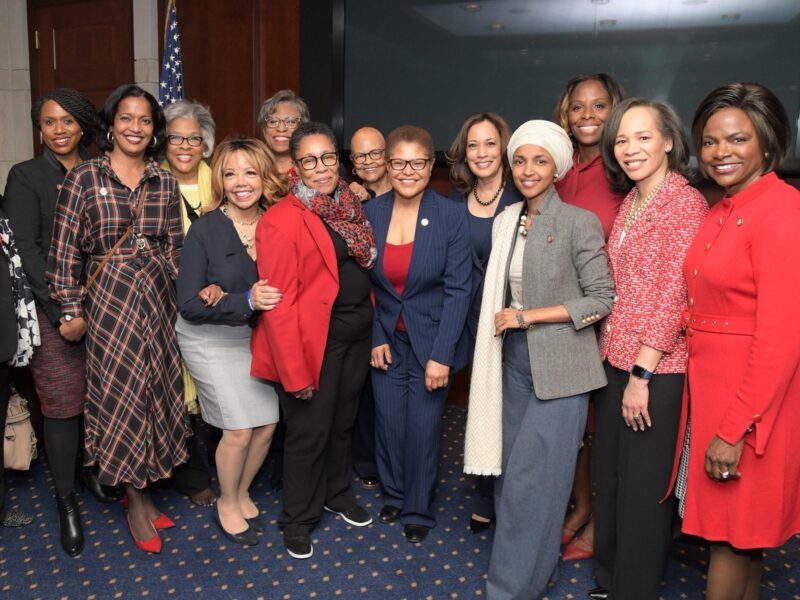
Kamala Harris with women of the Congressional Black Caucus, 2019 (Image credit: United States Senate, Office of Senator Kamala Harris, Wikipedia)
And for more Language on the Move resources about language and social identity:
- In search of language and an identity
- Whiteness, Accents and Children’s Media
- Life in a New Language, Part 1: Identities
- Between Deaf and hearing cultures
- Making Sense of “Bad English”
If you liked this episode, be sure to say hello to Brynn and Language on the Move on Bluesky! You can also support us by subscribing to the Language on the Move Podcast on your podcast app of choice, leaving a 5-star review, and recommending the Language on the Move Podcast and our partner the New Books Network to your students, colleagues, and friends.
Transcript (coming soon)
]]>In this episode of the Language on the Move Podcast, Dr Agnes Bodis talks to Dr Masaki Shibata from Monash University in Melbourne, Australia. Dr Shibata researches beach signs in Australia and how they are understood by beachgoers and what consequences this has for beach safety.
If you enjoy the show, support us by subscribing to the Language on the Move Podcast on your podcast app of choice, leaving a 5-star review, and recommending the Language on the Move Podcast and our partner the New Books Network to your students, colleagues, and friends.

Surf Rescue Australia (Image credit: Australian Government, Study Australia)
References
Shibata, M. Peden, A., Watanabe, H., Lawes, J..(2024) “Do red and yellow flags indicate a danger zone?”: Exploring Japanese university students’ beach safety behaviour and their perceptions of Australian beach safety signage. Safety Science. DOI: https://doi.org/10.1016/j.ssci.2024.106606
Shibata, M. Peden, A., Lawes, J., Wong, T., Brander, R.(2023) “What is a shore dump?: Exploring Australian university students’ beach safety knowledge and their perceptions of Australian beach safety signage”. Safety Science. DOI: https://doi.org/10.1016/j.ssci.2023.106366
Transcript (coming soon)
]]>If you enjoy the show, support us by subscribing to the Language on the Move Podcast on your podcast app of choice, leaving a 5-star review, and recommending the Language on the Move Podcast and our partner the New Books Network to your students, colleagues, and friends.

Two men and a woman signing (Image credit: David Fulmer via Wikipedia)
Transcript:
Emily: Welcome to the Language on the Move Podcast, a channel on the New Books Network. My name is Emily Pacheco and I’m a PhD candidate in Linguistics at Macquarie University in Sydney, Australia.
My guest today is Associate Professor Su Kyong Isakson. Su Kyong teaches Interpreter Education at the Community College of Baltimore County in Maryland, in the U.S. She is also a co-founder of The Coda Network and a professional interpreter. Her work includes mentoring, coaching, and focusing on the teaching methods of heritage signers.
Today we are going to talk in general about interpreter education, and in particular about a 2018 paper that Su Kyong wrote entitled The Case for Heritage ASL Instruction for Hearing Heritage Signers. Just a note for the audience, ASL stands for American Sign Language.
Su Kyong, welcome to the show, and thank you so much for joining us today.
Su Kyong: Thank you for having me here. I’m excited to talk about this body of work.
Emily: Yeah, absolutely. And just to start us off, can you tell us a bit about yourself and how you became an interpreter educator?
Su Kyong: Sure, funny story, I went to grad school because I was mad. So, nothing like having a passion to get you to do something.
(Emily and Su Kyong laugh)
And so, really what had happened was our national certifying body and professional organization had taken a vote on whether deaf interpreted parents or deaf-parented interpreters should have a dedicated seat on the board, the governing board of this national body, and the membership voted on it, and in fact, they voted on it twice.
They voted it down. (laughs)
Emily: Wow…
Su Kyong: And so, it was at a time in my life when I was taking some professional development courses around interpreting and like, you know, getting better in my own practice. And for the first time had a cohort of other Codas, you know, children of deaf adults, who were also interpreters, that I was doing this work with and like really digging into the interpreting work with, and to then have this motion like fail by the majority of people who are in our organization just really spoke to me about the fact that people do not appreciate and under appreciate what we bring to the field.
So, I got mad, and I went back to grad school (laughs) and decided that I was going to change the field, from within the classroom, one student at a time.
Emily: Yeah, absolutely. Yeah. That’s an awesome origin story, you know, if you watch any Marvel or something, (Emily and Su Kyong laugh) that’s a wonderful origin story, how you became an interpreter educator.
And just to get us kind of shifted into your work and what you did your grad studies on, could you tell our audience what it means to be a heritage language learner in general and what differentiated instruction is?
Su Kyong: Yeah, sure. So, a heritage language learner is somebody who has a heritage language, and so I think, maybe your audience may not know what heritage language stands for, but it’s basically a minority language used within the home that is different than the majority language of the place that you’re living in and so it typically doesn’t have a lot of supports to maintain that language and so a heritage language learner would be somebody who has a heritage language, but then later decides to learn that language in a formal setting.
So, I myself, my heritage language is Korean sign language and Korean. And so, me going to a community Korean language class is me becoming a heritage language learner of Korean. So that’s what a heritage language learner is. And then differentiated instruction is a teaching approach that basically meets students where they are. So, part of that requires you to be able to assess students and their current level of performance and then tailor your instruction to that student so that you can then take them to the next level. That’s basically differentiated instruction.
Emily: Yeah, well said, and I think that’s good background for us to officially switch to talking about your paper, your 2018 paper entitled, The Case for Heritage ASL Instruction for Hearing Heritage Signers. And in this paper, you present a solution to the shortage of culturally and linguistically competent interpreters, which is the education of heritage signers as heritage language learners. So, why is there a shortage of interpreters and what were some of the difficulties American Heritage signers reported when they began learning American Sign Language?
Su Kyong: Yeah, so something to keep in mind that’s really interesting about the context of sign language interpreters in the United States, and I’ll only speak to the United States, I don’t know about other markets but something that’s really unique to this context is that most of the interpreters who are working in this field are second language learners. And so, they’re coming to this language and this culture by way of maybe a college class or maybe they had a friend who is deaf, or a family member, like a distant family member who is deaf or something, you know, and like they’re learning this language like, you know, as an after fact, right?
Like not like somebody like you and I who grew up with this language. And this is not the case for most people who go into like interpreter translation work. In fact, they are native users of the language. You know, when you hire a Chinese English interpreter, they are native users of Chinese, and they perhaps have learned English as a second language, right? But our field is predominantly filled with second language users of American Sign Language, most of them are native English users as well, okay. But folks like you and I, who grew up with deaf parents, we are native users of American Sign Language or whatever sign language you used in our home and native users of English.
Basically, this paper is saying, well, the solution is right in front of us. Why aren’t we utilizing and training up the folks that we already know hold proficiency in these languages? You know, there’s a whole host of, there’s this whole market that’s been geared towards the development of second language learners in American Sign Language. And almost nothing has been focused on developing native language users of sign language. And so, you know, this all started when we had the Rehab Act, you know, back in the 70s and the passage of the Americans with Disabilities Act like it, it opened the floodgates basically for requiring interpreters, which is all great! And at the same time, the market had to react very quickly, right? Putting interpreters out into the field. When you look at the history of interpreter education, it went from like an eight-week signing class to now a six-year program. You can get a PhD in it, right? It’s changed a lot since the 60s you know, and it’s come a really long way! But that demand for interpreters really has continued to outpace the supply that the market has been able to give of qualified interpreters in ASL and English.
Emily: Yeah, yeah, absolutely. And if you could touch upon briefly in your study, what were the difficulties that a heritage signer had when they did want to pursue formalized ASL classes? Like what were the experiences there?
Su Kyong: Yeah, sure. So, most heritage signers would report that the classes that they were taking, first of all, they were met with teachers that had language attitudes about their signing ability. They were met with classmates that also had language attitudes about what they expected the heritage signer to be able to do, and that was sometimes in stark contrast with what they really could do. Because what we do know about heritage signers is that variability in their their production and their receptive variability of language is like goes, it swings the gamut, right? Like you could be super passive and like only understand sign language and not even be able to produce sign language, all the way up to being a super, super proficient signer, right? Who can hold very, you know, in-depth conversations, you know, and everywhere in between. And so, when heritage signers were going to take ASL classes or screening into ASL classes and then going into interpreter training programs, they were coming across people that had all sorts of expectations about what they should and should be able to do.
So, coming across language attitudes and biases around that was a big, big thing. But then because I had already mentioned before that a lot of this field had largely focused its effort on quickly training up interpreters, which meant that they were focusing on the development of L2 language users. And so, everything was too basic for Codas. They were coming into the classroom, they’re like, I already know how to do all this stuff. However, there wasn’t anything that was targeted towards the things that they needed, which, you know, and there are some things that they need, right?
And you can describe heritage signers or any heritage language user as something like Swiss cheese. (Su Kyong and Emily laugh) Swiss cheese is very delicious, ages well, but there’s lots of holes in it. And you don’t know where the holes are, right? And so, part of it is trying to figure out where the gaps are and how you can fill that in. And it could be anything from like grammatical structures to limited vocabulary to like, you know, being able to use some of the more sophisticated parts of language like personification and depiction and things like that.
So yeah, Codas were struggling with a whole range of things when it came to the classroom. And they basically felt like none of this was designed for me. Like nobody sees me. And they don’t get what I need. (laughs)
Emily: Yeah, yeah, I agree with everything you’re saying, and I really love that Swiss cheese visual or example, that’s a great way to put it. So, thank you for that explanation, yeah.
So, to talk a bit more about the methodology that you used in this paper and in your master’s, your paper presents data from The Heritage Signers: Language Profile Questionnaire, can you explain how you developed this heritage language tool to be relevant in this context in the heritage designer context?
Su Kyong: Yeah, sure. So, this is an adaptation of an existing tool that was used by Maria Carreira from CSULB, California State University of Long Beach, and she uses this in her heritage Spanish program. And so I took that tool, and I basically translated it for our audience, thinking carefully about, well, what is relevant within the context of heritage signers, trying to be really as broad and encompassing as I can, knowing that there are folks out there that experience you know parents who speak only and sign a little bit or speak and sign simultaneously or are deafblind and use a tactile mode of you know sign language. And so, trying to be really encompassing of that whole breadth really of variety that we have in our community. And it was literally going through line by line and thinking about each question with that level of depth.
And… In addition to that, I had worked with Dr. Joseph Hill, who’s a sociolinguist who graduated from Gallaudet University and currently focuses a lot on Black ASL. But we had worked together to develop these language attitude questions and the scale to try to determine, to try to determine like the heritage signer’s own feelings about their language or like even being corrected around their language and what language attitudes they may hold themselves, which was an interesting endeavor. And let’s see, and then I had also done one-on-one interviews with those who were willing to follow up after filling out my survey. You know, I had done a pilot and got about a hundred and, don’t quote me, about 160 people who filled it out and followed up with some one-on-one interviews and really had asked questions about like, you know, tell me your most salient memory around language and just really trying to get to the heart of some of these stories about what it means to be a heritage signer and having like these early recollections of, of difference, language difference in our lives, yeah.
Emily: Yeah, absolutely. Yeah, and you report two really interesting, to me, distinctions between heritage speakers and heritage signers. So that being the generational status and schooling in the heritage language. Could you give us some examples of distinctions in those two areas that I just mentioned?
Su Kyong: Yeah, so this is a very interesting thing to look at because when we look at generational status. So, the original work about heritage languages in the United States was focused on the community of Spanish speakers. And so, when we talk about the community of Spanish speakers, we talk about, well, a couple of things. One, those who are native and indigenous to the land, right? Because as we know, the borders of America have not always been the borders as we know that they are now. So, there are indigenous speakers of Spanish in the United States, but then there are also those that have migrated here from other countries.
And so, when we look at generational status, what we’re really talking about and often what happens with, what we say is that those that are closer to the motherland, so to speak, you know, like the first-generation person is going to have like the most proficiency and they’re native. But this isn’t necessarily the case when it comes to the deaf community, right? First of all, there’s no country that deaf people come from where there’s a majority of sign language users, right? (laughs) And oftentimes what we see is that deaf folks are isolated in their experience. They are one deaf person among many hearing family members and so, it is very questionable at what age that person receives exposure to language.
What we do know is that children who are born of those deaf parents and who grew up in a signing environment, those children definitely have native exposure, in the same way that like, you know, somebody from Mexico would have native exposure to Spanish, right. Like it was a part of their environment, and they were enriched with that language in their home. But then there’s also this piece about being heritage, right? It was only within the home, and it’s not supported anywhere else, which is where the schooling part comes in.
So, from the ages of zero to five, they’re at home, they’re with their family, they’re signing all the time, if it’s a signing family, that’s great. And then the child enrolls into kindergarten where they now for however many hours a day, seven, eight hours a day, are being exposed to English, much more than they would have from the ages of zero to five. Exposure to English could have been very like incidental, going to the grocery store, you know, seeing extended family members for short periods of times you know instead of those eight hours of academic instruction in English.
And so, this is where a lot of the research on heritage signers really starts to notice a difference in the ability to maintain the heritage language for these kids, right? And so, their signing starts to suffer and their English skills start to go on the upswing. And so, yeah, two very, very big differences um, in that way.
Now when it comes to heritage speakers, let’s say a Spanish speaking child were to go to an immersion school where they also speak Spanish, they would be able to better maintain their language and would be able to learn academic subjects in that language. However, this isn’t something that is widely available, although it is more widely available in that context, in the Spanish speaking context, than it is for signers.
Deaf children because of the, you know, because of IDEA and the federal government’s responsibility to provide equal access to education, gives deaf children the opportunity to go to like schools for the deaf or like programs where they use American Sign Language primarily. But Codas don’t have access to those programs.
And so, schooling in American Sign Language is not even really an option. There really isn’t. I mean, I think I can think of maybe on one hand, across the United States, and not all at the same time, where there have been programs in American Sign language that are open to Codas. And there’s maybe two that I know of right now that are still running. One is PS47 in New York, and then there’s an immersion program in New Mexico. But all the other programs have come and gone, right? So, there is no like long standing practice of incorporating Codas with deaf children in the classroom to be able to maintain their heritage language.
Emily: Yeah. Yeah. So essentially the first time that they are going into heritage language schooling is in, when they go to university or college, and or maybe go to an associate’s degree program if they want to pursue like a career, but there’s no like recreational or community language schools it seems right just to-
Su Kyong: Well, yeah, so community language classes, you know, it’s not like going to a Saturday school to learn Ukrainian. (laughs)
Emily: Mm-hmm. Yeah, because it’s Saturday school. Exactly. Yeah, that’s the word I was looking for.
Su Kyong: You know, like we don’t really have those. Yeah, we don’t have those really. But we do have like elective classes in American Sign Language, like in middle school and high school and in colleges. But that also affords a certain set of privileges, right? And so does going to a Saturday school. But yeah, and these Saturday schools, yeah, in American Sign Language, like really don’t don’t exist anywhere that I know of.
Emily: Yeah, so as you’ve mentioned before, I myself am a heritage signer and sign language interpreter as well. So, I believe the implications of your work in this paper is very important. So how can the future education of heritage signers be modified? And how can deaf parents establish specific opportunities for heritage language development for their hearing children?
Su Kyong: Yeah, so one of the things that is, that’s really tricky is well, here’s what we know, is that… When heritage language users have a strong connection with the community, they have a stronger identity with that community, right? So, let’s take Codas, for example, you have a strong connection with the Deaf community, Deaf signing community. You identify strongly as a Coda and that in turn will speak to your proficiency in the language. Like they tend to have better proficiency in the language.
Okay, so if families really are looking to maintain a child’s use of sign language and really encourage that, then maintaining that connection with the community is a key, as a key piece there. But also having peers.
Peers for language is really, really important. And the thing that’s super tricky about Codas and their peers is that it’s so much easier for them to speak to one another because their vocabulary in English is much larger than their signed vocabulary often. And because, like I had mentioned also, their sign proficiency is highly variable and so once they run into a roadblock, they switch immediately to English to ease that, you know, to ease the communication because really, you know, I just want to borrow your Barbie doll and let’s play, right? (Su Kyong and Emily laugh) Like, that’s really what it’s all about. So, trying to find peers that will maintain that language can be quite tricky.
If I were to take a page out of my own book, my own story. Growing up, so in the home, my mom used Korean Sign Language, and she didn’t learn American Sign Language, we both didn’t learn American Sign Language until I was probably about six or seven years old when she enrolled at the Ohlone School for the, Ohlone College rather in California. So that’s when she started learning ASL. That’s when we started using ASL in the home. But not too long after that, probably two or three years after that, we started going to Korea quite regularly over the summers. And during that time, I would spend anywhere from one to two months at a summer religious camp with my family where there were tons of Coda kids and deaf kids. And the only common language we had was Korean Sign Language.
Now, this is a very unique situation. I don’t know how anybody would be able to recreate this but, but it’s so strongly imprinted in my mind, this experience. And I had this summer experience probably two or three times during, which most people consider a pretty tenuous time in maintaining your heritage language, which is around like preteen. Like, you know, 10, 11, 12, 13, 14, you know, this is where like the kids really are like, no, I’m using the majority language! You know, they don’t want to use the the home language at all, right? But I had that reinforcement in these summer camps and then because I grew up in a culturally Korean home and have identified as Korean and later when my daughter was born, my partner and I were talking about how are we going to maintain these heritage languages that, you know, which ones are we going to maintain? And I was like, well, to me it’s a no-brainer that we’re going to pass on Korean Sign Language.
But then the question became how because I’m not proficient enough at this point because it’s been years since I had those summer experiences. And of course, those were about borrowing Barbie dolls, right? Not raising children. (Su Kyong and Emily laugh) And, you know, so the context is quite a bit different. And so, I hired a nanny who was deaf and from Korea, to basically be the language model that I wanted my child to have, right. And so, yeah, these intentional choices that we can make and same thing with like doing a Saturday class or like, you know, intentionally choosing a peer group that will reinforce that language use, intentionally being plugged into the Deaf community so that your child is exposed to and engages with many different types of signers is all going to help maintain that heritage language. Yeah, so that’s what families can be doing.
Now, in terms of education, it depends on if we’re talking K through 12. I don’t know that we have very much control over that. But if we’re talking college, it’s a different story. One of the things that folks can be doing is really taking a critical assessment of sign language use by heritage signers. And what I mean by that is not just being like, oh, you’re better than all your peers in ASL 5, we’re just going to pass you on. Because really that doesn’t help them. It doesn’t help them get any better, right? And every time they sign something a little funky or not quite the right way, you know, coming down on them hard. It doesn’t really help because again, like they wanted to be in school. They wanted to learn the language. And now you’re telling me that I’m better than all my peers. But then when I make a mistake, you’re coming down me like I should have known better. Like there’s a lot of conflicting information that’s going on here, right?
So really taking a careful assessment of a heritage signer’s skills and thinking critically about how you can be providing these supports while they are in, of course, with your other class, your other classes, because it’s always where you have one heritage signer and like the rest of them L2ers you know, (laughs) thinking about how you can be providing additional supports. And this is differentiated instruction. This is really just differentiated instruction.
It’s going to be, you know, the hearing students in the class are always going to be like, oh, but the Coda knows so much more, and you know they’re going to want to pair with them and want to learn from them. But that doesn’t necessarily benefit the Coda at all. In fact, all it does is benefit the L2ers. And all the research tells us that, that having mixed classrooms like this really just benefits the L2ers. (laughs)
Emily: Again!
Su Kyong: Again, right?! (Su Kyong and Emily laugh)
But what are we doing to enrich the experience of Codas? Right, how can we be bringing in deaf people, other deaf maybe even signing peers to be partnered with them or in the classroom, right? Our program right now is launching a deaf interpreter training program. And so, we have deaf interpreters in with hearing interpreters and of course Coda interpreters, right? And so, what an enriched classroom to be able to have this mix of students, but then also Codas are not alone any longer, they have deaf students too. And that’s a completely different experience, but it still enriches one another in a way that is very different than when a Coda is paired with an L2er, you know.
Emily: Yeah, yeah. Thank you so much for sharing your family story as well, just to acknowledge that it’s a beautiful story and everything you said about the educational changes or things that could be considered, I think is very important to think about. So, thank you for that.
And to start to wrap up our conversation today, what is next for you and your work? Is there anything else you’d like to share with our audience today while you’re on the podcast?
Su Kyong: Oh, boy. What is next? I’m always… I’ve always got my fingers in lots of different projects. (laughs) I am on a team that supports a federal grant working with atypical language users and training interpreters to work with atypical language users. And this is actually a really interesting project that is going to be wrapping up within the next year because the grant runs out. But I actually do look forward to where that’s, where that’s going to take me, and I’d love to see that work continue.
And for the audience, you know, this atypical language users are like folks who um who probably have, let’s say, kind of like my mom, right? Like she didn’t learn a formal sign language until she was like 10 or 11 years old. And prior to that she relied on home made signs. And all the way to folks who like have rheumatoid arthritis and probably have like different signing ability because their hand mobility is, you know, limited. And so, continuing to train interpreters to work with this population, I think is really important and uplifting multicultural and multilingual Codas and signers and deaf folks to really claim to really like space and their knowledge and what they have to contribute to the field of interpreting I think is something that I would love to continue to do. I’ve already been doing some of that work. But the more I see us stepping into ourselves and really claiming what we bring and sharing it with our field, the more I can see the dialogue around the work of interpreters shift. And I think it really needs to do a hard pivot. (Su Kyong and Emily laugh) We’re behind. We’re behind! So, we need to do a hard pivot. And so, I’m happy to see that move. And so, I hope to continue down that path.
Emily: Yeah, that’s wonderful. Yeah, thanks, thank you again, Su Kyong, for your time today. This has been a wonderful conversation. So, thank you!
Su Kyong: Absolutely.
Emily: Yeah, and thanks for joining, everyone! If you enjoyed the show, please subscribe to our channel, leave a 5-star review on your podcast app of choice, and recommend the Language on the Move podcast and our partner, The New Books Network, to your students, colleagues, and friends. Till next time!
]]>